Annual report for limited companies – complete guide 2026
Share
Fact-checked: October 1, 2026 · Swedish accounting
All Swedish limited companies must prepare an annual report for every financial year, even companies that have not conducted any business. The annual report must be addressed at the annual general meeting and subsequently submitted to the Swedish Companies Registration Office (Bolagsverket) within the statutory time limits.
What should an annual report contain?
For a limited company, the annual report normally consists of:
- a directors' report,
- an income statement,
- a balance sheet,
- notes,
- for larger companies, a cash flow statement as well,
- other disclosures required under the Annual Accounts Act (ÅRL) and the accounting framework the company applies.
The annual report must be signed in accordance with the rules of the law. If the company has an auditor, the annual report is audited and an auditor's report is prepared.
K2 or K3 2026?
K3 is the main regulatory framework. Many smaller limited companies are permitted to use K2, but changes by the Swedish Accounting Standards Board (BFN) mean that the scope of application for K2 has changed for financial years beginning after December 31, 2025. Companies that previously used K2 therefore need to verify that they are still covered by the framework.
A company that is no longer permitted to use K2 must manage the transition to K3, including the transitional rules that apply to the opening balance sheet and comparative figures.
What is a larger company according to the Annual Accounts Act?
The Annual Accounts Act defines a larger company as, among other things, a company that meets more than one of the following conditions during each of the last two financial years:
- more than 50 employees on average,
- more than 40 million SEK in total assets,
- more than 80 million SEK in net turnover.
These thresholds should not be confused with the significantly lower threshold values for audit requirements in private limited companies.
Timeline from annual closing to the Companies Registration Office
| Task | Deadline / Main rule |
|---|---|
| Annual report ready without an auditor | No later than two weeks before the annual general meeting according to the guidance of the Swedish Companies Registration Office |
| Annual report ready with an auditor | No later than six weeks before the annual general meeting |
| Annual general meeting | Within six months from the end of the financial year |
| Submission to the Swedish Companies Registration Office | Within one month after the annual general meeting and no later than seven months after the end of the financial year |
For a calendar year ending December 31, the annual report must normally reach the Swedish Companies Registration Office no later than July 31 of the following year. If the final day is a public holiday, the adjusted date of the Swedish Companies Registration Office applies.
When must a limited company have an auditor?
A private limited company may, under certain circumstances, have articles of association stating that the company shall not have an auditor. This option is lost when the company, during each of the last two financial years, meets more than one of the following conditions:
- more than 3 employees on average,
- more than 1.5 million SEK in total assets,
- more than 3 million SEK in net turnover.
It must be the same two threshold values that have been met for two consecutive years. Parent companies must also consider the size of the group.
Must the annual report be submitted digitally in 2026?
No. As of October 1, 2026, limited companies can submit the annual report digitally or on paper. Digital submission requires a program or service that supports the digital submission process of the Swedish Companies Registration Office. The previous version of this article presented digital submission as if it were the obvious or mandatory route; this has now been clarified.
Step by step
- Reconcile ongoing bookkeeping and balance sheet accounts.
- Perform year-end adjustments, accruals, depreciation, and tax calculations.
- Determine the correct accounting framework.
- Prepare all parts of the annual report.
- Have the board sign it.
- Submit to the auditor on time if the company has an auditor.
- Hold the annual general meeting and adopt the income statement and balance sheet.
- Prepare a certificate of adoption.
- Submit the documents to the Swedish Companies Registration Office on time.
Also read the guide to the directors' report, the annual general meeting, and year-end closing in limited companies.
Common mistakes
- Using the wrong version of K2/K3.
- Missing the internal timeline for the annual report before the meeting.
- Believing that seven months means the annual general meeting can be held after the six-month deadline.
- Sending the annual report without a correct certificate of adoption.
- Overlooking the audit requirement when the company has grown.
- Using the same information from the previous year without re-evaluating material events, notes, and accounting principles.
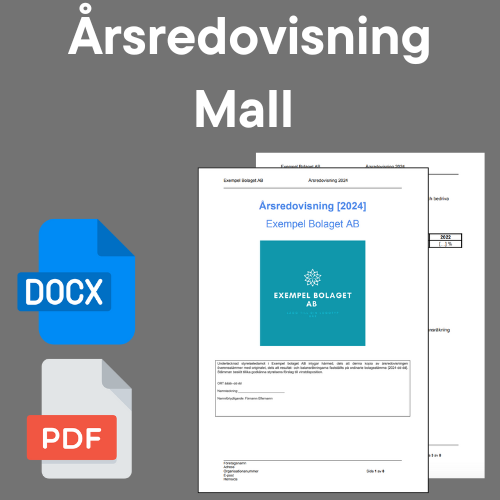
Mallbutiken's Annual Report Template (K2) – Limited Company Word/PDF costs 49 SEK. Check first that the company is allowed to apply K2 and adapt the template to the actual circumstances of the year.