
Reasonable lease for a summer cottage – how is the lease fee determined?

When someone owns a summer cottage but leases the land, the lease is often a residential lease (bostadsarrende). There is no simple national percentage for what the lease fee should be. During a terms review, the fee must be reasonable and correspond to the value of the leased property.
When is it a residential lease?
A residential lease exists when land is leased for purposes other than agriculture and the tenant has the right to erect or keep a residential building used for housing purposes. A holiday home on leased land is a common example.
How is a reasonable fee determined?
When reviewing new terms, factors such as the value of the leased site, the content of the agreement, and other circumstances are assessed. Therefore, there is no general formula such as "X percent of the assessed value." Comparisons with similar leases can be relevant.
Can the fee be raised at any time?
No. Fee changes must be handled within the rules of the agreement and the Land Code regarding changes to terms and termination. If the parties do not reach an agreement, the matter can be reviewed by the regional rent and lease tribunal (arrendenämnden) under the right conditions.
What should the agreement regulate?
- the exact scope of the leased area,
- fee and payment period,
- indexing or other adjustment model,
- lease term and termination,
- buildings, maintenance, and insurance,
- assignment and security of tenure.
How to prepare for a change in the lease fee
If the parties cannot agree on the fee for a residential lease, it is important to distinguish a voluntary agreement from a formal request for a change of terms. According to the rules of the Land Code and the guidance of the Swedish Courts, there are specific deadlines and formal requirements. The nature, duration, and security of tenure of the lease affect the opportunities available to have the terms reviewed.
- Read the lease agreement. Check the lease period, termination provisions, agreed index regulation, and what has already been agreed upon regarding the fee.
- Gather documentation. Describe the location, size, and use of the plot, access to roads and water, other benefits, and comparable residential leases. Separate the value of the land from the value of a house owned by the tenant.
- Negotiate and document. State the proposed fee, the effective date, and the information on which the proposal is based. Keep written records.
- Check the deadlines before acting. For a formal change of terms, written notice and specific deadlines may apply; if no agreement is reached, an application to the regional rent and lease tribunal may need to be made within the prescribed time. Do not wait until the agreement has expired to research the rules.
Example: two holiday plots can have different reasonable lease fees
Two cottage owners may have houses of equal size but still pay different land lease fees. One plot has road access, a beachfront location, and a functioning water connection, while the other lacks several of these features. Therefore, when making comparisons, the actual characteristics of the leased property and the contractual terms need to be considered. There is no general percentage of the property's assessed value that automatically determines a reasonable fee.
If you are unsure whether the lease is a residential lease, a secondary apartment lease (lägenhetsarrende), or something else, the type of lease should be clarified before you apply rules regarding fees, termination, or security of tenure.
Also read the guide on security of tenure and building on non-owned land.
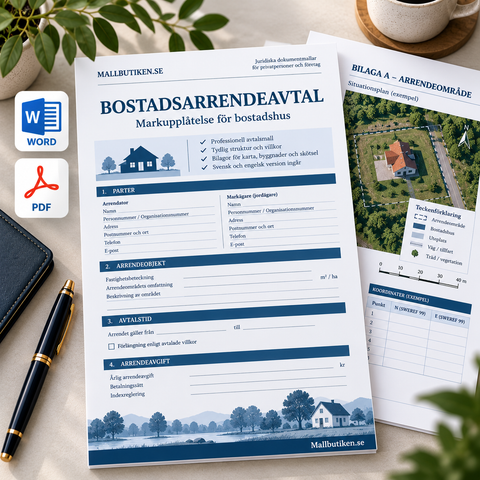
Template for residential lease
See Residential Lease Agreement – 49 SEKSources
Templates in this article
Explore the topic
 Land lease agreements – guides, rules & templates
Security of tenure for leaseholds – agriculture, residential, and facility
Security of tenure differs between forms of lease. Compare direct protection in agricultural and residential leases, and indirect protection in com...
 Land lease agreements – guides, rules & templates
Building on leased land – what applies when the house stands on rented ground?
A building on leased land means that the house and the land have different owners. Read about residential land leases, changes in ownership, proper...


