
Tax and banking issues for monetary gifts in 2026 – Sweden and abroad

A private gift without consideration is generally tax-free for the recipient in Sweden. At the same time, there is no general rule stating that banks automatically report a gift just because it exceeds a certain monetary amount. Instead, banks work on a risk-based approach involving customer due diligence and anti-money laundering controls.
Are cash gifts tax-free in Sweden?
Yes, a gift that is truly a gift and not compensation for work or other consideration is normally tax-free for the recipient under the Income Tax Act. Sweden does not have a general gift tax.
Must a private cash gift be declared?
A standard private cash gift does not normally need to be reported as taxable income. However, the situation may be different if the transfer is in reality compensation for work, a business transaction, or anything other than a gift.
Three situations – gift, compensation, and payment from abroad
| Situation | Swedish tax perspective | Control |
|---|---|---|
| A parent gives their adult child 150,000 SEK without consideration. | A genuine gift is as a main rule tax-free for the recipient according to Chapter 8, Section 2 of the Income Tax Act. | Save the deed of gift and transfer receipt. Investigate separately whether the gift should be an advance on inheritance. |
| An employer pays 150,000 SEK and calls the amount a “gift.” | If the transfer is based on work performance, it may be taxable as compensation. The heading in the document is not decisive. | Check the connection to work and the special rules for tax-free employee gifts. |
| A relative residing abroad transfers a genuine gift to someone in Sweden. | Swedish gift tax does not arise automatically. Swedish income tax exemption and potential tax and reporting requirements in other countries are separate issues. | Document the parties, currency, amount, gift intent, and the origin of the funds, as well as check relevant foreign regulations. |
Source: The Swedish Tax Agency's legal guidance – gifts and family law acquisitions. A gift intended to be the recipient's separate property may also require a specific clause; see separate property in the case of cash gifts.
Why might the bank still ask questions?
Banks and other entities subject to the Anti-Money Laundering Act must know their customers and understand the purpose of transactions. A large or unusual transfer may therefore lead to questions regarding the origin of the funds, the relationship between the donor and the recipient, and the purpose of the payment. This does not mean that the gift is taxable.
Is there a fixed AML limit for gifts?
No. The Anti-Money Laundering Act contains certain monetary limits for when specific customer due diligence measures must be taken in certain situations, but these are not a rule that “all gifts over X kronor are reported.” Suspicious activity reporting is based on the circumstances and the entity's risk assessment.
Gifts to or from abroad
If the donor or recipient has ties to another country, that country's tax or reporting rules may apply. The rules vary significantly between countries and can change from year to year. Therefore, one should not use old tables of foreign tax-free thresholds as general guidance.
- Check the tax rules in the recipient's and donor's relevant jurisdiction.
- Check whether the gift needs to be declared or registered locally.
- Document the gift's date, amount, currency, and that the transfer lacks consideration.
Four common bank questions – prepare documentation without assuming a monetary limit
- Who is sending and receiving? Information about the donor, recipient, and their relationship.
- What is the purpose? A dated deed of gift without repayment requirements and documentation of the transfer.
- Where do the funds come from? For example, documentation regarding previous savings, a property sale, or an inheritance, when requested by the bank.
- Why are the funds coming from another country? Verifiable explanation of the transfer route, currency, and payment intent, along with information about relevant foreign regulations.
Chapter 3 of the Anti-Money Laundering Act concerns customer due diligence, while Chapter 4, Sections 1–3 regulate the monitoring, investigation, and reporting of suspicious activities. These obligations may be triggered regardless of the gift amount. A suspicious activity report is not the same as an automatic declaration of all large gifts. Read the Financial Intelligence Unit's information and the Anti-Money Laundering Act.
What documentation is good to keep?
- deed of gift,
- account statement or receipt of the transfer,
- documentation of the origin of the funds if requested by the bank,
- any documentation regarding advance on inheritance and separate property.
Frequently asked questions
Does the recipient pay Swedish gift tax?
No, Sweden has no general gift tax.
Is every large gift automatically suspicious?
No. The bank makes a risk-based assessment based on the customer relationship and the transaction.
Is a deed of gift always enough for the bank?
Not necessarily. The bank may request additional documentation regarding, for example, the origin of the funds.
Also read Deed of gift for money and separate property in the case of cash gifts.
Document the cash gift
Clear documentation can facilitate both proof and the bank's questions regarding the purpose of the transaction.
See Deed of Gift for Money – 29 SEKBank control is not the same as tax or the validity of the gift
Three different questions: whether the private transfer is a gift under civil law, whether it provides taxable income, and whether the bank needs to perform customer due diligence or transaction monitoring. The fact that the bank asks for documentation does not in itself mean that the gift is invalid, taxable, or suspicious.
There is no general Swedish monetary limit that automatically requires all cash gifts above a certain sum to be reported as suspicious. The Anti-Money Laundering Act does, however, have specific thresholds for certain customer due diligence measures and risk-based obligations to monitor transactions. The bank's question regarding the origin of the funds can therefore arise even without any “gift limit.”
To avoid documentation errors, read five common mistakes with cash gifts and when a promise to give a gift is binding and when a gift is completed.
Regulations: Act (2017:630) on Measures against Money Laundering and Terrorist Financing, Chapters 3–4.
Related templates and further reading
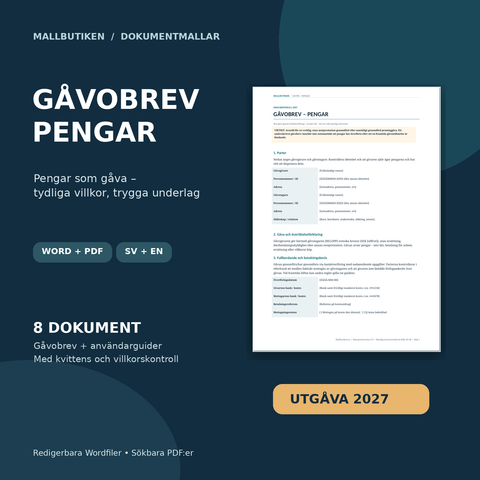
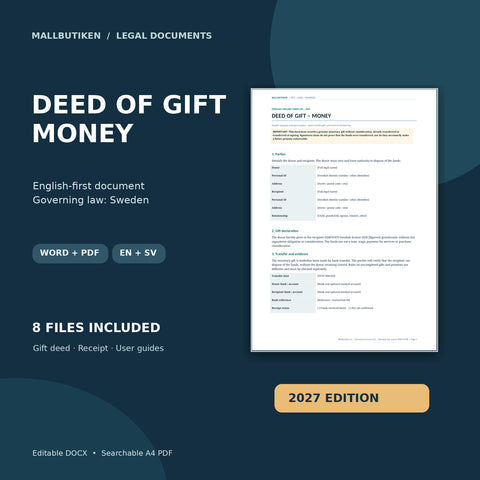
For a Swedish cash gift, there is the deed of gift for money (29 SEK). If the bank or recipient needs to read English, the Gift Deed – English-language deed of gift under Swedish law (49 SEK) can serve as documentation. Always check if the recipient requires anything beyond a deed of gift. Also read the guide to an English Gift Deed.
Sources
Templates in this article
Explore the topic
 Deeds of gift – guides, formalities & document templates
Separate property for a monetary gift – what applies to spouses and cohabitants?
How separate property works when money is given as a gift. The guide explains the difference between spouses and cohabitants, traceability, surroga...
 Deeds of gift – guides, formalities & document templates
Gift deed for money – monetary gift, advancement of inheritance, and separate property
Guide to gift deeds for money: when the monetary gift is completed, gift or loan, advancement of inheritance, separate property, spouses, tax, and ...
 Deeds of gift – guides, formalities & document templates
5 common mistakes in deeds of gift for money – and how to avoid them
Five common mistakes with monetary gifts: unclear if it is a gift or a loan, advance on inheritance, separate property, lack of traceability, and u...


