
Employee reminder – when and how the employer uses it
Guide to employment law reprimands/LAS warnings: when they can be used, how misconduct is investigated, what should be communicated, and the difference from disciplinary measures.

A labor law formal warning (erinran) is often used as a clear written notification regarding misconduct and what the employee must change. The term is not a specific disciplinary sanction under the Employment Protection Act (LAS). Therefore, the content and purpose determine how the document should be understood.
When can a formal warning be relevant?
Examples include recurring late arrivals, unauthorized absence, refusal to follow reasonable management decisions, poor performance after clear requirements, or violations of safety and order regulations. However, the employer first needs to understand the cause and assess whether the situation relates instead to factors such as illness, work environment, discrimination, or lack of instructions.
Investigate first
Verksamt emphasizes that the employer should have concrete evidence and not base decisions on loose rumors. The employee should be given the opportunity to describe their version of events. Particularly in cases of performance, absence, and collaboration issues, the background can affect which measures are reasonable.
What should a formal warning achieve?
- identify the concrete misconduct,
- link it to an obligation, instruction, or rule,
- state what must change,
- provide relevant support or prerequisites for improvement,
- explain that continued misconduct may lead to employment law consequences,
- create a clear point for follow-up.
A formal warning is not automatically a punishment
A reprimand/LAS warning differs from a disciplinary sanction. A disciplinary punishment requires legal support in statute or collective agreement. For government employees, for example, there are specific rules in the Public Employment Act.
If termination is considered later
The employer must still perform the full assessment under the Employment Protection Act. Section 7 requires objective grounds and includes a duty to relocate. Section 30 regulates notification and notice to unions prior to dismissal or termination for personal reasons.
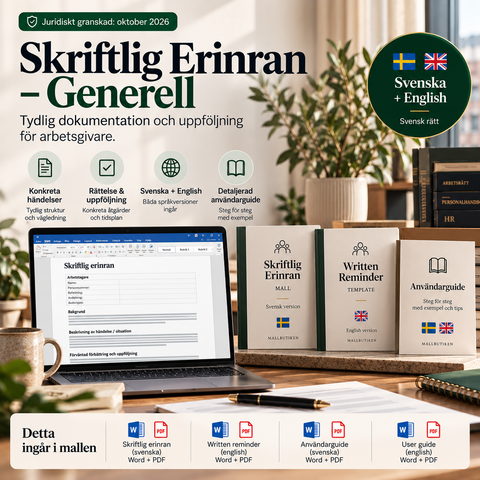
Written Formal Warning Template – general
Editable Word/PDF, SEK 49.
View the formal warning templateTemplates in this article
Explore the topic
 Written notice (erinran) – guides & rules
What should a written warning contain? Checklist for employers
Checklist for a clear employment law warning: incident, obligation, employee explanation, demand for change, support, follow-up, and potential cons...
 Written warning to an employee – guides & rules
Written warning or admonition – what is the difference?
The difference between a warning, a reprimand, an LAS warning, and a disciplinary sanction. The terms are used differently, so the content and lega...


