Cohabitation agreement – what applies and what can the agreement regulate?
Share
Facts verified: October 1, 2026 · Cohabitation Act (2003:376)
A cohabitation agreement is used to contract out of all or parts of the division of property rules in the Cohabitation Act. However, it is not a general agreement where cohabitants can freely determine inheritance, ownership, loan liability, or the specific percentage at which all property is to be divided.
What is cohabitation property?
According to Section 3 of the Cohabitation Act, cohabitants' joint home and household goods are cohabitation property when the property has been acquired for joint use, with the exceptions provided by law and any cohabitation agreement.
The deciding factor is therefore not just who paid for it or is listed as the owner. A home that one cohabitant buys for the couple to live in together can be cohabitation property even if only that person is listed on the purchase documents and loans.
Household goods include, for example, furniture and household appliances for the joint home. Cars, boats, bank funds, stocks, and property used primarily for leisure purposes are not cohabitation property just because the cohabitants use them together.
Gifts, wills, or inheritances with conditions of separate property can also fall outside of cohabitation property according to Section 4.
What can a cohabitation agreement regulate?
Section 9 provides two clear main options:
- to agree that no division of property according to the Cohabitation Act shall take place, or
- to agree that certain specified property shall not be included in the division of property.
Through a new cohabitation agreement, the cohabitants can later change what they previously agreed upon.
What does a cohabitation agreement not resolve?
It is important not to give the cohabitation agreement a wider scope than the law allows.
- Inheritance: Cohabitants do not inherit from each other automatically. Inheritance is regulated by a will, not a cohabitation agreement.
- Ownership shares: A cohabitation agreement does not in itself change who legally owns a home or other asset.
- Bank loan requirements: An agreement between cohabitants does not release anyone from liability toward the bank.
- Private loans between cohabitants: A promissory note may be needed if one party has financed the other's share.
- All other property: Property that is never cohabitation property generally does not need to be "excluded" from the division of property via a cohabitation agreement.
Formal requirements – must the cohabitation agreement be witnessed or registered?
The cohabitation agreement must be in writing and signed by the cohabitants or the future cohabitants. The Cohabitation Act does not require registration with the Swedish Tax Agency and does not impose any witness requirements.
Including the date, clear identification of the parties, and a precise description of which property is excluded is nonetheless practically important to reduce future evidentiary difficulties.
An unreasonable term may, according to Section 9, be adjusted or set aside during the division of property, taking into account, among other things, the content, the circumstances when the agreement was entered into, and subsequent events.
Different down payments for a joint home
This is a common reason to review the legal situation. If a home has been purchased for joint use, it may be covered by the Cohabitation Act even when the cohabitants have contributed different amounts.
How does the division of property work without a cohabitation agreement?
When the cohabitation ends, any of the cohabitants can request a division of property. The request should normally be made no later than one year after the cohabitation ended. After debt coverage according to Section 13, the remaining net value of the cohabitation property is added together and, as a main rule, divided equally according to Section 14.
There are adjustment rules in Section 15 and rules regarding who can be allotted a specific home or household goods in Section 16. An equal division of value therefore does not mean that every individual piece of furniture or half of the home is physically divided.
Can the other cohabitant take over a home that is not cohabitation property?
In some cases, yes. Section 22 contains a specific rule for rental or tenant-owned housing that is not cohabitation property. The other cohabitant may, under certain conditions, have the right to take over the home if that cohabitant is in the greatest need of it and it is reasonable. If the cohabitants do not have or have not had children together, exceptional reasons are required.
What happens in the event of death?
In the event of death, only the surviving cohabitant can request a division of property according to the Cohabitation Act. The request must then be made no later than at the probate proceedings. The surviving cohabitant also has, to the extent the cohabitation property suffices, a specific minimum protection equivalent to two price base amounts from the remaining cohabitation property.
A cohabitation agreement is not a will. Read about how the order of inheritance works without a will and our article on cohabitants as estate beneficiaries.
Checklist before you draft
- Which home and which household goods could actually be cohabitation property?
- Do you want to contract out of the division of property entirely or only exclude certain property?
- Are the ownership shares in the home correctly registered and documented?
- Is there an economic imbalance that requires a promissory note rather than just a cohabitation agreement?
- Do you need a will for protection in the event of death?
- Does the agreement have a clear written formulation and the signatures of both parties?
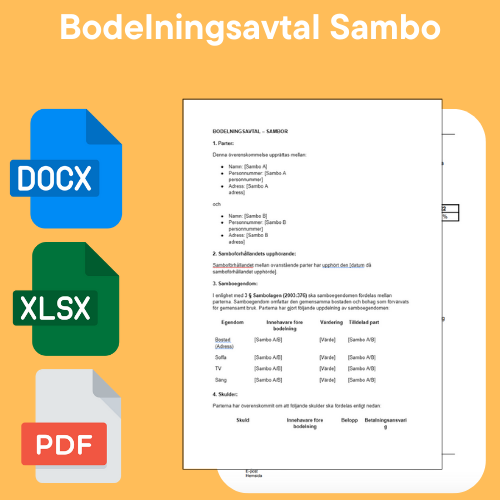
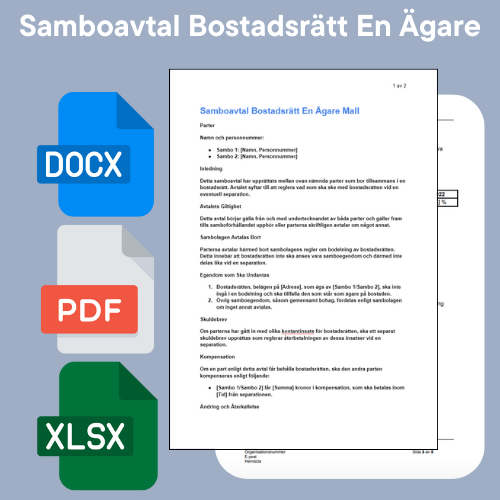
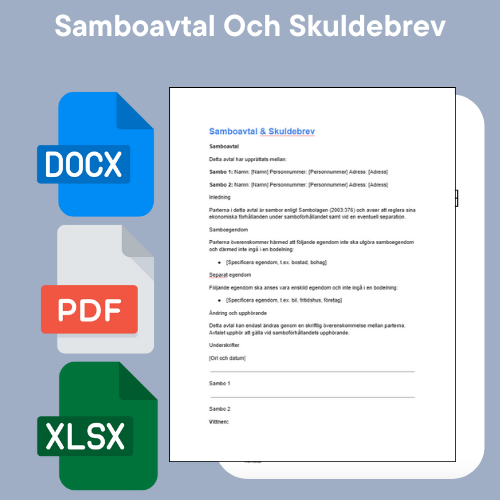
Mallbutiken's Cohabitation Agreement Template – Word/PDF costs 49 SEK. Always adapt the agreement to the home, ownership conditions, and what you actually wish to exclude.