

About this template
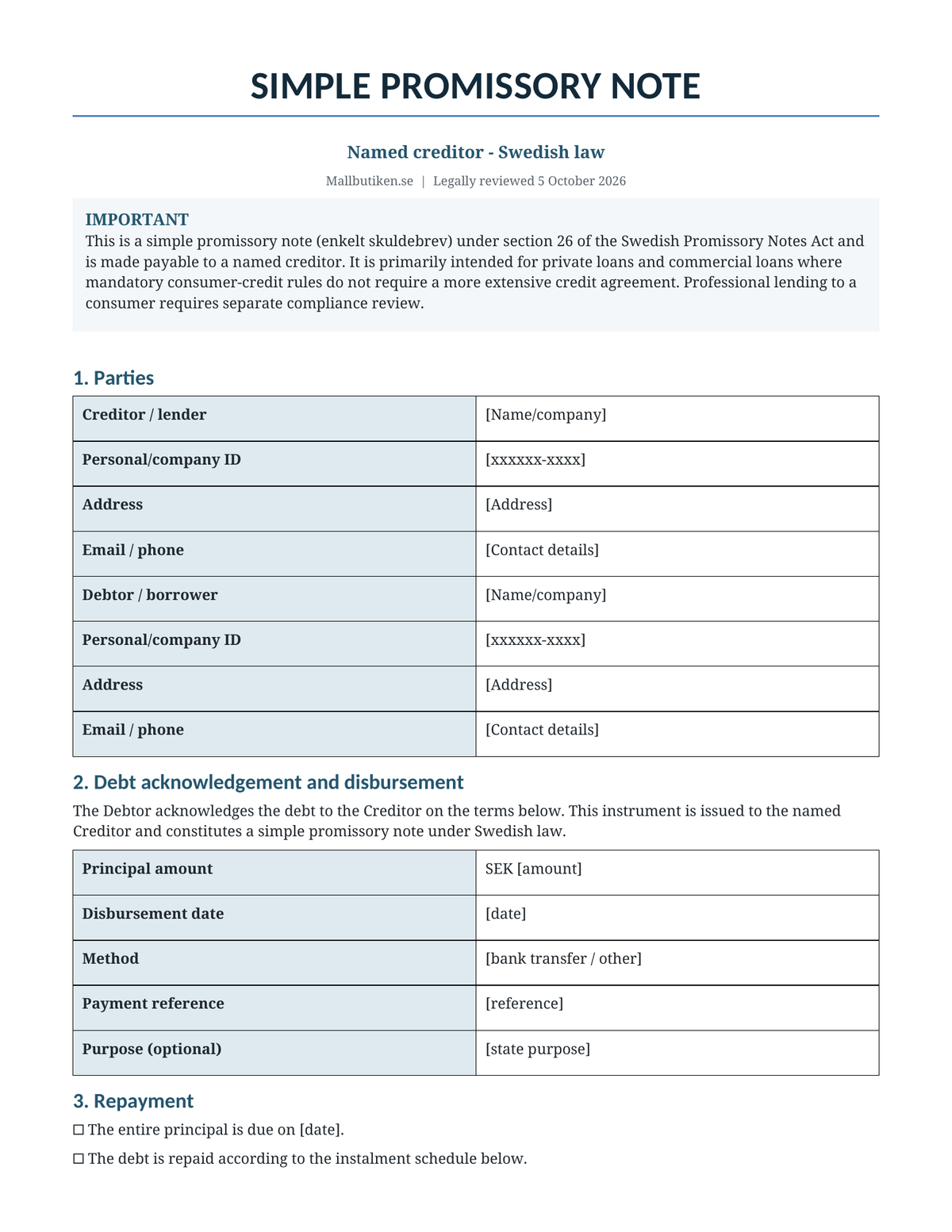
Simple Promissory Note – complete template package for loans under Swedish law with Swedish and English Word/PDF templates and detailed user guides. The package is designed to document a loan to a specific creditor with clear terms regarding the principal amount, repayment, interest, late payment, assignment, and any collateral.
Legally reviewed: October 5, 2026
The review covers the Promissory Notes Act, the Interest Act, the Statute of Limitations Act, the Contracts Act, and specific consumer credit regulations where applicable.
Included in the package
| Swedish simple promissory note – Word | Editable template for private and commercial loans. |
| Swedish simple promissory note – PDF | Print-friendly version. |
| Simple Promissory Note – English | English language version in Word + PDF, designed for Swedish law. |
| Swedish user guide | Step-by-step guide in Word + PDF. |
| English user guide | English guidance in Word + PDF. |
What is a simple promissory note?
A simple promissory note is issued to a specific creditor. It differs from a negotiable promissory note and is subject to different rules regarding, for example, assignment. This new template is therefore specifically designed for a clear loan between identified parties.
What the template covers
- creditor/lender and debtor/borrower,
- principal amount and actual disbursement,
- fixed due date, amortization schedule, or repayment upon demand,
- interest-free loan or agreed standard interest,
- penalty interest and handling of late payments,
- early repayment,
- optional clause for early acceleration (default),
- separate handling of collateral or guarantees,
- assignment of claims,
- payment details, notices, and documentation,
- choice of law, dispute resolution, and signatures.
Integrated amortization schedule
The template includes a table for amortizations specifying the due date, principal, interest/fees, and total payment. This makes it easier to document a loan that is to be repaid in multiple installments.
Interest and penalty interest
The parties can choose between an interest-free loan and an agreed annual interest rate. For late payments, there is a clear option to use the Interest Act’s standard rule of the reference rate plus eight percentage points, while the template also allows for other valid terms where permitted.
Early repayment and early acceleration
The template makes it possible to allow the borrower to repay all or part of the debt early. A separate, optional clause regarding early acceleration (default) is included for significant payment delays, but it is worded cautiously as mandatory regulations may limit how such a clause can be used.
Assignment of a simple promissory note
When assigning a simple promissory note, the new creditor does not, as a general rule, acquire better rights against the debtor than the previous creditor had. The template therefore includes options for free assignment or requirements for the debtor's consent, as well as guidance on written notification and new payment instructions.
Collateral and guarantees kept legally separate
If the loan is to be secured by collateral or personal guarantees, this is marked in the promissory note, but the security itself should be documented in a separate pledge or guarantee agreement. This reduces the risk of ambiguity regarding the scope of the security and when it may be claimed.
Statute of limitations and evidence
The guide explains the central limitation rules and why the parties should save the signed promissory note, proof of payment, amortization history, payment demands, and any acknowledgments. Different limitation periods may apply to ordinary claims versus consumer claims.
Important regarding loans from traders to consumers
This template is primarily intended for private and commercial loans. If a trader provides credit to a consumer, mandatory consumer credit regulations may require, among other things, specific pre-contractual information, credit assessment, and more extensive contractual documentation. Therefore, do not use the standard promissory note as the sole document in such lending.
Loans between limited companies and owners
If a limited company lends money to a shareholder, board member, CEO, or related party, the Swedish Companies Act's specific rules regarding prohibited loans may apply. This issue must be checked separately before the promissory note is used.
Swedish + English in the same package
The English version is a language version under Swedish law. It is suitable for Swedish businesses or private individuals who need to document the loan in English. It is not intended as a British, American, or other foreign promissory note.
Detailed user guide included
The guide covers the difference between simple and negotiable promissory notes, payment receipts, amortization, interest, penalty interest, early repayment, security, assignment, statute of limitations, applications for summary proceedings (betalningsföreläggande), consumer credit, and loans between companies and owners.
File format and delivery
Format: DOCX, PDF, and ZIP.
Languages: Swedish and English.
Number of files: 8.
Delivery: digital download. No physical product is sent.
Frequently asked questions
Does a simple promissory note need to be witnessed?
Witnesses are generally not a formal requirement for an ordinary simple promissory note, but the template includes optional witness lines that can be used if the parties desire additional evidence.
Can the promissory note be interest-free?
Yes. The template has an explicit option for an interest-free loan. If interest is to be charged, the interest rate, calculation basis, and payment terms should be clearly stated.
Can the lender sell or assign the claim?
Yes, a simple claim can normally be assigned, but the parties can agree on restrictions. The template includes both options.
Is the template sufficient for a company's consumer loan?
Not always. Professional lending to consumers is subject to specific mandatory rules and may require additional documentation and controls.
The template package is a general documentation support tool and does not replace individual legal, tax, or credit law advice. In cases involving large amounts, collateral, consumer credit, or loans between companies and related parties, qualified professional advice should be sought.