
Written warning or admonition – what is the difference?
The difference between a warning, a reprimand, an LAS warning, and a disciplinary sanction. The terms are used differently, so the content and legal function are more important than the heading.

In Swedish labor law, the terms "varning" (warning) and "erinran" (formal reprimand) are not always used consistently. It is therefore misleading to state generally that an *erinran* is always mild and a *varning* is always more formal. The decisive factor is the legal function the employer intends.
| Type | Purpose | Legal basis |
|---|---|---|
| LAS warning / formal notice | Inform about misconduct, demand change, and clarify that employment may be at risk | Part of the employer’s handling ahead of a potential assessment under LAS (Employment Protection Act); no specific formal "warning clause" |
| Disciplinary warning | Punish a misconduct | Requires support in law or collective agreement |
| Erinran (Formal reprimand) | The term can be used for a formal notice/LAS warning | Judged by content and context, not by the heading alone |
Why are old "mild–serious" tables problematic?
There is no general legal rule that places "erinran" at level one and "varning" at level two. In many workplaces, the terms are used this way in practice, but other employers use "erinran" specifically for the written notice intended to make the employee aware of the risk of termination.
What is a LAS warning?
This term is used for a notice where the employer explains what misconduct must cease and that continued behavior could put the employment at risk. The union Unionen describes this type as something other than a disciplinary punishment.
What is a disciplinary sanction?
A disciplinary punishment requires legal support. Section 62 of the Co-Determination Act (MBL) limits the ability to impose other sanctions on employees without support in statute or collective agreements. For government employees, the Public Employment Act (LOA) regulates, among other things, disciplinary sanctions such as warnings and salary deductions.
Which heading should the employer choose?
Choose a heading that aligns with the purpose, but above all, write the content clearly. If the document is a formal notice, it should, for example, specify the misconduct, expected change, support/measures, and that continued relevant misconduct may have labor law consequences.
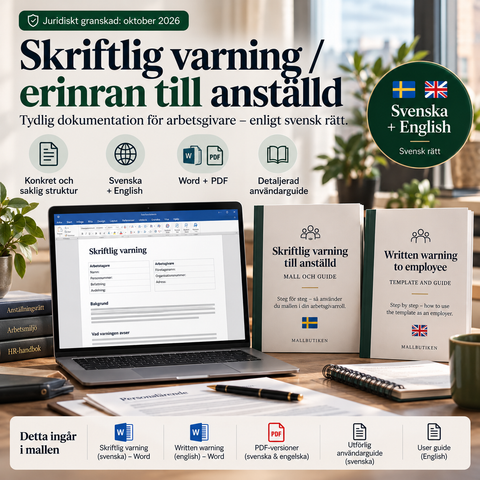
For employers who need to document a notice with clear requirements and follow-up, there is an editable template for a written warning and reprimand. Choose the document's design based on the purpose and the applicable collective agreement.
Related guides
Erinran – guide · Written warning step by step · If the employee refuses to sign the warning
Sources
Templates in this article
Explore the topic
 Written notice (erinran) – guides & rules
Employee reminder – when and how the employer uses it
Guide to employment law reprimands/LAS warnings: when they can be used, how misconduct is investigated, what should be communicated, and the differ...
 Written warning to an employee – guides & rules
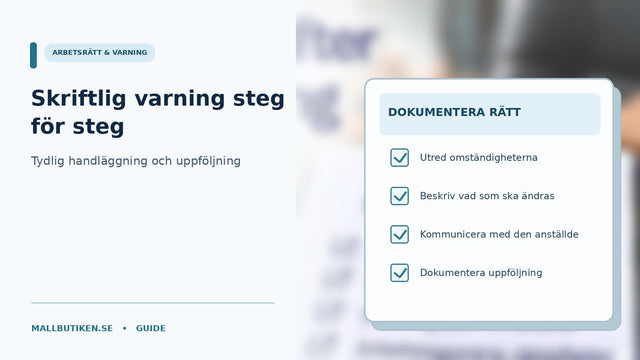
Written warning to employee – step-by-step for employers
Step-by-step guide for investigating, formulating, handing over, and following up on a written LAS warning or reprimand regarding misconduct.
 Written warning to an employee – guides & rules
Refuse to sign a written warning – is a signature mandatory?
Can you refuse to sign a written warning? Direct answer, example of an objection, the difference between an acknowledgement of receipt and approval...

