
Svenska Dokumentmallar
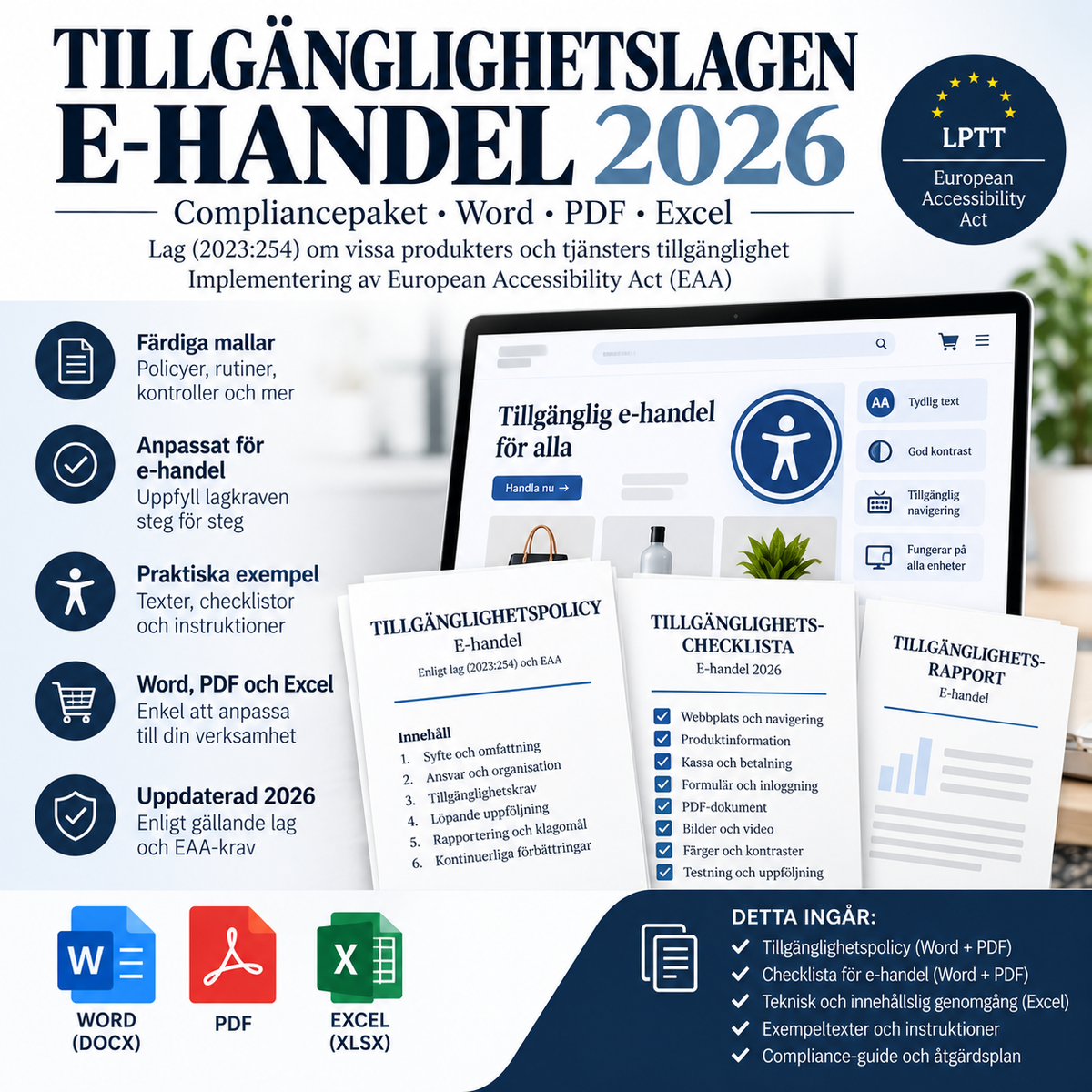
Accessibility Act E-commerce Template Package 2026 – Word/PDF/Excel
Accessibility Act E-commerce Template Package 2026 – Word/PDF/Excel
 Downloading the template is available immediately after purchase. Our document templates are always delivered in customizable formats.
 If you are unsure which template is appropriate or how you should complete it, please see the relevant information under the 'Legal Information' tab in our main menu.
 Our templates are designed in accordance with current legislation and practice in each area to ensure that the documents you create are legally correct.


Couldn't load pickup availability
Accessibility Act for E-commerce 2026 – complete compliance package
Professional template package for Swedish e-commerce companies that need to work in a structured manner with the Act (2023:254) on the Accessibility of Certain Products and Services (LPTT) and the European Accessibility Act (EAA). The package contains ready-to-use Word and PDF templates as well as a comprehensive Excel tool for scope assessment, auditing, defect management, suppliers, feedback, exemptions, and ongoing follow-up.
The Accessibility Act entered into force on June 28, 2025. E-commerce services covered by the act must, among other things, be accessible to persons with disabilities, provide information on the service's accessibility, and ensure that key functions such as identification, electronic signing, security, and payment can be used in an accessible manner.
Included – 9 files
- Information on e-commerce service accessibility 2026 – Word (DOCX)
- Information on e-commerce service accessibility 2026 – PDF
- Accessibility routine and compliance policy for e-commerce – Word (DOCX)
- Accessibility routine and compliance policy for e-commerce – PDF
- Assessment of exemptions from accessibility requirements – Word (DOCX)
- Assessment of exemptions from accessibility requirements – PDF
- Audit log for accessible e-commerce – Word (DOCX)
- Audit log for accessible e-commerce – PDF
- Accessibility Act E-commerce 2026 – Excel compliance tool (XLSX)
1. Information on the service's accessibility
A service provider covered by the act must produce information on how the service meets accessibility requirements. The information must, among other things, describe the applicable requirements and, where necessary for the assessment, the design and function of the service.
The template contains ready-made sections for:
- service provider and service
- general description of the e-commerce service
- applicable accessibility requirements
- navigation and keyboard
- text, contrast, and magnification
- images and media
- forms and error messages
- shopping cart and checkout
- identification, security, and payment
- accessibility information for products sold
- customer support
- testing and quality assurance methods
- known defects and action plan
- any exemptions
- contact path for accessibility feedback
The Swedish Post and Telecom Authority (PTS) states that this information serves a similar function to an accessibility statement under the DOS Act, even though the term accessibility statement is not used in the LPTT. The information must be easily accessible along with the service, available to persons with disabilities, and capable of being provided in written and oral form.
2. Internal accessibility routine and compliance policy
The internal policy creates an ongoing workflow for compliance. It includes, among other things:
- scope and micro-enterprise assessment
- responsibility matrix for management, e-commerce, IT, content, customer service, and legal
- minimum checks before release
- test strategy
- process for public accessibility information
- defect and incident management
- reporting to authorities
- feedback and complaint procedure
- requirements for third-party components and suppliers
- annual and event-driven review
3. Audit log for web shop and app
The audit log is a practical working document for testing the parts of the website or app that belong to the e-commerce service. It is structured according to the four fundamental principles:
- Perceivable
- Operable
- Understandable
- Robust
The log also contains specific checks for e-commerce, including accessibility product information, identification, electronic signing, CAPTCHA/2FA, security functions, payment, order confirmation, and support.
EN 301 549 and WCAG are used in the package as practical technical support where relevant. They do not replace the actual legal requirements in the LPTT, the regulation, and the PTS regulations.
4. Exemption assessment – disproportionate burden
The LPTT contains the possibility, in certain situations, to make exemptions from a specific accessibility requirement if the application would result in a significant change to the fundamental nature of the service or a disproportionate burden.
The separate assessment template contains:
- identification of the exact accessibility requirement
- assessment of alternative solutions
- net-based cost analysis
- cost in relation to total costs
- cost in relation to net turnover
- assessment of user benefit
- number and frequency of use for affected users
- assessment of external accessibility resources
- decision, justification, and next reassessment
- fields for reporting to the supervisory authority
5. Excel tool for practical implementation
The Excel file is a complete working tool and contains separate sheets for:
- Start – dashboard with KPIs and legal reference points
- Scope – check of e-commerce service, consumer focus, and micro-enterprise exemption
- Audit Web/App – ongoing test register
- Critical Functions – identification, e-signing, security, payment, and order confirmation
- Accessibility Info – check of public information on service accessibility
- Defects & Actions – prioritization, responsible party, deadline, and re-test
- Support & Feedback – user complaints and accessibility issues
- Exemptions – documentation of exemption assessments
- Suppliers – third-party components and accessibility documentation
- Tests – test and revision log
- Sources – key legal sources and PTS guidance
The start page automatically calculates, among other things, the number of defects, critical functional defects, open actions, feedback issues, suppliers needing action, exemptions, and overdue reviews.
Which e-retailers are covered?
The Act covers e-commerce services provided at a distance via websites or services for mobile devices, electronically and at the individual request of a consumer for the purpose of concluding a consumer contract.
Micro-enterprises are exempt from the accessibility requirements for services. According to the act, a micro-enterprise is a company with fewer than ten employees and an annual turnover or annual balance sheet total not exceeding 2 million euros. The package therefore contains a specific scope and micro-enterprise assessment.
What is required of the website and app?
Websites, web applications, and mobile apps that are part of the service in question must be made accessible in a uniform and functional way by being perceivable, operable, understandable, and robust. In practice, this includes, for example, keyboard usage, focus, alternative texts, contrast, forms, error messages, semantics, support for assistive technologies, and functional user journeys.
Specific requirements for e-commerce
In addition to the general requirements, there are e-commerce-specific requirements. An e-retailer must, among other things, provide accessibility information about the products and services sold when such information is provided by the responsible economic operator.
Customer support and assistive technologies
If the company offers support services, such as a helpdesk or technical support, the support service must be able to provide information about the accessibility of the service and how the service works with assistive technologies. The information must be provided via accessible means of communication.
Ongoing responsibility and PTS supervision
The service provider must continuously ensure that the service meets accessibility requirements. If a service does not conform to the requirements, the provider must take the necessary measures and immediately inform the supervisory authorities in the Member States where the service is provided about the defect and the measures taken.
The Swedish Post and Telecom Authority (PTS) supervises e-commerce services. During 2025 and 2026, PTS will conduct active supervision of the accessibility of Swedish e-commerce services.
Legal basis
- Act (2023:254) on the Accessibility of Certain Products and Services
- Regulation (2023:676) on the Accessibility of Certain Products and Services
- PTSFS 2024:6 on the accessibility of certain services
- PTSFS 2024:7 on criteria for disproportionate burden
- Directive (EU) 2019/882 of the European Parliament and of the Council – European Accessibility Act
- EN 301 549 and WCAG as technical support where relevant
Suitable for, among others
- web shops selling to consumers
- companies with Shopify, WooCommerce, or another e-commerce platform
- companies with a mobile app for purchases
- e-commerce, IT, compliance, and legal departments
- agencies and consultants assisting e-retailers with accessibility work
Important to know
Which parts of a website are covered by the LPTT and what technical measures are required must be assessed based on the actual service. PTS assesses that it is the parts of the website belonging to the e-commerce service that are covered by the requirements for e-commerce. The package is a professional working document and does not replace individual legal or technical advice in complicated cases.
Format: Word (DOCX) + PDF + Excel (XLSX)
Language: Swedish
Jurisdiction: Sweden / EU
Number of files: 9
Version: 1.0 – 2026-10-02