
Member register for association – GDPR, member data and fees 2026
Guide to association membership registers 2026: what personal data is required, GDPR, data minimization, legal basis, security, membership fees, and specific requirements for economic associations.

A member register constitutes the processing of personal data and is therefore subject to the GDPR. The association needs to determine what data is actually necessary, why it is processed, how long it is stored, who has access, and which legal basis is used. Economic associations also have specific legal requirements regarding the register of members.
What information should be in a member register?
That depends on the purpose of the association. A non-profit association can often manage with a member ID, name, contact details, membership category, date of joining, status, and information needed for membership fees. Personal identity numbers should not be collected as a matter of routine.
| Data | Question to ask |
|---|---|
| Name | Normally needed to identify the member. |
| Contact details | Which channels does the association actually need to use? |
| Personal identity number | Is there a concrete and proportionate need? |
| Membership category | Does the category affect rights, fees, or administration? |
| Fee status | Needed to monitor membership and payments? |
| Sensitive data | Is there specific support under the GDPR to process them? |
GDPR: purpose, legal basis, and data minimization
The association must know why each category of personal data is processed. It is not sufficient to collect information because it "might be good to have." The IMY emphasizes that member registers must not contain more personal data than necessary.
The legal basis must be assessed for each processing activity. Consent is not automatically the correct basis for all association administration. Depending on the situation, for example, a contract, legal obligation, or legitimate interest may be applicable. Sensitive personal data also require specific support under the GDPR.
For an introduction to the roles, you can read controller vs. processor – what is the difference?.
Special rules for economic associations
For economic associations, the register of members is not just an administrative choice. According to Chapter 5 of the Economic Associations Act (2018:672), the board must maintain a register of members.
The register must, among other things, contain the name and postal address, information about any investing member, date of entry, and information about member contributions. It must be established when the association is formed, and changes must be recorded as soon as possible.
A particularly important difference is accessibility. According to the law, the register of members in an economic association must be kept available at the association for anyone who wishes to view it. This differs from ordinary private associations, where the IMY states that a member does not generally have the right to have the entire member register disclosed.
Security and permissions
The register should not be accessible to more people than those who need it for their assignment. The IMY points to technical and organizational security measures such as permission control and secure passwords. If the association handles protected or sensitive data, special caution is required.
Practical permission model
- The board decides who is the system or register administrator.
- The treasurer gets access to fee information needed for payment follow-up.
- Other officers only receive the information needed for their assignment.
- Permissions are removed when assignments end.
- Export of the entire member register is restricted and documented.
Member registers and membership fees
It is practical to keep member information and fee follow-up linked but separated. A register can, for example, show the invoiced amount, paid amount, payment date, and status without unnecessary bank or payment details being stored longer than necessary.
Also document the decisions behind the membership fee. For many associations, fee decisions are made at the annual meeting or according to the statutes. See the guide on association minutes and annual meetings.
What rights do members have under the GDPR?
Members must be informed about how their personal data is used. They may also have the right to access, rectification, erasure, restriction, and objection, depending on the processing and its legal basis. The association therefore needs a routine for receiving, assessing, and documenting such requests.
The IMY also recommends that associations maintain control over their processing activities through a record of processing activities. Article 30 contains specific requirements and exceptions that must be assessed for one's own organization.
Erasure – how long can data be stored?
The GDPR does not contain a general retention period that applies to all member data. The association must determine and be able to justify the retention period based on the purpose and other legal requirements. Data that is no longer needed should normally be deleted or anonymized.
Economic associations have specific retention rules for the register of members and historical information. Those rules must be weighed in before any automatic erasure rule is used.
Common mistakes
- Collecting personal identity numbers "just in case."
- Using consent as a default basis without analysis.
- Giving the entire board or all officers full access.
- Lacking an erasure rule.
- Sending member lists unencrypted when the data is particularly sensitive.
- Confusing the GDPR's record of processing activities with the actual member register.
- Missing the specific transparency/accessibility rules for economic associations' register of members.
Checklist for a sustainable member register
- Describe the purpose of the register.
- Determine the minimum necessary set of personal data.
- Document the legal basis for each processing activity.
- Establish permissions.
- Determine retention period and erasure routine.
- Inform members about the processing.
- Create a routine for register extracts, rectification, and other rights.
- Check special rules for an economic association or housing cooperative.
Frequently asked questions
Must an association follow the GDPR?
Yes, when the association processes personal data in a way that is covered by the GDPR, which a normal member register does.
Can a member demand the entire member register?
Not as a general GDPR right in a standard private association. The data subject has the right to data about themselves. Economic associations, however, have special rules regarding the accessibility of the register of members.
Is a personal identity number mandatory?
No, not generally. There must be a real need, and the processing must be legal and proportionate.
The template package includes Excel for up to 500 members, 1,000 fee entries, GDPR documentation, roles, and a dashboard, as well as Word/PDF in Swedish and English. See the template – 79 SEK.
See also all templates for associations and member administration and the guide on annual reports for associations.
See also our collected guide to association administration 2026.
Downloadable Excel register or online membership system – which fits?
Mallbutiken's membership register is a downloadable Excel, Word and PDF package for self-managed administration, not a hosted membership portal, online service or subscription. The association is responsible for storage, access, backups and deletion. A hosted system may be better for many simultaneous users, but GDPR roles and potential processing agreements must then be assessed.
Even the fact that someone belongs to an association can reveal religion, health, political beliefs or trade-union membership depending on its purpose. A simple name list may then involve special-category personal data. Assess an Article 9 condition and access controls before creating or sharing it. Read the Swedish data protection authority's guidance for associations.
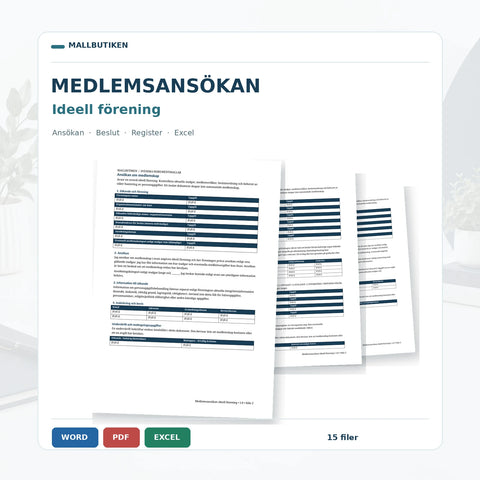
For joining applications and admission decisions under the association's rules, use the membership application package for voluntary associations. For approved dues, payment notices and reminders, consider the membership fee and follow-up package.
Set separate rules for resignation, deletion and retention. Read the GDPR retention and deletion guide. Do not export complete membership lists to open folders or broad email distributions; restrict access and protect files according to risk.
Sources
- IMY – How to handle the association's member register
- IMY – Associations' processing of personal data
- Act (2018:672) on Economic Associations, Chapter 5
The information is general and does not replace individual legal or data protection advice.
Templates in this article


Explore the topic
 Business guides – contracts, HR, AI & compliance
Data controller or data processor – what is the difference?
Understand the difference between a controller and a processor under the GDPR, how the roles are determined in practice, and when a data processing...
 Business guides – contracts, HR, AI & compliance
Association minutes – annual meeting, board meeting, and statutory meeting
Guide to association minutes: what annual general meeting, board, and constituent meeting minutes should contain, how the rules differ between non-...
 Annual reports – guides, rules & templates
Annual report for associations 2026 – financial, non-profit, and housing cooperatives
Annual report for associations 2026: the difference between economic associations, housing cooperatives, and non-profit associations, the K3 requir...


