
GDPR data purging 2026 – how long may personal data be stored?

Short answer: The GDPR does not have a single general retention period for personal data. The main rule is that data must not be stored longer than is necessary for the purposes for which it is processed. The company must therefore determine and document a retention period or criteria for each category of processing.
What does the GDPR say?
The storage limitation principle in Article 5(1)(e) means that personal data shall be kept in a form which permits identification of data subjects for no longer than is necessary for the purposes for which the personal data are processed. Article 17 regulates the right to erasure, but also contains exceptions – for example, when processing is necessary for compliance with a legal obligation or for the establishment, exercise or defense of legal claims.
How to determine a retention period
When an employee leaves, access to systems must be stopped or changed, while lawful storage of certain work tasks and documents may continue. See the guide on IT offboarding, email, and termination of access for the practical difference.
| Question | Examples of supporting documentation |
|---|---|
| Why is the data being processed? | Agreement, legal obligation, legitimate interest, consent, or other purpose. |
| Are there legal requirements? | Accounting, labor law, AML/KYC, tax, or other special regulations. |
| Is the data needed for claims? | Statute of limitations, complaints, disputes, and insurance matters. |
| Can it be anonymized? | If identification is no longer needed, true anonymization may be an option. |
| How is deletion performed? | Production systems, archives, exports, data warehouses, logs, and backups must be considered. |
Example: accounting records
According to the Swedish Bookkeeping Act, accounting information must, as a general rule, be kept until the end of the seventh year following the end of the calendar year in which the financial year ended. If the material contains personal data, this legal requirement may provide a legal basis for preserving the specific information that must be retained – but not for keeping other personal data that is no longer needed.
Retention schedule – practical approach
- Inventory processing activities and link them to the record of processing activities under Article 30.
- Define data category, system, purpose, and legal basis.
- Determine the retention period or clear criteria.
- Document exceptions, legal holds, and dependencies on special legislation.
- Determine the technical method for deletion or anonymization.
- Assign a responsible function and establish regular audits.
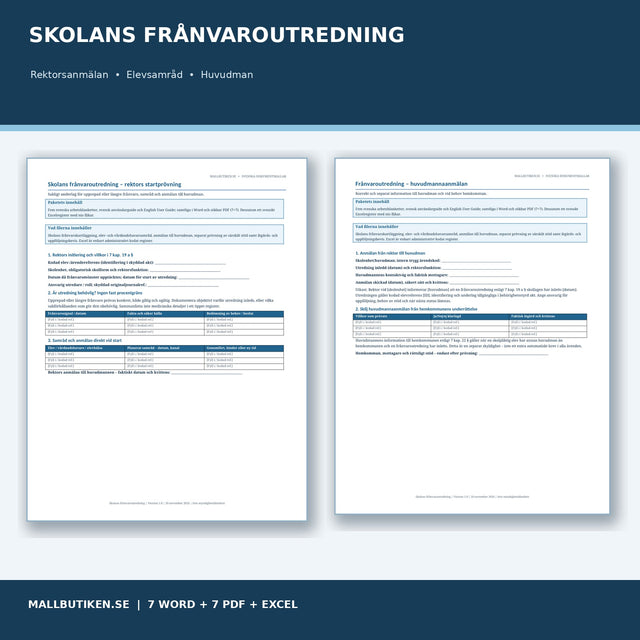
A school's school absence investigation under Swedish law illustrates why GDPR storage limitation must be considered alongside education-specific record retention and archiving rules. Municipal school records may be subject to public-records requirements, while independent providers can have different duties. Do not assume an inquiry may be deleted immediately or that one universal GDPR period applies.
Backup and deletion
Backup is not a free pass for unlimited storage. The company should have documented backup cycles, access restrictions, and a process that ensures deleted data does not return to active processing if a backup is restored.
Four documents that complement a GDPR retention and deletion plan
A retention policy explains when and how personal data is removed. Other documentation may be needed to implement and explain the process. Check each processing purpose, legal basis, retention requirement and system.
- Deletion by service providers: data processing agreement (DPA) — Under Article 28(3)(g) GDPR, the processor agreement must address return or deletion after services end, subject to statutory retention duties.
- Document processing and deadlines: record of processing activities (RoPA) — Article 30 includes envisaged time limits for erasure where possible. The register obligation has exceptions; a RoPA is not an individual's access response.
- Tell data subjects: privacy notice and cookie policy templates — Articles 13–14 address information about storage periods or criteria. Cookie rules need separate review; a privacy notice does not itself delete data.
- Record completed deletion: deletion decision and destruction record — An internal record may document owner, date, scope, method and checks. GDPR does not prescribe a document with this particular title; avoid unnecessary personal data in the record.
Storage limitation does not require immediate erasure in every case. Accounting law and other legal obligations can require retention. Tailor procedures to actual processing and applicable law.
Frequently asked questions
Must personal data be deleted immediately when a customer relationship ends?
Not always. Certain data may need to be stored for legal obligations or legal claims. The assessment should be made per data category and purpose.
Can we write “stored as long as necessary”?
That is generally too vague for internal governance. Use specific timeframes or objective criteria where possible.
Is it enough to delete from the CRM?
No. Also map document archives, export systems, support tools, data warehouses, and relevant backups.
See GDPR Erasure Policy & Data Retention 2026/2027.
Related guides
- Record of processing activities under GDPR Article 30
- Data Processor Agreement
- Joint controllership under Article 26
More work materials: See more templates for GDPR and data protection.
Sources
This guide provides general information. Retention periods must always be adapted to the processing, legal basis, and special regulations.
Templates in this article



Explore the topic
 Business guides – contracts, HR, AI & compliance
IT Offboarding 2026 – Checklist for access revocation when employees leave
IT offboarding 2026: practical checklist for terminating user accounts, VPN, cloud services, email, and external permissions when an employee or co...
 Legal guides & document templates
School absence investigation in Sweden – principal, pupil and school authority
Repeated or extended absence from Swedish compulsory education may need investigation even when the absences have been reported as justified. The p...
 Business guides – contracts, HR, AI & compliance
Record of Processing Activities under GDPR Article 30 – how to build a RoPA
Guide to the Record of Processing Activities (RoPA) under GDPR Article 30: content, responsibilities, exemptions, and how the record is used in pra...


