
School absence investigation in Sweden – principal, pupil and school authority
Repeated or extended absence from Swedish compulsory education may need investigation even when the absences have been reported as justified. The principal must arrange a prompt inquiry unless it is unnecessary in the individual circumstances. The purpose is to understand the pupil's situation, consult the pupil and family, assess support and ensure the responsible bodies are informed. This guide explains the workflow under Swedish law.

Repeated or extended absence from Swedish compulsory education may need investigation even when the absences have been reported as justified. The principal must arrange a prompt inquiry unless it is unnecessary in the individual circumstances. The purpose is to understand the pupil's situation, consult the pupil and family, assess support and ensure the responsible bodies are informed. This guide explains the workflow under Swedish law.
What the Swedish Education Act requires
Section 19 a of chapter 7 of the Swedish Education Act (skollagen 2010:800) requires the principal in compulsory school forms to arrange a prompt investigation of repeated or prolonged absence unless unnecessary. Both justified and unjustified absences count. Consultation with the pupil, guardians and student health services is required.
Upper secondary schools have similar duties to investigate under chapters 15 and 18, but the compulsory-school requirements on the form of consultation are not identical. Do not apply chapter 7 mechanically to every school type.
When to start: no fixed percentage threshold
No nationwide law says an inquiry must begin at exactly 10, 15 or 20 percent absence or after a particular number of days. The principal considers patterns, duration and circumstances. Repeated sickness-related absence is not automatically exempt.
A school may use internal warning thresholds to find cases, but they cannot replace the legal case-by-case assessment. If an inquiry is considered unnecessary, recording why is sound practice rather than a prescribed national template.
Principal, school provider and home municipality
The principal must notify the school provider promptly once a compulsory-school absence inquiry begins. Where a child subject to compulsory schooling attends a school whose provider is not the home municipality, the provider must promptly inform that municipality under chapter 7, section 22.
The two notices have different senders and recipients. A municipality may coordinate support when needed, but sharing personal records with another organisation still requires a lawful basis and appropriate confidentiality safeguards.
Consulting pupil, guardians and student health services
Listen to the pupil's account of lessons, safety, relationships and barriers to attendance. Consult guardians and school health or support professionals. Record the invitation, what was discussed and any meaningful disagreement rather than claiming that a signature alone completes consultation.
If a participant cannot take part in the usual way, consider age-appropriate and accessible alternatives. Avoid circulating sensitive health records more widely than necessary.
Investigating school factors and appropriate measures
Consider learning difficulties, inaccessible teaching, bullying, transitions, social relationships, health and home circumstances without assuming a diagnosis. Identify what the school can actually change.
Choose measures that respond to the causes, set a responsible person and a review date, and change the approach if attendance does not improve.
Separate inquiries: special support and safeguarding
An absence inquiry does not replace a separate assessment of special educational support under chapter 3, section 7 when its conditions are met. Work can be coordinated appropriately, but decisions on special support follow their own rules.
Suspected bullying or a child at risk can trigger other immediate duties, including a report to social services. Do not postpone those duties until the attendance inquiry ends.
Records, privacy and protection of pupil data
Use a restricted record with case reference, date range, assessment, consultation, relevant findings, notices, actions and follow-up. The school provider, rather than the individual principal, is generally the data controller.
Health and student welfare information may be sensitive. Limit access and retention, follow the provider's policies and do not paste real pupil files into unsecured spreadsheets or public AI services.
The school provider is responsible for personal-data processing in an absence investigation even when the principal and student health staff conduct the work. An external system supplier may act as a data processor, depending on its actual role. See guide to data controllers and processors before sharing pupil data or introducing new systems.
Closing an attendance investigation does not automatically mean deleting every record that day. Follow the applicable retention policy and legal requirements; municipal schools must also consider archival rules for public records. Read guide to GDPR retention and deletion, while checking the rules that apply to your school.
Three practical school absence cases
Repeated justified sickness absence
Recorded sickness can still reveal a pattern requiring inquiry. Identify school support without demanding unnecessary medical details.
Pupil feels unsafe
Consult the pupil about lessons and breaks, while separately following duties concerning suspected bullying or mistreatment.
Independent school and home municipality
The principal notifies the provider; the provider checks the duty to notify the child's home municipality and protects the records.
Checklist for the school's investigation
- Review the actual dates and patterns of absence.
- Assess whether an inquiry is needed and document a reasoned decision.
- Start promptly and notify the school provider.
- Consult pupil, guardians and student health staff where required.
- Assess special support and other safeguarding duties separately.
- Set measures, responsible persons and a review date.
- Check whether the provider must inform the home municipality.
- Follow up and revise ineffective measures.
Frequently asked questions
Is 15% absence the legal trigger?
No fixed national percentage appears in the Education Act.
Does justified sickness absence count?
Yes, repeated or prolonged justified absence can require inquiry.
Is this the same as a special support programme?
No; support is assessed separately when required.
Does the principal inform the municipality directly?
The principal reports to the provider, which has a separate duty in relevant cases.
Official legal sources and scope
- Skollagen (2010:800), 7 kap. 19 a, 21–22 §§, 3 kap. 7 §, 15 kap. 16 §, 18 kap. 16 §
- Skolverket – Frånvaro i skolan
- Skolverket – Främja närvaro och förebygga frånvaro
- IMY – Personuppgiftsansvariga inom skola och förskola
General information on Swedish education law, not a decision on any particular pupil. Sources checked 21 November 2026.
Explore the topic
 Business guides – contracts, HR, AI & compliance
Data controller or data processor – what is the difference?
Understand the difference between a controller and a processor under the GDPR, how the roles are determined in practice, and when a data processing...
 Business guides – contracts, HR, AI & compliance
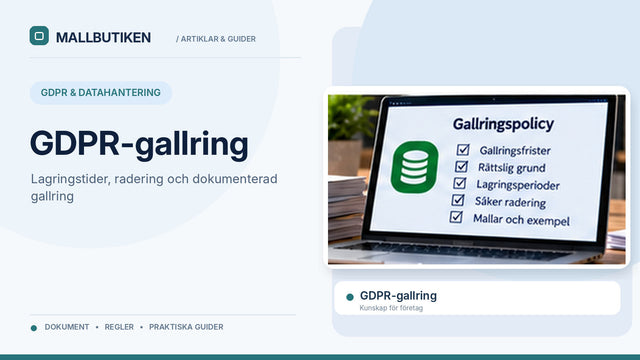
GDPR data purging 2026 – how long may personal data be stored?
How long may personal data be stored under GDPR? A guide to storage limitation, deletion policies, retention schedules, erasure, legal hold, and Sw...


