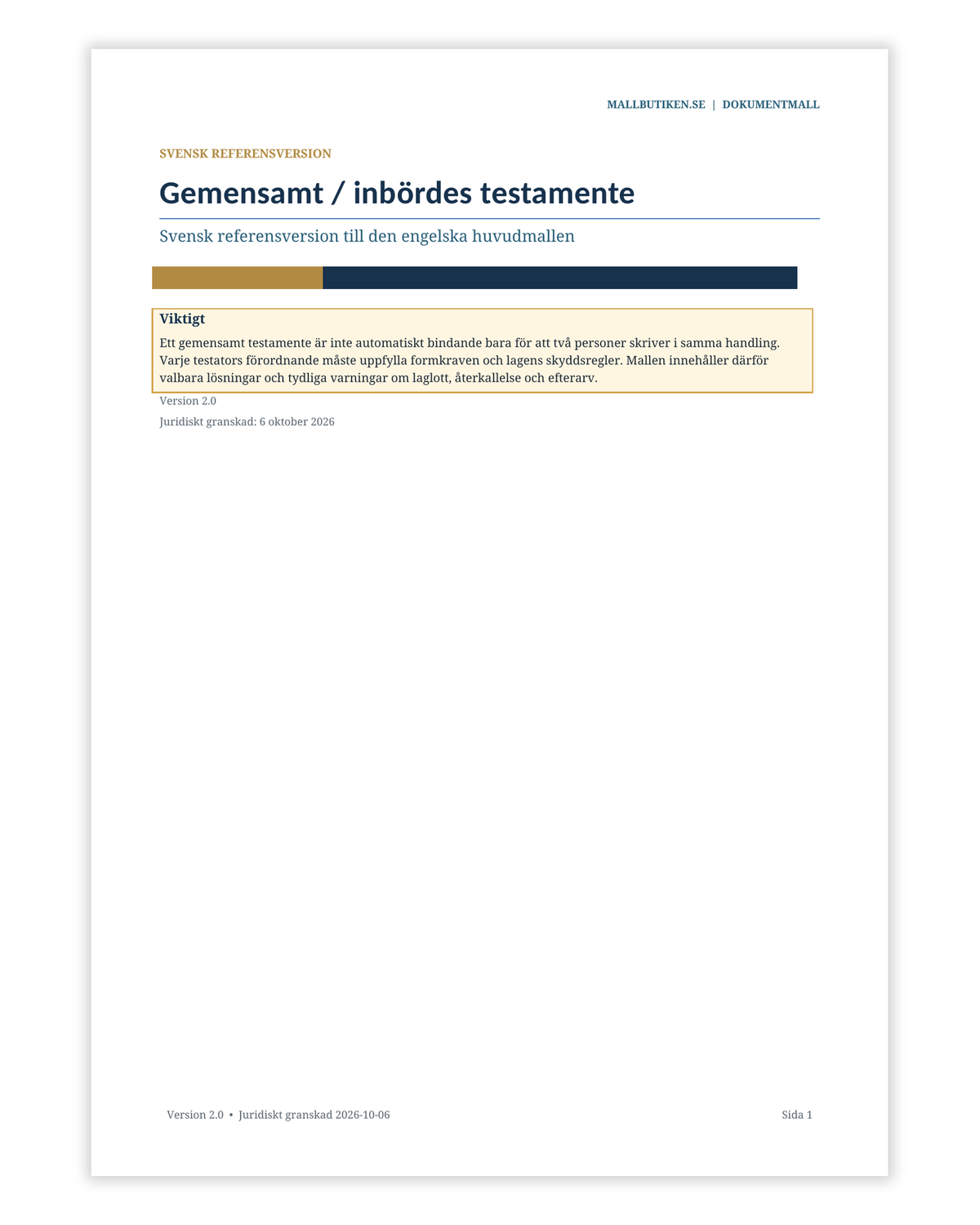


About this template
Joint / Mutual Will under Swedish law – an English-first document package for two people who want to place coordinated testamentary dispositions in one instrument. The package includes an English Word/PDF template, a Swedish reference version and detailed user guides in both languages.
Legally reviewed: 6 October 2026
The review covers Swedish execution formalities, witnesses, forced share, reciprocal wills, revocation and amendment, separation/divorce, successive inheritance, executors and relevant separate-property rules.
What is included?
| Joint / Mutual Will – DOCX | Editable English primary template governed by Swedish law. |
| Joint / Mutual Will – PDF | Print-ready English version. |
| English user guide – DOCX + PDF | Step-by-step guidance on the choices in the template, witnesses, forced share and later changes. |
| Swedish reference will – DOCX + PDF | Swedish reference version for family members, advisers and Swedish authorities. |
| Swedish reference guide – DOCX + PDF | Corresponding Swedish guidance. |
Important: a joint or mutual will is not automatically irrevocable
The older product text has been corrected. Under Swedish law, a will can be revoked, and a promise not to revoke a will is not binding. A mutual or reciprocal will can nevertheless have special consequences if one person unilaterally revokes or changes their disposition in a way that materially disturbs the basis of the reciprocal arrangement.
The template therefore does not promise that the document becomes permanently “locked” after the first death.
What does “joint” or “mutual” will mean in Sweden?
Two people may place their testamentary dispositions in one document. Where the dispositions are reciprocal or interdependent, Swedish legal terminology commonly refers to an inbördes testamente. Each person's disposition is still assessed as a testamentary act. Using a single document does not by itself make every provision irrevocable.
Choose one of two different structures on the first death
The new template makes the user choose between two legally different models instead of combining them.
Free disposal with successive inheritance
This structure is intended for situations where the Survivor should be able to use, sell and consume property during life, while remaining property derived from the first deceased may later pass to final beneficiaries under an effective successive-inheritance arrangement.
Full ownership
Full ownership normally gives the Survivor a stronger ownership position. If the first deceased also wants specific final beneficiaries to be protected after the Survivor's death, the drafting needs greater care. The template therefore warns against selecting full ownership while assuming that a later successive inheritance is automatically preserved.
Forced share (laglott)
Swedish descendants have forced-share protection. The forced share is one half of the statutory inheritance share. A will that interferes with the forced share is not automatically wholly ineffective: a descendant generally needs to request adjustment within the statutory period after formal service of the will.
The template contains separate fields for each Testator's descendants and highlights children from earlier relationships.
Married couples, cohabitants and children from earlier relationships
- Married couples: a surviving spouse has statutory inheritance rights in many situations, but children from earlier relationships and other rules can materially affect the result.
- Cohabitants: a cohabitant does not have a general statutory inheritance right after the other cohabitant under Swedish law.
- Children from earlier relationships: can normally have immediate inheritance rights after their parent and are also protected by forced-share rules.
Individual legal review is recommended when the intention is to maximise the Survivor's position in a family with children from earlier relationships.
Swedish execution formalities
As a main rule, a will must be in writing. The Testator must sign it or acknowledge an existing signature in the simultaneous presence of two eligible witnesses. The witnesses then sign the instrument and must know that it is a will, although they do not need to know its contents.
For the joint instrument in this package, the practical execution model is for both Testators to sign or acknowledge their signatures before the same two eligible witnesses while the witnesses are simultaneously present.
Witness eligibility
Swedish law contains several witness disqualifications, including restrictions affecting the Testator's spouse or cohabitant, close relatives and certain persons who themselves or through close relatives benefit from the disposition. The included guide contains a dedicated witness checklist.
Final beneficiaries and substitutes
The template includes a table for final distribution after the last death and options for what should happen if a named final beneficiary dies before entitlement arises. Percentage shares should be checked so that they total 100%.
Separate property
An optional clause allows property received by a final beneficiary to be designated as that beneficiary's separate property under Swedish matrimonial-property rules. The package also distinguishes the inherited property from replacement property and income because those issues can require express drafting.
Executor
An optional executor clause is included. An executor appointed in a will may have a significant role in the administration of the estate, so the appointment should be made deliberately rather than added automatically.
Revocation and later amendments
Each Testator's disposition remains subject to Swedish revocation rules. Testamentary amendments and additions must generally comply with the applicable testamentary formalities. In a reciprocal will, a unilateral change that materially disturbs the basis of the mutual arrangement may also affect the changing party's rights under the will.
Separation and divorce
A testamentary provision to a spouse is ineffective if the marriage has ended when the Testator dies or divorce proceedings are then pending. A provision to a cohabitant is ineffective if the cohabitation has ended before death. The will should therefore be reviewed after separation, divorce proceedings, a new marriage or cohabitation, new children or major asset changes.
After death
The user guide explains the Swedish rules on service of the will, six-month periods that can apply to forced-share adjustment and challenges, and handling of the will in connection with the estate inventory (bouppteckning).
English primary – Swedish reference included
The English document is the primary version in this product. The Swedish version is included as a reference. Both versions are structured around Swedish law.
This is not a UK or US joint will template. If either Testator lives abroad, has another nationality, owns foreign assets or otherwise has cross-border connections, applicable-law, jurisdiction, registration and tax questions may need separate analysis.
Prefer the Swedish-first product? See Gemensamt testamente – Word/PDF + English + guide →
Rule entering into force on 1 January 2027
Sweden has adopted an amendment extending acquisition-permit requirements under the Agricultural Land Acquisition Act to acquisitions of Swedish agricultural property by legal persons through testamentary dispositions. This special issue becomes relevant if a company, association, foundation or other legal person is intended to receive such property.
Proposals that are not current law
SOU 2025:91 proposes, among other things, a voluntary public will register, secure digital wills and strengthened protection for surviving cohabitants. As of the legal review date, the legislative process remains ongoing. This package therefore does not treat those proposals as current Swedish law.
When this template is suitable – and when to seek advice
The package is mainly intended for married couples or cohabitants who want a structured reciprocal arrangement under Swedish law and prefer the working documents in English.
Individual advice is particularly appropriate for children from earlier relationships, significant business interests, agricultural property, advanced successive-inheritance arrangements, earlier mutual wills, substantial gifts, cross-border estates, foreign assets or residence, concerns about testamentary capacity, or a foreseeable dispute.
File formats and delivery
Formats: DOCX, PDF and ZIP.
Languages: English primary version + Swedish reference.
Number of files: 8.
Total pages: 18 across the four documents.
Delivery: digital download. No physical product is shipped.
Frequently asked questions
Is a joint will automatically irrevocable after the first death?
No. Swedish law contains revocation rules. Reciprocal wills can nevertheless create special consequences if a unilateral change materially disturbs the basis of the reciprocal arrangement.
Is full ownership the same as free disposal?
No. They give the Survivor different legal positions and should not be treated as interchangeable.
Can the Survivor always inherit everything?
No. Forced-share rights, children from earlier relationships, property division, debts and other mandatory rules can affect what can pass under the will.
Do cohabitants inherit each other automatically in Sweden?
No. Cohabitants do not have a general statutory inheritance right after each other under Swedish law.
Do both Testators need witnesses?
Each testamentary disposition must satisfy the statutory formalities. In the joint instrument, the package is structured for both Testators to sign or acknowledge their signatures before the same two eligible witnesses who are simultaneously present.
This package is a general documentation aid under Swedish law and does not replace individual legal advice. A will must be appropriate for the Testators' actual family and asset circumstances and executed in accordance with applicable formal requirements.