

About this template
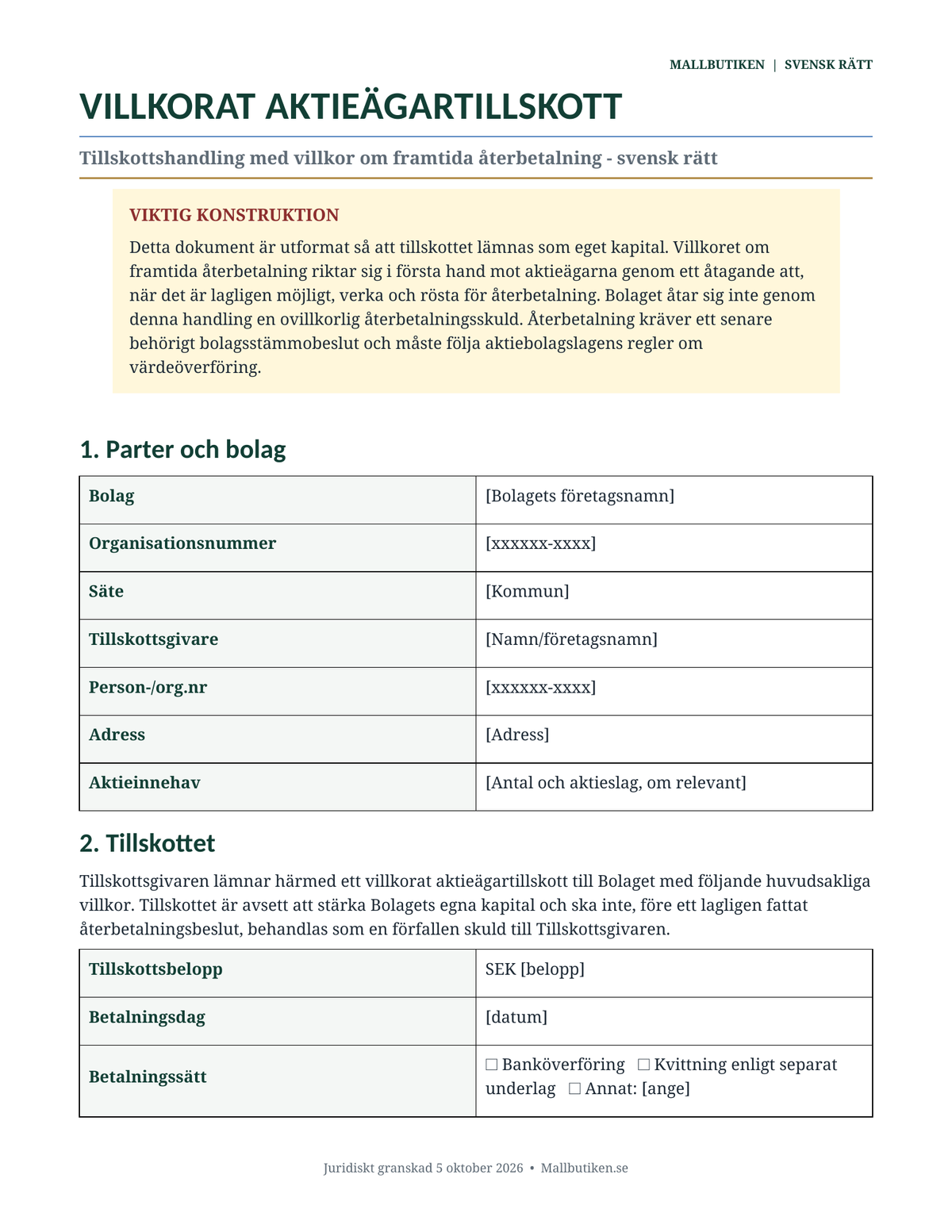
Conditional Shareholder Contribution – English-first template under Swedish law for Swedish limited companies that need to document a shareholder contribution which strengthens equity while preserving a conditional right to future repayment. The package also includes a Swedish reference version and detailed user guides in both languages.
Legally reviewed: 5 October 2026
Reviewed against Swedish corporate-law rules on value transfers and distributions, current guidance from the Swedish Tax Agency and Accounting Standards Board, and relevant case law.
What is included?
| English template – Word | Editable conditional shareholder contribution agreement. |
| English template – PDF | Print-ready version of the same document. |
| English user guide – Word + PDF | Detailed guidance with examples and repayment logic. |
| Swedish reference template – Word + PDF | Swedish reference version for bilingual organisations. |
| Swedish user guide – Word + PDF | Swedish reference guide corresponding to the English version. |
Not the same as a shareholder loan
The template is deliberately structured so that the contribution strengthens the company's equity. The company does not undertake an unconditional repayment debt when the contribution is made. Instead, the repayment condition is directed toward the shareholders and depends on a future lawful resolution when repayment is legally possible.
Why the structure matters
Swedish Tax Agency guidance makes clear that the actual repayment terms are crucial. If the repayment claim is directed against the company as an unconditional debt, the transaction may instead be treated as a liability rather than a conditional shareholder contribution.
The template covers
- company and contributor details,
- contribution amount and payment details,
- conditions for future repayment,
- requirement for a lawful future general-meeting resolution,
- priority between several conditional shareholder contributions,
- transfer of the repayment right,
- company acknowledgement,
- accession/acceptance by other shareholders where relevant,
- governing law, dispute clause and signatures.
Repayment requires more than available cash
Under Swedish law, repayment of a conditional shareholder contribution is treated civilly as a distribution/value transfer. This means that distributable reserves must be available, the capital-protection and prudence rules must be satisfied, and the general meeting must make a valid decision.
There is therefore no automatic right to repayment on a predetermined date merely because the contribution has been made.
Priority between several contributions
If the company already has one or more conditional shareholder contributions, the order of priority should be documented. The template provides options for equal priority, subordinated priority and another expressly agreed ranking.
Transfer of the repayment right
The right to future repayment may need to be handled separately from the shares, for example in connection with a share sale. The package therefore includes a specific section on transfer and consent, together with guidance on documenting ownership changes.
Accounting and tax considerations
Swedish accounting guidance treats received shareholder contributions as equity. For the contributor, accounting and tax treatment may differ from an unconditional contribution. The Swedish Tax Agency also treats the repayment right separately in capital-gains calculations. Larger contributions, group structures and ownership changes may justify separate legal, accounting and tax advice.
Interest
The standard template does not provide for running interest before a future repayment decision. Swedish Tax Agency guidance states that the company does not have a debt-like obligation toward the contributor until the general meeting has decided on repayment.
English + Swedish in the same package
The English version is the primary document in this product. The Swedish version is included as a reference for Swedish boards, accountants, advisers and bilingual ownership structures. Both versions are designed for Swedish law, not UK, US or other foreign company law.
Detailed user guide included
The guides explain the difference between a conditional shareholder contribution and a loan, how the template is completed, why the repayment condition is directed toward shareholders, how future repayment works, priority, transferability, accounting, tax, ownership changes and common mistakes.
Prefer a Swedish-first package? See the Swedish product →
File formats and delivery
Formats: DOCX, PDF and ZIP.
Languages: English and Swedish.
Number of files: 8.
Delivery: digital download. No physical product is shipped.
Frequently asked questions
Can the company promise repayment on a fixed date?
That should generally be avoided in a standard conditional shareholder contribution. An unconditional due date and direct repayment obligation can make the arrangement resemble a loan or debt.
Do the other shareholders need to accept the condition?
Where the repayment condition is intended to bind future shareholder voting, the relevant shareholders should accept the arrangement. The template includes a dedicated accession/acceptance section.
Can the repayment right be transferred separately from the shares?
Yes. Swedish Tax Agency guidance recognises separate transfer of the repayment right, so the transfer should be documented clearly.
Can repayment be made as soon as the company is profitable?
Not automatically. The requirements for distributable reserves, capital protection, prudence and a lawful general-meeting resolution must first be satisfied.
This package is a general documentation aid and does not replace individual legal, accounting or tax advice. More complex ownership structures, multiple contributions or larger amounts may require professional review.