
PPWR packaging reuse systems – registration, rotations and 2027 reporting

Short answer: Since 12 August 2026 the EU Packaging and Packaging Waste Regulation (PPWR, EU 2025/40) has applied. In Sweden, the operator responsible for a packaging reuse system must register it with the Swedish Environmental Protection Agency BEFORE it starts operation, where the national registration rule applies. Responsible operators covered by the reporting rule must also prepare reports for 12 August–31 December 2026, due by 31 March 2027.
Not every company shipping goods in reusable crates must itself register a system. Distinguish the system operator, a participant, an actor first making reusable packaging available in Sweden and one merely using it. Some open-loop systems have no operator and have specific exceptions. This guide covers Swedish business packaging reuse systems, not ordinary recycling or all disposable packaging.
1. What is a PPWR reuse system?
A reuse system consists of organisational, technical or financial arrangements and incentives that actually allow packaging to be collected and used repeatedly. Merely calling a box 'reusable' is not enough: a real return and preparation cycle is needed. See PPWR Articles 26–27 and Annex VI Parts A and B. Participants may collect, transport, fill, recondition, distribute or provide the packaging. An operator is a participant managing the system; determine this role from the facts, not just a job title.
2. Closed, open and operatorless systems
| System type | Typical arrangement | Evidence and actions |
|---|---|---|
| Closed loop | Identified participants circulate packaging without transferring its ownership, such as retained company crates between a warehouse and suppliers. | Identified system operator, approved collection points, return/take-back rules, reverse logistics and reconditioning. |
| Open loop with an operator | Packaging may change owners across an unspecified number of participants while a named participant manages the system. | Rules, equal and fair access, incentives, ownership changes and traceable activity records. |
| Open loop without an operator | Reusable packaging moves between economic actors without a designated operator. | Identify Annex VI exceptions and remaining duties. Do not assume a nonexistent operator can file a national notification. |
Open loops established before the PPWR entered into force on 11 February 2025 can have additional Annex VI exceptions. They are not automatically exempt from all new rules. Document establishment date, role and structure.
3. Who must register a reuse system in Sweden?
Under Chapter 7 Section 13 of Swedish Regulation 2022:1274 (as amended by 2026:1462), a system operator must notify the Swedish Environmental Protection Agency BEFORE bringing the system into operation. Supply the responsible person's name, contacts, personal, organisation or tax identifier and the packaging types circulating. Notify changes promptly. The registration e-service is NOW AVAILABLE under 'System för återanvändning enligt PPWR'. An internal Word form or spreadsheet does not substitute for actual notification and does not certify compliance. For open loops without an operator, investigate role-specific duties instead of assigning everyone the operator's registration duty.
4. What rules and evidence must the system have?
PPWR Annex VI Part A calls for rules on governance, ownership, eligible packaging, accepted participation conditions, collection, storage, filling and loading, return incentives, reconditioning and fair access. Closed systems have specific reverse-logistics and take-back duties; open systems have their own additional rules and certain express exceptions. Annex VI Part B covers inspecting condition, removing damaged parts, cleaning, repair where appropriate and checks before reuse. Food-contact packaging may require additional hygiene controls. A returned crate is not automatically safe for next use.
5. Build an auditable return and rotation log
Record planned dispatch separately from actual dispatch, received returns, inspection/reconditioning and completed reuse cycles. Annex VI includes operational data such as rotations by category, collection rates, rejects and units added, subject to applicable system exceptions.
| Field | Purpose | Evidence |
|---|---|---|
| Packaging category, material and mass | Reliable category and weight basis | Versioned packaging specification |
| Dispatch and return times | Separate intended from completed movements | Scan log and signed receipt |
| Condition and reconditioning | Determine readiness and safety for reuse | Inspection, cleaning or repair record |
| Rotation counts and return rates | Operational performance and reporting support | Reconciled inbound/outbound movements |
| Owner and nonconformity | Accountability and correction | Participation contract, incident and sign-off |
Illustration: 20 verified completed rotations of packaging weighing 0.75 kg each correspond to 15 kg of rotational mass in this simple calculation. This is not an official reporting decision. Follow the authority's applicable definitions and period.
6. Reporting on 31 March 2027: keep the periods separate
Under Chapter 11 Section 8a of Swedish Regulation 2022:1274, the system operator who is REPORTABLE under PPWR Article 44(10) submits information by 31 March each year. The first new-law reporting period is 12 August–31 December 2026, due 31 March 2027. Systems operated and registered before 12 August 2026 may additionally need final reporting for 1 January–11 August 2026, also due 31 March 2027. Keep the periods separate to prevent double counting; continuing systems may also require a new registration. The authority has opened its REGISTRATION service, while the separate new PPWR REPORTING service is planned around the turn of 2026/2027; do not treat it as already operating.
7. Two practical scenarios
Example A: closed crate pool
A wholesaler owns 500 returnable crates circulating with known customers and retains ownership. Record the operator, approved return points, participant duties, reconditioning and real movements. For a newly started system, the responsible operator submits the required notification before operations.
Example B: an open packaging pool
Standardised reusable packaging passes between several companies and its ownership may transfer. Check whether an operator exists, when the arrangement began and which Annex VI exceptions apply. Copying a closed-loop contract would not establish the right operating rules.
8. Seven checks before registration and reporting
- List the actual reusable packaging types separately from single-use packaging.
- Identify closed/open structure, operator, participants, ownership, establishment date and exceptions.
- Document Annex VI rules including participation, collection, storage, cleaning and safety.
- Submit the required real notification through the Swedish authority before launching a new system; retain the authority receipt.
- Collect evidence of dispatches, returned units, actual rotations, rejected and newly added packaging.
- Keep old-law and new-law periods separate; prepare the relevant 31 March return when obligated.
- Record changes, controls, responsibilities and corrections; have the final return checked by an authorised person.
9. Frequently asked questions
Does every participant using returnable crates have to register?
No, not automatically. The Swedish notification rule addresses the system operator. Participants may have separate duties under PPWR Article 27.
Is registration available now?
Yes. The Swedish Environmental Protection Agency says its e-service for PPWR reuse-system registration is available. Register before a new system is put into service when required.
Must everybody report by 31 March 2027?
No. The date applies to the operator that is subject to Article 44(10) and national reporting rules. Older registered systems may also have a separate final reporting period.
Does a spreadsheet alone demonstrate compliance?
No. A spreadsheet supports traceability but cannot prove real returns, safe reconditioning, registration or official reporting.
10. Legal sources and limitations
- Regulation (EU) 2025/40 – PPWR, Articles 11, 26–27, 44 and Annex VI.
- Swedish Regulation 2022:1274, Chapter 7 Section 13, Chapter 11 Section 8a and transitional rules in amendment 2026:1462.
- Swedish Environmental Protection Agency – reuse system guidance.
- Read the broader PPWR guide.
Editorial legal source check: 11 November 2026. General Swedish/EU compliance information, not an official filing or certification. Check current authority instructions and seek expert advice for operatorless open loops, food hygiene and producer responsibility.
Templates in this article

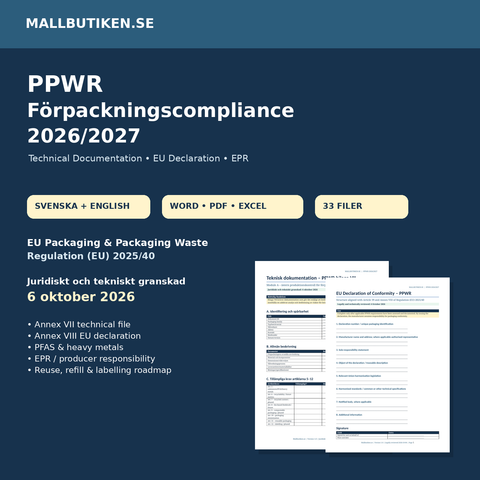
PPWR Packaging Compliance 2026/2027 – Swedish + English | Technical Documentation, EU Declaration, EPR & Reuse Word/PDF/Excel
Word (DOCX) + PDF + Excel (XLSX)
169 SEK
View template: PPWR Packaging Compliance 2026/2027 – Swedish + English | Technical Documentation, EU Declaration, EPR & Reuse Word/PDF/Excel

Explore the topic
 Business guides – contracts, HR, AI & compliance
PPWR 2026 – what applies to packaging from August 12?
PPWR began to apply on August 12, 2026. Here, companies get a practical guide to roles, technical documentation, substance requirements, producer r...


