
PPWR 2026 – what applies to packaging from August 12?

Short answer: The EU Packaging and Packaging Waste Regulation (PPWR), Regulation (EU) 2025/40, began to apply on August 12, 2026. It gradually replaces the previous directive-based model with directly applicable EU rules. However, not all requirements take effect on the same day: several labeling, reuse, and material requirements have later application dates.
- The PPWR has been applicable in the EU since August 12, 2026, with many requirements phased into later years.
- Manufacturers, importers, distributors, brand owners, and producers may have different obligations.
- Companies need to distinguish between requirements that apply now, future requirements, and purely preparatory measures.
- Technical documentation, conformity assessment, material and substance requirements, as well as extended producer responsibility (EPR), need to be mapped per packaging type and role.
- The PPWR should be integrated with product data, supplier evidence, purchasing requirements, and a live compliance register.
What is the PPWR?
PPWR stands for Packaging and Packaging Waste Regulation. The regulation aims to reduce the volume of packaging waste, improve recyclability, and create more harmonized requirements for packaging within the EU.
Crucially for companies, the PPWR is not just about waste management. The regulatory framework concerns the entire chain, from design and material selection to technical documentation, supplier data, labeling, reuse, producer responsibility, and market surveillance.
What applies from August 12, 2026?
The PPWR began to apply on August 12, 2026. Provisions that do not have a specific later application date should therefore be treated as effective from this date, while other obligations explicitly begin later.
| Area | Practical question | Documentation |
|---|---|---|
| Role and scope | Are you a manufacturer, importer, distributor, producer, or multiple roles simultaneously? | Role matrix and product/packaging register |
| Materials and substances | What materials, components, and restricted substances are in the packaging? | Specification and supplier evidence |
| Conformity | Which assessment procedure and technical file are required? | Technical documentation |
| Producer responsibility | Who is the producer in Sweden and what registration/reporting requirements apply? | EPR register and reporting documentation |
| Future requirements | Which labeling, reuse, or other requirements have later start dates? | Deadline and readiness plan |
What is the company's role under the PPWR?
Role assessment determines which obligations become relevant. A company selling a product under its own name may have different obligations than a pure distributor. An importer, in turn, needs to verify that the non-European supplier's documentation is sufficient before the product is placed on the EU market.
For e-tailers and brand owners, the roles may also vary between product lines. A single corporate registration number might therefore need to handle multiple roles in the same compliance register.
Technical documentation and EU declaration
The PPWR is based on the ability to substantiate relevant requirements. For certain obligations, this means the company needs technical documentation describing the packaging, materials, design, testing or calculation, applicable requirements, and evidence. When an EU declaration of conformity is required, it must be consistent with the technical file and the actual packaging.
It is therefore not enough to have a general supplier certificate in your inbox. The documentation must be linkable to the correct article, model, material version, and time period.
PFAS, heavy metals, and supplier evidence
Substance requirements are an area where purchasing and compliance need to work together. A robust process defines what evidence is requested, who reviews it, how long it is valid, and what happens if materials or suppliers change.
For products with long supply chains, contracts should also include an obligation to notify of material or process changes that could affect PPWR compliance.
Producer responsibility and Swedish reporting
The PPWR and the Swedish producer responsibility regulations need to be read together during the transition. Companies should therefore map who is the producer in every sales flow, which registrations are required, which quantities are to be tracked, and what documentation must be available for inspection.
The Swedish Environmental Protection Agency (Naturvårdsverket) publishes Swedish guidance on the PPWR and producer responsibility. Since transitional rules and national administration can change, companies should use the authority's current information for each reporting period.
PPWR checklist – step-by-step
- Inventory packaging. List product packaging, group packaging, transport packaging, and e-commerce packaging where relevant.
- Determine economic operator and producer role. Document the role per market and sales flow.
- Map materials and suppliers. Gather specifications, substance data, and relevant certificates.
- Build a conformity matrix. Link each requirement to evidence, owner, status, and validity.
- Establish a technical file where required. Ensure the file can be linked to the correct packaging version.
- Check producer responsibility. Ensure registration, reporting, and internal quantity data.
- Separate future deadlines. Create a roadmap for labeling, reuse, recycled content, and other upcoming requirements.
- Implement change control. Material or design changes should trigger a new compliance check.
Common mistakes
This leads to incorrect over-implementation and unnecessary costs.
The company does not know whether it acts as a manufacturer, importer, distributor, or producer.
A test or certificate is saved without it being possible to see which packaging it relates to.
The regulation requires interplay between product, purchasing, quality, legal, logistics, and finance departments.
Frequently asked questions about the PPWR
When did the PPWR start to apply in practice?
August 12, 2026. The regulation entered into force earlier, but the main parts began to apply on this date. Certain specific provisions have later dates.
Does the PPWR only apply to manufacturers?
No. Importers, distributors, producers, and other actors may also have obligations depending on their role and sales model.
Do we have to change all labeling immediately in 2026?
No, not generally. Labeling requirements have their own application dates. Check the specific provision and relevant implementing act before changing labels.
Do we need supplier data?
Yes, in practice often. The company needs to be able to substantiate material, substance, and other product data and should therefore build data requirements into the purchasing and supplier process.
Build traceable PPWR work
Mallbutiken's PPWR package includes Swedish and English templates for compliance plans, technical documentation, EU declarations, role verification, materials/substances, EPR, reuse, and an Excel register for requirements, deadlines, and evidence.
See PPWR Packaging Compliance 2026/2027Related guides
- Supplier agreements – quality, delivery, responsibility, and supply chain risk
- Supplier agreements – what should a B2B Supplier Agreement contain?
- General terms for e-commerce 2026 – what must be included?
- EU compliance for businesses 2026/2027 – guide to new EU rules
Sources
- Regulation (EU) 2025/40 – Packaging and Packaging Waste Regulation
- EU Commission PPWR guidance C/2026/3084
- Swedish EPA – New EU rules for packaging (PPWR)
Practical importer documents: PPWR importer templates: EU declaration of conformity, Annex VII and batch holds. The pack supports record checks and importer-role assessment; first verify which obligations apply.
Related guide
Read also Balloon producer responsibility – latex, foil and the 31 March 2027 report. PPWR packaging rules are distinct from Sweden's specific producer responsibility for single-use balloons. Assess whether one or both regimes apply.
PPWR for coffee capsules: Permeable coffee bags and soft after-use single-serve units face specific compostability requirements from 12 February 2028, while rigid non-permeable machine pods must be assessed separately, including any applicable national rules. See our guide to soft and hard coffee capsules under PPWR Article 9 for definitions, dates and evidence checks.
Own cups and food boxes for takeaway from 2027
Cafés and restaurants offering takeaway drinks or prepared meals should distinguish Article 32 (suitable customer-provided containers from 12 February 2027) from Article 33 (operator-provided reusable packaging within a reuse system from 12 February 2028). Article 32 also calls for clear signs and no higher prices or worse terms than disposable packaging. Article 28 allows justified refusals of unhygienic or unsuitable containers. Read: PPWR 2027: customer-owned cups, food boxes, hygiene and pricing
Templates in this article
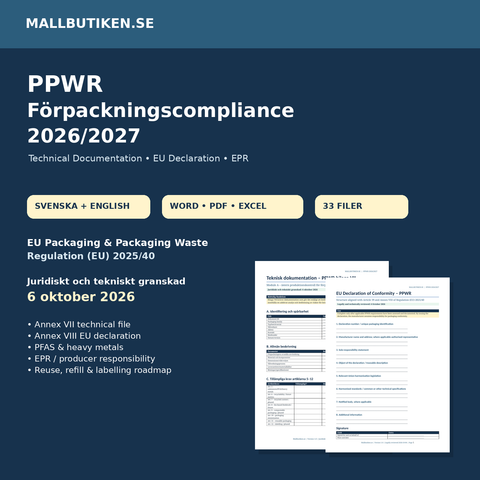
PPWR Packaging Compliance 2026/2027 – Swedish + English | Technical Documentation, EU Declaration, EPR & Reuse Word/PDF/Excel
Word (DOCX) + PDF + Excel (XLSX)
169 SEK
View template: PPWR Packaging Compliance 2026/2027 – Swedish + English | Technical Documentation, EU Declaration, EPR & Reuse Word/PDF/Excel

Explore the topic
 Business guides – contracts, HR, AI & compliance
Supplier Agreement – quality, delivery, liability and supply chain risk
Guide to supplier agreements: forecast and order, price, delivery, quality, warranty, audit, subcontractors, continuity and supply chain risk.
 Business guides – contracts, HR, AI & compliance
Supplier agreement – what should a B2B Supplier Agreement contain?
Guide to B2B supplier agreements: orders, forecasts, price, delivery, quality, GPSR, subcontractors, continuity, liability, insurance, and exit.
 Business guides – contracts, HR, AI & compliance
General Terms and Conditions for E-commerce 2026 – what must be included?
Guide to general terms and conditions for Swedish e-commerce 2026: information requirements, pricing, payment, delivery, complaints, right of withd...


