
Swedish jam and marmalade rules 2026 – fruit content and labelling

Sweden has applied new rules on jam, jelly and marmalade since 14 June 2026. The general minimum is 450 g of fruit pulp and/or purée per 1,000 g of finished ordinary jam, and usually 500 g of unconcentrated fruit pulp for extra jam. The correct legal category, exceptions and label must also be checked.
This guide is for small producers and farm shops selling in Sweden. It explains Swedish law, not a universal rule for all fruit spreads or other countries. The main source is LIVSFS 2025:6, particularly sections 3–9 and its annexes; EU Regulation 1169/2011 also applies to food information. Under section 1, these rules do not apply to products intended for making confectionery, cakes or biscuits.
Identify the correct product category
| Category | General threshold | Qualification |
|---|---|---|
| Ordinary jam / marmalade | 450 g per 1,000 g | Certain fruits have lower thresholds; the statutory definitions still matter. |
| Extra jam / extra marmalade | 500 g per 1,000 g | Usually based on fruit pulp, with category-specific exceptions and mixing restrictions. |
| Citrus marmalade | 200 g citrus per 1,000 g | At least 75 g must derive from the inner fruit, under the separate category. |
Calculate and record fruit content
First select the legally correct category. Record the fruit species, eligible pulp or purée, supplier records, batch and actual final product weight. As a simple illustration, 480 g of qualifying fruit per 1,000 g of finished product equals 48 g per 100 g. This does not establish compliance: ingredient eligibility, extracts, exceptions and soluble dry matter may require separate checks. Retain the dated recipe and the approval decision.
For products covered by sections 8–9, the Swedish package must state “fruktmängd: … g per 100 g” for the finished product, legibly and in the same field of vision as the product designation. Also verify the named fruits and their order under section 6, plus other mandatory food information. Compare the physical label with the webshop listing.
A practical farm-shop example
A farm shop records 470 g eligible fruit for a finished kilogram. That exceeds the ordinary-jam general threshold but falls below the usual extra-jam threshold. A recipe with 480 g similarly fails the usual 500 g test for extra jam. Neither calculation alone establishes the lawful designation: ingredients, fruit varieties and the full category definition still matter.
Old stock and the 2027 amendment
Products already placed on the market or labelled under the previous rules before 14 June 2026 may be sold until stocks are exhausted, subject to the transitional provisions. Keep evidence of dates and batches; do not assume the exemption applies to newly produced goods.
The Swedish Food Agency also lists an adopted amendment, LIVSFS 2026:3, taking effect on 1 March 2027. Review Annex 1 before planning 2027 labels; do not present future provisions as already applicable.
Common mistakes and limits
Do not apply 450 g indiscriminately to extra jam and citrus marmalade, calculate against an unverified batch weight, omit the same-field-of-vision rule or treat a spreadsheet as official certification. Complex formulas may require qualified food-law advice.
Frequently asked questions
Does every jam require exactly 45% fruit?
No. 450 g per kilogram is a general rule, subject to specific fruits and categories in Annex 1.
Is 450 g of berries in a recipe enough?
Not by itself. Check eligible material, the finished-product denominator, the legal category and all other label and ingredient rules.
Sources and related rules
Packaging compliance is a separate topic. See our guide to PPWR packaging requirements to distinguish packaging rules from jam composition and labelling.
Swedish legal sources checked 15 November 2026. General information only, not individual legal advice.
Explore the topic
 Business guides – contracts, HR, AI & compliance
PPWR 2026 – what applies to packaging from August 12?
PPWR began to apply on August 12, 2026. Here, companies get a practical guide to roles, technical documentation, substance requirements, producer r...
 Business guides – contracts, HR, AI & compliance
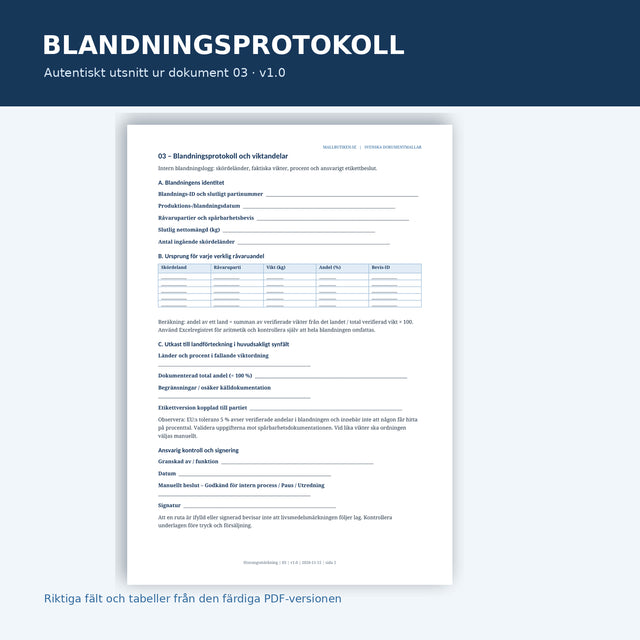
Honey labelling in Sweden 2026 – origin countries, percentages and old stock
Swedish honey blend labels after 14 June 2026: actual harvest countries, percentage shares, 30g mini jars, 5% tolerance and old stock.


