

Svenska Dokumentmallar
Cohabitation agreement and promissory note – Word/PDF/Excel + guides
Cohabitation agreement and promissory note – Word/PDF/Excel + guides
- File format
- DOCX, PDF, XLSX
- Document language
- Swedish
- Number of files
- 29
Digital download. No physical product is shipped.
Couldn't load pickup availability
SKU:7350139913829
View full detailsAbout this template
Cohabitation agreements and promissory notes – a complete template package in Swedish and English. For cohabitants who want to clarify what should be included in a potential division of property, document an actual private debt, and track different down payments. The package contains editable Word templates, PDF versions, detailed user guides, and an Excel register for payments and supporting documentation.
1. Cohabitation agreements regulate whether a division of property under the Cohabitation Act should take place or which cohabitation property is to be exempted. 2. Promissory notes document an actual debt between named parties. 3. Ownership rights are stated in acquisition documents and are not automatically changed by these templates. Different down payments do not automatically imply that a loan has been created.
This is included in the document package
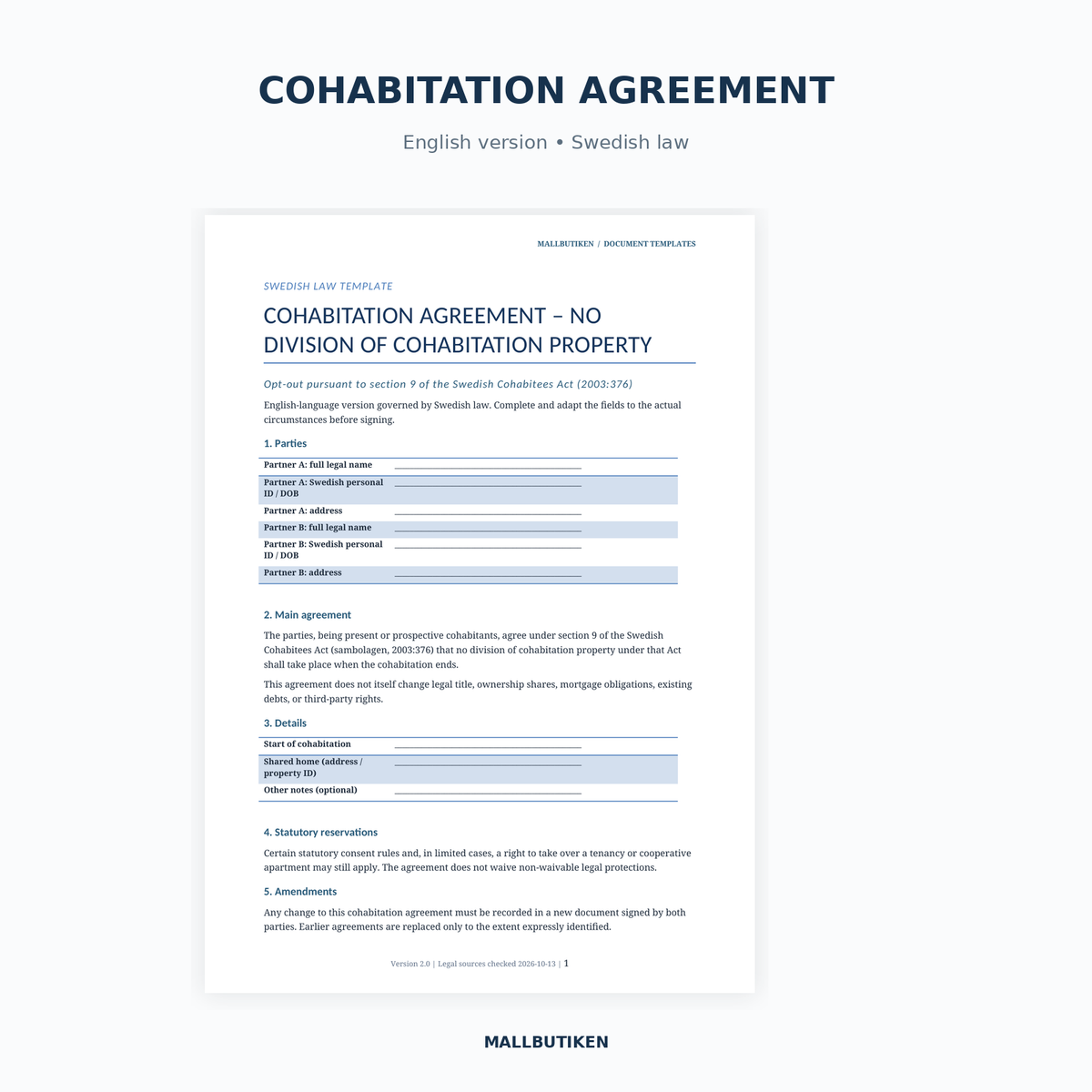
- Cohabitation agreement – no division of property: Swedish and English DOCX/PDF, according to Section 9 of the Cohabitation Act.
- Cohabitation agreement – certain property exempted: Swedish and English DOCX/PDF, with identification of assets.
- Simple promissory note between cohabitants: Swedish and English DOCX/PDF for an actually incurred and documentable loan receivable, including terms for amount, interest, due date, and proof of payment.
- Down payment and ownership appendix: Swedish and English DOCX/PDF for reporting actual financing contributions and ownership shares – without creating or transferring ownership rights.
- Receipt and balance confirmation: Swedish and English DOCX/PDF for payments and amortizations of promissory notes.
- Amendment of cohabitation agreement: Swedish and English DOCX/PDF documenting a new written agreement.
- Product-specific User Guide: detailed Swedish and English DOCX/PDF with step-by-step instructions, examples, legal boundaries, signatures, evidence preservation, and sources.
- Excel register (XLSX): seven sheets with dashboard, down payments, debt register, amortization journal, checklist, legal sources, and instructions.
Total of 29 customer files: 14 DOCX, 14 searchable PDF, and 1 XLSX. The English-language documents are English-language versions governed by Swedish law, not British or American standard contracts.
Digital delivery: The documents are provided as a downloadable ZIP file. No physical delivery is included.
When are cohabitation agreements and promissory notes needed?
Different down payments for home purchases
If one cohabitant pays more in cash than the other while the home is owned in equal shares, the parties may need to document what is actually intended. A promissory note can be used when one party has actually lent money to the other. The cohabitation agreement can separately affect how cohabitation property is treated during a division of property. Neither different contribution amounts nor a signed cohabitation agreement in itself changes registered ownership rights.
Exempting a home or certain household goods from division of property
According to Section 9 of the Cohabitation Act (2003:376), cohabitants or prospective cohabitants may agree in writing, with both signatures, that a division of property shall not take place or that certain property shall not be included. In special cases, the right to take over a rental apartment or tenant-owned apartment may still be invoked under Section 22 of the Cohabitation Act. The suitability of the agreement must therefore be assessed for the specific home.
Documenting an actual debt between cohabitants
A simple promissory note under Section 26 of the Promissory Notes Act is issued to a named creditor. Specify the loan amount, proof of payment, repayment terms, and whether interest is to apply. If payments are not made, default interest and statute of limitations become separate issues that need to be monitored.
How do you use the documents?
- First determine whether the issue concerns division of property, an actual loan, or ownership shares – these rights are not the same thing.
- Choose a cohabitation agreement for a full exemption or for specifically identified property; remove other options.
- Fill in the parties' details and identify any home with correct address/property details.
- If there is an actual debt: fill in the promissory note and check bank transfer, amount, interest, and due date.
- Document historical down payments and ownership shares in the appendix without stating them as automatic receivables.
- Have both cohabitants sign the cohabitation agreement and keep the original or reliable signed copies.
- Track payments in Excel; write a receipt only for actual payment and keep reconciliation documentation.
Legal issues to be aware of
Is everything included in a cohabitation division of property?
No. The main rule applies to qualified joint homes and joint household goods acquired for joint use, with the exceptions provided by law. Ordinary bank funds, stocks, and cars are, for example, generally not cohabitation property in the legal sense.
Must a cohabitation agreement be witnessed or registered?
According to Section 9 of the Cohabitation Act, the agreement must be in writing and signed by the cohabitants or the prospective cohabitants. No general requirement for witnesses or registration is stipulated there.
Do we own different shares if one has paid more?
Not automatically. Down payments can constitute evidence, but ownership and personal receivables are decided through a broader assessment of acquisition documents and the legal relationship between the parties.
How long is a promissory note valid?
Ordinary private receivables are as a rule statute-barred after ten years if the statute of limitations is not interrupted. The correct calculation may depend on the nature of the receivable and special rules.
Can interest on a private loan be deducted in 2026?
The Swedish Tax Agency (Skatteverket) states that interest on loans without such security that meets the requirements of the law is generally not tax-deductible from the 2026 income year. Private loans between cohabitants are therefore not automatically tax-deductible. Check the current conditions for the specific loan.
What happens if we separate or one of us passes away?
Division of property, any personal debts, and inheritance rights must be assessed separately. A request for division of property is generally subject to a one-year deadline upon separation, and in the event of death, special rules apply. Cohabitants do not automatically inherit from each other. A will may therefore be needed.
Legal sources and limitation of liability
Legal sources checked October 13, 2026: The Cohabitation Act (2003:376), The Promissory Notes Act (1936:81), The Interest Act (1975:635), The Statute of Limitations Act (1981:130), and Skatteverket – interest deductions. The documents are general documentation aids designed based on Swedish law and may need to be adapted. They do not replace individual advice from a lawyer or tax advisor.
Also explore cohabitation agreements – templates and promissory notes – templates.
Cohabitation agreement and promissory note – which documents do you need?
Under Swedish law, a cohabitation agreement can exclude the division of property or specified cohabitation property under Section 9 of the Cohabitees Act. A promissory note serves a different purpose: documenting an actual debt. Unequal down payments do not by themselves create a loan.
- Unequal down payments: Guide to cohabitation agreements and promissory notes · Special package with a calculation appendix
- Only a cohabitation agreement: General cohabitation agreement template · Guide to what an agreement can regulate
- Separation or division of property: Guide to cohabitation property and the time limit
The agreement must be in writing and signed by both current or prospective cohabitees. It does not automatically change ownership or inheritance rights. Sambolag (2003:376).