
EUDR bamboo and rattan 2026 – exemption, mixed materials and codes

Bamboo and rattan are not treated as the relevant commodity ‘wood’ under the EU Deforestation Regulation (EUDR). Commission Delegated Regulation 2026/2102, in force from 18 September 2026, added a specific note to Annex I of Regulation 2023/1115 excluding bamboo, rattan and other materials of a woody nature – including products listed under ‘Wood’ to the extent they are made of those non-wood materials.
A product described as ‘bamboo’ is not automatically exempt if it also contains ordinary wood. Conversely, a CN/HS heading associated with wood does not turn a product made exclusively from non-relevant bamboo into wood for EUDR. Test the actual materials, correct code and updated Annex I together.
What changed in September 2026?
The delegated act was published on 17 September 2026 and took effect on 18 September. Its new Annex I wood note (4) is a scope clarification. The Swedish Forest Agency also lists other woody materials such as reeds, rushes, willow/osier, raffia and certain straw and lime-bark materials. Distinguish the date when the annex changed from the later dates on which businesses must comply with EUDR duties.
Three checks before deciding EUDR scope
- Identify the actual product: SKU, component structure, intended use, supplier, CN/HS code and basis for tariff classification. A product category on a web shop is not a binding customs decision.
- Obtain the real bill of materials: identify bamboo, rattan, ordinary wood and other relevant commodities, by part, with supplier evidence and any uncertainty.
- Compare both the real commodity and the precise CN/HS entry in the amended Annex I, including ‘ex’ restrictions. Neither ‘listed code’ nor ‘bamboo’ as a marketing term alone determines the answer.
Examples: pure bamboo, rattan and mixed products
| Product | Provisional assessment | Evidence to check |
|---|---|---|
| Item made entirely of bamboo | Generally outside EUDR's relevant commodity wood | Confirm absence of relevant wood and other relevant commodities; verify product code |
| Basket entirely of rattan | Rattan excluded as wood by Annex I note (4) | Check supplier identification and material composition |
| Chair with bamboo seat and ordinary wooden legs | Not automatically exempt; actual wood may be relevant | Check complete chair code, Annex I, wood components and operator role |
| Label says ‘bamboo fibre’ but BOM missing | Exemption not evidenced by marketing wording | Get species/material specification, manufacturing records and code |
| Wooden furniture with decorative rattan | Rattan detail does not exempt ordinary wood | Identify covered wood and applicable listed product entry |
Why a CN code or ‘wood-like’ label is not enough
Article 1 of EUDR and Annex I require both a relevant product and a relevant commodity. The Commission's 2026 guidance explains that a product made of a non-relevant commodity is not in scope merely because its tariff heading could also cover an equivalent product made from a relevant commodity. Mixed products need an individual classification and commodity review. No fixed percentage of wood automatically decides every case, and a decorative bamboo component does not nullify ordinary wood.
Supplier evidence for a defensible scope decision
- Verified SKU/model, photographs and technical description of actual product
- Documented CN/HS code and rationale; ask customs experts if doubtful
- Supplier bill of materials identifying actual plant materials and any genuine wood components
- Manufacturer and supplier identity, dated declarations and verifiable batch records
- Change-control requirement if material, production or code changes
- Documented scope conclusion identifying the commodity, Annex I entry and business role; escalate uncertainty
Which 2026 and 2027 dates matter?
| Event | Date | Meaning |
|---|---|---|
| Annex amendment 2026/2102 | 18 Sep 2026 | Bamboo/rattan exclusion note came into force |
| Medium and large operators/traders | 30 Dec 2026 | Main EUDR application date |
| Micro/small businesses already under the EU Timber Regulation | 30 Dec 2026 | Special earlier application date |
| Most other micro/small businesses | 30 Jun 2027 | Later application date |
| Newly added Annex I products under delegated act | 30 Dec 2027 | Separate date for the newly added goods, not for the bamboo exclusion |
When should an exclusion decision be revisited?
Supplier changes materials: A rattan furniture range receives a new support frame made from genuine wood. Reassess the bill of materials, CN classification and Annex I before carrying forward an older 'out of scope' conclusion.
Only a photo of a ‘bamboo chair’: The appearance does not establish whether the core, legs or joints are ordinary wood. Obtain a component specification; do not guess from the sales name.
Frequently asked questions
Does EUDR apply to bamboo furniture from December 2026?
Products made solely of bamboo are normally outside the relevant commodity wood; verify the actual materials, commodity codes and any other relevant content.
Is a chair with a bamboo seat and wooden legs exempt?
Not automatically. The ordinary wood component, final product's tariff classification and Annex I entry need a specific assessment.
Must an importer supply geolocation for a pure rattan basket?
Not solely because of the rattan, which is not the EUDR wood commodity. Other relevant materials must be considered separately.
Is a supplier statement the same as a DDS?
No. It may evidence material composition; a due diligence statement is a specific submission in the EUDR information system where legally required.
Do all small businesses have until June 2027?
No. Certain micro and small businesses already covered by the former Timber Regulation are subject to the 30 December 2026 date.
Further reading: company duties and DDS
If your material and CN-code assessment shows that the product falls within EUDR, determine the business role and applicable obligations. See our general EUDR guide to who is in scope and our detailed guide to DDS, simplified declarations and business roles. Neither guide replaces the separate material-scope assessment above.
Official sources and limitations
- EU delegated regulation 2026/2102 – Annex I note (4)
- EU regulation 2023/1115 – EUDR
- Swedish Forest Agency – excluded goods
- European Commission – application dates
- European Commission EUDR guidance 2026
Legal source review: 13 November 2026. General Swedish/EU information, not binding customs classification, a government exemption certificate, DDS or product-specific legal advice. Verify mixed goods and uncertain tariff classifications with qualified experts.
Related document package
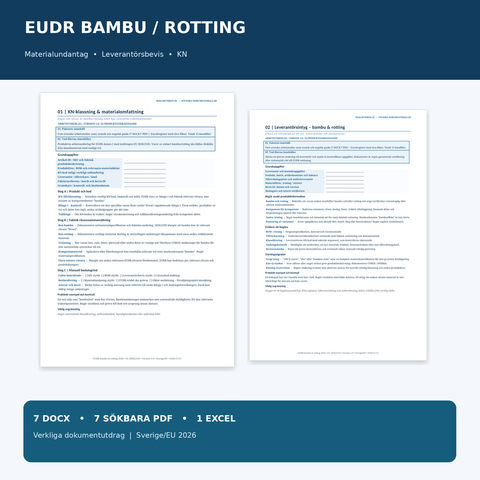
For editable documentation on this subject, see the matching Word, PDF and Excel package. Check the product description for the exact contents. It may currently be presented in Swedish.
Templates in this article
Explore the topic
 Business guides – contracts, HR, AI & compliance
EUDR 2026/2027 – which companies are affected and how is due diligence conducted?
EUDR Guide 2026/2027 with current deadlines, product scope, roles, geolocation, risk assessment, risk mitigation, and due diligence statement.
 Business guides – contracts, HR, AI & compliance
EUDR: DDS or simplified declaration 2026/2027? Roles and traceability
EUDR 2026/2027: learn who must submit a DDS, who is permitted to use a simplified declaration under Article 4a, and what information downstream ope...


