
EUDR 2026/2027 – which companies are affected and how is due diligence conducted?

Short answer: According to the current timeline, the EUDR (EU Deforestation Regulation) will begin to apply on December 30, 2026, for large and medium-sized operators, and on June 30, 2027, for micro and small operators, with specific transitional rules for certain EUTR operators. Companies in scope must be able to demonstrate that relevant products are deforestation-free, legally produced, and covered by the correct due diligence documentation or a simplified declaration where permitted by the rules.
- The EUDR covers relevant products linked to, among others, cattle, cocoa, coffee, oil palm, rubber, soy, and wood.
- The current main deadline is December 30, 2026; micro/small enterprises often have until June 30, 2027.
- Geolocation of production areas is a central part of the information requirements.
- Due diligence includes information gathering, risk assessment, and, where necessary, risk mitigation.
- Products may not be placed on the market or exported if the conditions in Article 3 are not met.
What is the EUDR?
The EUDR is Regulation (EU) 2023/1115 on deforestation-free products. This regulatory framework aims to reduce the EU's contribution to global deforestation and forest degradation by setting requirements for certain commodities and products that are placed on, made available in, or exported from the EU market.
The central guiding principle is that relevant products must be deforestation-free, produced in accordance with the relevant legislation of the country of production, and covered by the documentation required by the EUDR.
When does the EUDR take effect in 2026/2027?
The EUDR has been postponed and simplified in several stages. Following Amending Regulation (EU) 2025/2650, the current main timeline is:
| Actor | Application date | Practical implications |
|---|---|---|
| Large and medium-sized operators | December 30, 2026 | Main obligations begin to apply |
| Micro and small operators | June 30, 2027 | Later application in many cases |
| Certain micro/small actors already subject to EUTR | December 30, 2026 | Specific transition applies |
| New products added via the 2026 delegated amendment | December 30, 2027 | Separate later start for these additions |
Which products are covered?
The EUDR is based on seven commodity categories: cattle, cocoa, coffee, oil palm, rubber, soy, and wood. However, the commodity name alone does not determine scope. Annex I lists relevant products and CN/HS codes covered.
Companies must therefore conduct a product-by-product assessment. A purchase that "contains wood" is not automatically covered if the product code is outside the annex, while a processed product might be covered even if the raw material is only a part of the item.
Deep dive into DDS and Article 4a: See our new guide on EUDR due diligence statements, simplified declarations, and traceability requirements for downstream actors, featuring a specific breakdown of roles following the 2025 amendments.
EUDR due diligence – step-by-step
The EUDR has its own binding requirements and cannot be replaced by a general ESG questionnaire. For voluntary supplier assessments that complement specific legislation, read the guide on ESG-DDQ and Corrective Action Plans (CAP).
- Determine role. Is your company an operator, downstream operator, trader, or micro/small primary operator according to the current regulations?
- Identify products. Match part numbers and customs codes against the EUDR annex.
- Collect Article 9 information. Product description, quantity, country of production, supplier, geolocation, and other mandatory data.
- Assess risk. Analyze country risk, supply chain, traceability, complexity, and other relevant information.
- Mitigate risk if necessary. Request supplementary documentation, verification, auditing, or other measures until the risk is deemed negligible where required.
- Submit DDS or the correct simplified declaration. Use the information system and process that applies to your role.
- Save documentation. Build a traceable file and a register that can be presented during an inspection.
Geolocation and supplier data
For the practical application of Article 9, see our separate guide on EUDR Article 9: geolocation, point, and polygon requirements. It explains when polygons are required, how all production areas must be tracked, and when Article 4a permits the use of a postal address for certain primary producers.
The EUDR requires detailed information on where relevant commodities were produced. Geolocation is therefore not a voluntary sustainability field, but a core component of the compliance process.
Organizations should test early on whether suppliers can actually provide coordinates or polygon data in the correct quality and link them to the right production period, producer, and batch. It is better to discover data gaps during onboarding than just before a shipment or DDS.
Country benchmarking and risk assessment
For details on risk criteria, negligible risk, and action plans before market placement, see our step-by-step guide to EUDR Articles 10–11.
EU country benchmarking may affect how due diligence is carried out, but a "low-risk country" designation does not mean all documentation disappears. The company must still ensure that the correct product and supply chain are covered and follow the simplified requirements that actually apply to their specific role.
The risk assessment should be documented so that it is possible to understand which sources were used, which red flags were present, and why the remaining risk was deemed negligible.
Common EUDR mistakes
The company builds its project plan on 2025/2026 dates that have been changed by subsequent EU legislation.
Assuming that all products with wood, coffee, or rubber are covered without checking the annex and product codes.
Coordinates exist but cannot be tied to the correct production flow.
The conclusion of "negligible risk" is documented without clear sources and reasoning.
Frequently asked questions about the EUDR
When does the EUDR apply to large and medium-sized companies?
December 30, 2026, according to the current amended timeline.
When does the EUDR apply to micro and small companies?
June 30, 2027, in many cases. Certain actors and products have specific transitional rules.
Are GPS coordinates required?
Yes, geolocation is a central part of the information requirements. The geometric information required depends on the production area and the specific requirements of the rules.
Is a supplier declaration enough?
Not as a general solution. The company needs to fulfill the information, risk assessment, and risk mitigation steps that apply to their own role.
Build an operational EUDR register
Mallbutiken's EUDR package includes Swedish and English templates for scope/role assessment, information gathering and geolocation, risk assessment, risk mitigation, DDS/simplified declaration, downstream traceability, and Excel registers.
See EUDR Due Diligence 2026/2027Related guides
- Supplier agreements – quality, delivery, responsibility, and supply chain risk
- Supplier agreements – what should a B2B Supplier Agreement contain?
- CBAM 2026 – which companies are covered and how does the 50-tonne threshold work?
- EU compliance for companies 2026/2027 – guide to new EU rules
Material-scope deep dive: Bamboo, rattan and mixed-material products require a separate assessment of actual commodities, components and customs codes. Read EUDR and bamboo/rattan in 2026 – exclusions, mixtures and product codes.
Sources
- Regulation (EU) 2023/1115 – EUDR
- Regulation (EU) 2025/2650 – amended timeline and simplifications
- European Commission – Regulation on Deforestation-free products
- European Commission EUDR Guidance C/2026/3896
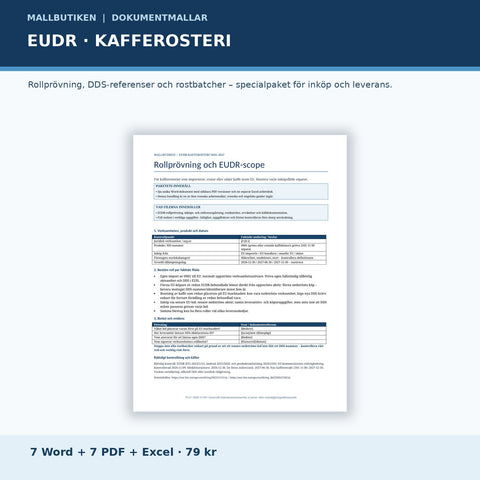
Practical template pack: EUDR templates for coffee roasters: DDS references, bean lots and roasting batches. Always check the relevant products, responsible parties and application dates.
Wood-furniture documents: EUDR timber-furniture templates: CN 9403, supplier evidence and batch controls. Check the current Annex I product scope and your operator role before assessing obligations.
Related document templates
For editable documents, see EUDR Glycerol 2027 – Crude Glycerol, 95% Glycerol, Palm Oil Traceability and Supplier Declaration | Word/PDF/Excel. Where relevant, confirm the precise legal scope and commodity classification.
Missing EUDR supplier information: what should you do?
If a supplier fails to provide geolocation, origin evidence or a DDS reference, first check the product's CN code against the current Annex I and determine your role in the supply chain. Request only what that role requires. Silence from a supplier is not automatically a proven violation, but it may leave an upstream operator unable to demonstrate compliance.
Upstream operator: identify the Article 9 evidence gap
For full due diligence, missing evidence may include product description, quantity, country of production, plot geolocation, production dates or verifiable evidence of legality and deforestation-free origin. Link each question to a specific SKU and batch. A supplier office address or generic certificate does not automatically replace legally required plot data. Record incoming evidence and any remaining Article 10–11 risk assessment.
First downstream buyer: do not request the wrong dataset
Following the 2025 amendment, Article 5 imposes different traceability duties on downstream operators and traders. A first downstream buyer must retain an applicable DDS reference or declaration identifier received from an operator but generally need not proactively request it or investigate whether it is first in the chain. The upstream operator must pass it on. If the buyer knows that its supplier is an operator and a required reference has not been supplied, Article 5's specific restrictions matter. Do not demand full Article 9 geolocation from every trader.
A four-step internal process
- Record the SKU, CN code, supplier, batch and actual EUDR role.
- List the exact missing evidence and documents already received.
- Send a targeted follow-up request with a commercial response date, not a fictitious statutory deadline.
- Record the decision, any internal batch hold and verified grounds for release.
An internal batch hold is an operational safeguard, not a distinct mandatory EUDR form. An upstream operator may not place or export a relevant product without meeting Article 3 and applicable due diligence obligations. Check the generally applicable dates of 30 December 2026 and 30 June 2027, plus exceptions. Consult the Swedish Forest Agency and the European Commission's role guidance. Skogsstyrelsen – EUDR; European Commission – EUDR roles.
Templates in this article


Explore the topic
 Business guides – contracts, HR, AI & compliance
EUDR: DDS or simplified declaration 2026/2027? Roles and traceability
EUDR 2026/2027: learn who must submit a DDS, who is permitted to use a simplified declaration under Article 4a, and what information downstream ope...
 Business guides – contracts, HR, AI & compliance
Supplier Assessment 2026/2027 – ESG, DDQ and Corrective Action Plan (CAP)
Practical guide for ESG supplier assessment: risk selection, DDQ questions, risk matrix, and Corrective Action Plan (CAP). The difference between v...
 Business guides – contracts, HR, AI & compliance
EUDR geolocation 2026/2027 – polygons and Article 9
EUDR Article 9: when are polygons required, when are GPS coordinates sufficient, and which exemptions apply? A practical guide to geolocation, prod...


