CBAM 2026 – which companies are covered and how does the 50-tonne threshold work?

Short answer: The definitive phase of CBAM has been in effect since January 1, 2026. For importers of goods such as iron and steel, aluminium, cement, and fertilizers, the new 50-tonne threshold is central: once the relevant aggregate imports exceed this threshold, the importer must generally be covered by CBAM requirements and hold the correct status for imports. Electricity and hydrogen do not follow the same weight-based de minimis rule.
- CBAM applies in its definitive phase from January 1, 2026.
- The 50-tonne threshold is cumulative per importer and calendar year for the affected sectors – not per shipment.
- Verification of CN code, origin, import role, and product category must be performed before drawing conclusions regarding scope.
- Companies covered need to organize supplier data, embedded emissions, verification, documentation, and CBAM certificates.
- For the 2026 import year, the organization needs to build a traceable foundation during 2026 for upcoming declarations and certificate management.
What is CBAM?
CBAM stands for Carbon Border Adjustment Mechanism. Its purpose is to attach a cost to embedded emissions in certain imported goods and reduce the difference between the climate cost of production within the EU and corresponding production outside the EU.
The regulation is not a general tariff on all goods. It affects specific product groups and CN codes in accordance with the CBAM Regulation. Therefore, an organization should start with classification and scope – not with a general question about whether it is "importing from a country outside the EU".
Which companies and goods are covered by CBAM in 2026?
CBAM mainly covers goods within iron and steel, aluminium, cement, fertilizers, electricity, and hydrogen, as well as certain products further down the value chain. The exact assessment is made against the applicable CN code.
| Question | What the company should check |
|---|---|
| Commodity code | Is the current CN code included in the CBAM regulation? |
| Origin | Where is the good imported from and is there any relevant exemption? |
| Importer | Who is the declarant/importer and who bears the CBAM responsibility? |
| Volume | What is the total relevant import volume during the calendar year? |
| Emissions data | Can the producer provide the data required for embedded emissions? |
How does the 50-tonne threshold work?
Following the 2025 simplification of CBAM, there is a weight-based de minimis threshold of 50 tonnes for some of the major product groups. The important thing in practice is not to treat 50 tonnes as a limit per delivery. The company needs to track the aggregate import volume during the calendar year and have a routine that catches when the threshold is approaching.
What does authorized CBAM declarant status entail?
For imports covered by the requirements, the importer or a relevant indirect customs representative must be able to meet the rules for authorized CBAM declarants. In Sweden, central parts of CBAM are handled by the Swedish Environmental Protection Agency. Companies close to the threshold should not wait until a shipment is stopped or customs clearance becomes time-critical.
A practical routine should therefore clearly state who tracks import volume, who monitors declarant status, who collects supplier data, and who is responsible for the annual closing.
CBAM step-by-step for an importing company
- Map import flows. Collect CN code, country of origin, supplier, producer, importer, and net weight.
- Perform scope assessment. Mark which goods are covered and which fall outside.
- Track the threshold continuously. Summarize relevant volumes per calendar year and build in an alert before 50 tonnes are exceeded.
- Secure the CBAM role. Check who should be the authorized CBAM declarant and ensure the application/status is handled in time.
- Request producer data. Define which emissions and facility data the supplier must provide.
- Document calculation and verification. Save methodology, source data, assumptions, reports, and version history.
- Plan certificates and finances. Build forecasts for emissions, certificate needs, and carbon prices.
- Prepare year-end closing. Reconcile import registers, emissions data, verification, discrepancies, and declaration documentation.
What supplier data does the company need?
The practical bottleneck is often not the customs task itself, but obtaining traceable emissions data from the producer. A good foundation identifies, among other things, the product, production facility, period, production method, direct and, where applicable, indirect emissions, precursors, and documentation of carbon prices already paid in the country of origin.
If data is missing, there should be a clear deviation process: who contacts the supplier, how long can the data gap remain open, and when does the issue need to be escalated to purchasing, customs, or compliance?
Common mistakes in CBAM work
The threshold is incorrectly treated as if each individual delivery were assessed in isolation.
The company builds the entire process on a product description instead of verifying the commodity classification.
The producer is only contacted at the time of reporting instead of incorporating data requirements into the purchasing process.
Customs, purchasing, sustainability, and finance departments assume someone else is responsible for the whole.
Frequently asked questions about CBAM 2026
Does CBAM apply to all companies importing from countries outside the EU?
No. The assessment depends on, among other things, the commodity code, origin, relevant sector, import role, and, in some sectors, the aggregate import volume.
Is 50 tonnes a limit per delivery?
No. For the sectors where the weight-based threshold applies, it is assessed cumulatively per importer and calendar year.
Does 50 tonnes apply to electricity and hydrogen?
No. They are not covered by the same weight-based de minimis threshold as the four main groups: iron/steel, aluminium, cement, and fertilizers.
When should supplier data be collected?
As early as possible. Data requirements should be incorporated into supplier onboarding, purchasing terms, and ongoing supplier follow-up, rather than left until the end of the reporting period.
Need to structure your entire CBAM process?
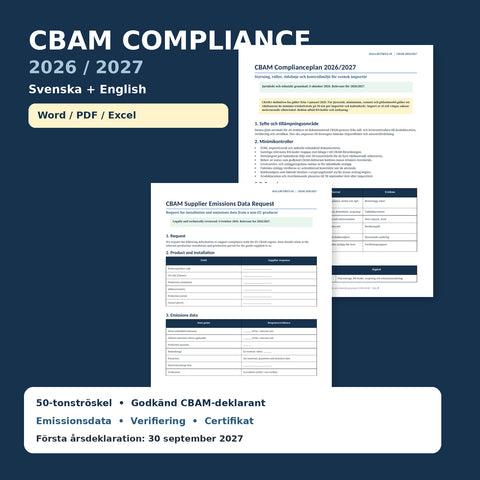
The Mallbutiken CBAM Compliance package includes Swedish and English work documents for scope, supplier data, emissions documentation, verification, certificates, annual declarations, and an Excel register with a dashboard.
See CBAM Compliance 2026/2027See more templates for EU compliance and product regulations
Sources and legal basis
- Regulation (EU) 2023/956 on CBAM
- Regulation (EU) 2025/2083 – simplification and amendment of CBAM
- European Commission – CBAM definitive regime
- Swedish Environmental Protection Agency – CBAM
Practical template pack: CBAM templates for aluminium profiles (CN 7604), emissions evidence and annual declarations. Check which goods, volumes and obligations apply to your importer role.