Balloon producer responsibility – latex, foil and the 31 March 2027 report
Who must register and report balloons in Sweden? A practical guide to latex, foil, producer status, units and weight for 31 March 2027.

A business that manufactures balloons in Sweden, brings balloons into Sweden or sells them directly from abroad to Swedish end users may be subject to producer responsibility. Ordinary single-use latex and foil balloons are generally covered. Producers must register before their first supply to the Swedish market and report the previous calendar year's number of balloons by 31 March each year. For 2026 volumes the deadline is 31 March 2027.
This guide is for importers, wholesalers, party shops, online retailers and manufacturers. It explains who the producer is, how to count individual balloons rather than packs and how to document the report. It does not replace filing through the Swedish Environmental Protection Agency's service.
Which balloons are covered?
Regulation (2021:999) defines balloons in this context as single-use plastic products. The Swedish Environmental Protection Agency explains that ordinary natural-rubber latex balloons are also covered because the latex is chemically modified during production, including vulcanisation. A 'natural' or 'biodegradable' label is not an automatic exemption. Examine the actual construction and intended use.
| Product | Typical assessment | Keep evidence of |
|---|---|---|
| Single-use vulcanised latex balloon | Generally covered | Material, item number, intended use, Swedish market event |
| Single-use foil/Mylar balloon | Generally covered | Construction, description, quantity |
| Reusable inflatable toy with return valve | May be excluded | Actual design for repeated use |
| Industrial weather or hot-air balloon | Generally outside this definition | Technical and industrial purpose |
Who is the producer: importer, manufacturer or reseller?
Under section 6, producers include businesses that bring balloons into Sweden, manufacture them in Sweden, or sell directly from another country to Swedish end users. Section 7 defines placing on the Swedish market as the first making available. A Swedish retailer buying from a Swedish importer is therefore not automatically the producer of the same balloons.
Example 1: Swedish party shop and wholesaler
A shop buys 400 packs from a Swedish wholesaler that imported the balloons. Check who first supplied them in Sweden and retain invoices and written supplier confirmation. Do not count the same first supply twice. Packaging responsibility may be a separate question.
Example 2: Swedish online shop imports from the EU
The shop buys directly from another EU country and resells in Sweden. It may be the person bringing the balloons into Sweden under section 6. Record receipt, quantities, SKU and any registration before the first Swedish supply.
Example 3: Foreign webshop selling to Swedish consumers
A seller outside Sweden shipping directly to Swedish end users may also be a producer. Assess any representative under sections 14–16; a Swedish warehouse is not a universal prerequisite.
What must be reported by 31 March 2027?
Section 18 requires the producer to report the number of balloons first supplied on the Swedish market during the previous calendar year by 31 March. The statute requires weight information upon the Agency's request. The Agency's current reporting guidance refers to both number and weight. Prepare both, but distinguish the statutory wording from the service's practical requirements.
Illustration, not an actual filing: 120 packs × 20 balloons = 2,400 individual balloons. At a verified 2.5 grams per balloon, this equals 6 kg. Retain proof of balloons per pack and individual weight; do not substitute an unverified estimate.
Reconcile Swedish first supplies against purchase records, deliveries, returns and duplicates. Report only volumes attributable to your producer role. Use the Agency's actual online service and retain its confirmation.
Registration, information, internal controls and fees
Under section 17 producers register before first placing on the Swedish market. Section 12 requires accessible information about reducing litter, for instance on a website. Section 20 requires internal controls for reported data. Littering fees are governed separately by Regulation (2021:1002); verify current fee notices.
Practical sequence: determine producer → classify each model → retain quantities and weight evidence → record Swedish market events → reconcile duplicates → confirm registration and information → submit and archive official acknowledgement.
Five frequent reporting mistakes
- Counting packs rather than individual balloons.
- Treating all natural latex as exempt.
- Counting the same first supply for both importer and reseller.
- Using an unsupported estimated weight or including packaging.
- Treating a spreadsheet as a substitute for the authority's registration or report.
Questions and answers
Are natural latex balloons covered?
Ordinary single-use natural-rubber latex balloons are generally covered because the material is chemically modified, including by vulcanisation.
Are foil or Mylar balloons exempt?
Typically no, when intended for one-time private use. Products genuinely designed for repeated use require separate assessment.
Does the 31 March deadline apply to small shops?
It applies to producers irrespective of size. A Swedish retailer buying only from a Swedish importer is not automatically the producer of the same balloons.
Must I report weight?
Section 18 requires weight upon request. The Agency's current reporting guidance mentions both number and weight, so prepare both.
Is producer responsibility new in 2027?
No. The rules already apply. 31 March 2027 is the ordinary reporting deadline for 2026 balloons.
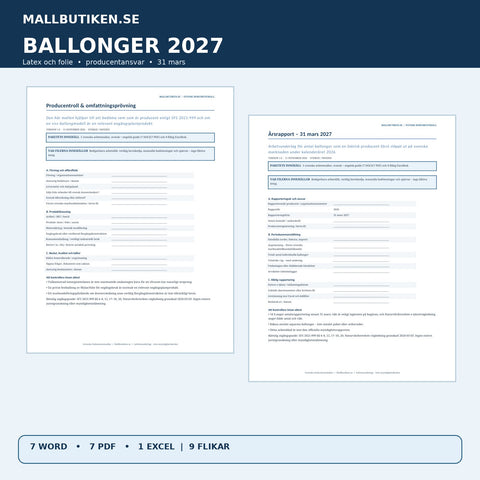
Related document package: Practical templates for producer reporting and internal checks.
Legal sources and verification
- Swedish Regulation (2021:999), §§ 6–8, 12, 17–20, amended through 2026:696
- Swedish Environmental Protection Agency – Producer responsibility for balloons (reviewed 3 March 2026)
Editorial legal source check: 12 November 2026. General information about Swedish law, not individual legal advice.