BPA in kitchenware – DoC, stock sales and EU deadlines 2026–2029
When can BPA-containing kitchenware first enter the EU market, and how long can existing stock be sold? Corrected Regulation 2026/250, declarations of compliance, supplier records and stock deadlines.

Does your business hold kitchen utensils, reusable containers or professional food-production equipment that may contain bisphenol A (BPA)? Regulation (EU) 2024/3190 is not solved by a generic 'BPA-free' statement. First determine the actual food-contact material, product type and any applicable derogation. Then distinguish the first placing on the Union market from later distribution of a previously placed batch. The correction in Regulation (EU) 2026/250 provides different end dates for ordinary reusable food-contact articles and certain professional food-production equipment.
Which food-contact materials are covered by the EU BPA ban?
The Regulation entered into force on 20 January 2025 and generally bans BPA and certain hazardous bisphenols in specified food-contact materials: adhesives, rubbers, ion-exchange resins, plastics, printing inks, silicones, varnishes and coatings. Limited derogations are provided, including Annex II. Not every legacy kitchen item must automatically be destroyed, and paper or cardboard in isolation is not necessarily covered by the same material-specific rule. Assess material, intended use, any permitted application and credible supporting records.
2026–2029 dates: first placement versus later stock sales
Regulation 2026/250 corrected Article 12(3) so that the later 2029 date does not apply indiscriminately to all reusable products. For ordinary reusable articles, the deadline for first placing on the EU market has already passed. A business must verify that the batch was first placed on the market within the applicable transitional deadline, not simply that it was purchased earlier.
| Article category | First placing on the EU market under transitional rules | Last continued marketing under corrected Article 12 |
|---|---|---|
| Ordinary reusable covered BPA food-contact article, including relevant kitchenware | 20 July 2026, Article 12(1) | 20 July 2027, if first placed on time under Article 12(1) |
| Certain reusable professional food-production equipment falling within the specific exception | 20 January 2028, Article 12(2) | 20 January 2029, if first placed pursuant to that exception |
| Single-use food-contact products and packaging | Separate Article 11 periods: generally 20 July 2026, with specified products permitted until 20 January 2028 | Different filling/sealing and sale-of-packaged-food provisions; do not apply reusable-product dates |
How can a batch's first EU market placement be evidenced?
An order date or import invoice is not always proof of when that particular article was first placed on the Union market. Identify the economic operator, the documented first supply in the EU and the correct product revision and batch. Later resale by a wholesaler is a separate event; evidence must match the particular goods and not merely a broad product series.
| Evidence to collect | What it should establish | When to hold stock |
|---|---|---|
| SKU, material revision and batch | Product identity, supplier, relevant plastics, coatings or silicone components | When a new variant is mixed with an earlier batch |
| First EU market placement | Traceable date and original EU operator for the actual goods | When eligible first placement cannot be evidenced |
| Product classification and intended use | Ordinary reusable item, genuinely professional food-production equipment, or single-use product | When all business-to-business sales are misclassified as professional production equipment |
| Supplier declaration of compliance and supporting records | Issuer, relevant article identity, date, covered regulation and any permitted derogation | When a required DoC is absent or addresses a different version |
| Continued distribution deadline | Applicable stop date and stock-release decision for each relevant batch | After 20 July 2027 for ordinary reusable articles or 20 January 2029 for the specific professional exception |
Declarations of compliance under Article 8 and Annex III
Article 8 requires a written Declaration of Compliance (DoC) for the covered materials and articles that have not yet contacted food throughout relevant marketing stages, except retail. Annex III specifies required details, including the responsible issuer and identity of the intermediate material or final article covered. Regulation 2026/250 corrected the wording regarding this identity. Request a version-specific DoC and supporting documents. A DoC is not CE marking, an authority certificate or a laboratory analysis; a laboratory report alone does not replace a required DoC.
Three situations for importers and wholesalers
Ordinary reusable food container already in Swedish inventory
A covered reusable BPA article was demonstrably first placed on the EU market by 20 July 2026. If Article 12(1) genuinely applies, continued distribution may be possible up to 20 July 2027. Keep the original placing evidence, correct batch and release lock. A warehouse location in November 2026 alone proves nothing.
Professional machinery in a food-production facility
A reusable article genuinely used as professional food-production equipment may qualify for first placement by 20 January 2028 and continued marketing until 20 January 2029. Merely selling to a restaurant or company is not enough: document the actual function and applicability of Article 12(2).
Supplier changes a coating or plastic composition
A new batch uses a revised material. The old DoC, test record or first-placement date for another version may not cover it. Request updated supplier documents and assess the bisphenol status before releasing the batch.
Seven steps towards a documented stock decision
- Inventory SKUs, food-contact purpose, material groups, product revisions and batches.
- Verify whether Regulation 2024/3190 covers the particular material and any Annex II derogation.
- Separate reusable kitchenware, professional food-production equipment and single-use packaging.
- Document genuine first EU placement and the separate final deadline for continued stock sales.
- Check Article 8/Annex III DoC, matching article identity and relevant supporting evidence.
- Apply a responsible person's recorded release or stock hold; do not assume a document proves compliance by itself.
- Reassess if the material, supplier, batch, legal provision or technical documentation changes.
Frequently asked questions about BPA and kitchenware
Are all old kitchen utensils banned from sale after July 2026?
No. First establish whether the item and material are covered. Some correctly first-placed reusable articles have a separate deadline for continued distribution, while professional food-production equipment may fall under another defined rule.
Does 20 January 2029 apply to every business customer's kitchenware?
No. It concerns the specifically defined professional food-production equipment under Article 12(2)–(3). Business-to-business sale alone does not establish eligibility.
Does a wholesaler need a DoC?
Article 8 requires a written declaration for relevant materials and articles through the covered distribution stages other than retail. Check the actual product and Annex III.
Is a supplier's 'BPA-free' claim sufficient?
Not alone. Check the relevant material, applicable provisions, product identity, DoC and supporting evidence. An unverified marketing label is not compliance proof.
Do the same dates apply to single-use packaging?
No. Article 11 has its own categories and transitional provisions, including specified 2028 exceptions and rules on filling and sealing.
Optional DoC and stock-control templates
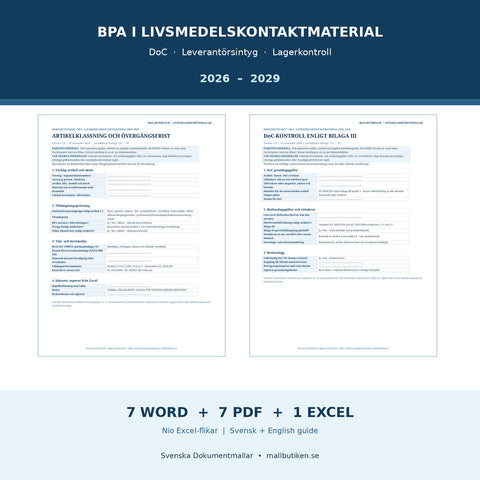
BPA in kitchenware 2026/2029 – DoC, supplier certificates and stock checks in Word/PDF/Excel – This optional template pack helps document genuine article, batch and supplier data. It does not provide laboratory testing, legal certification or automatic stock approval. The guide is usable without a purchase.
Official sources and review date
- Consolidated Regulation (EU) 2024/3190
- Correction (EU) 2026/250
- Swedish National Food Agency – EU 2024/3190
- European Commission implementation guidance C/2025/6721
- Food contact framework (EC) 1935/2004
- European Commission food-contact legislation
Editorial legal check: 12 November 2026. General information, not product-specific laboratory analysis, independent lawyer approval, an authority decision or permission to sell any particular batch.