
Record of Processing Activities under GDPR Article 30 – how to build a RoPA
Guide to the Record of Processing Activities (RoPA) under GDPR Article 30: content, responsibilities, exemptions, and how the record is used in practical data protection work.

Short answer: A record of processing activities, or RoPA, is the organization's structured register of personal data processing. GDPR Article 30 specifies the information that must be documented for controllers and processors. The register also serves as a hub for other data protection work.
An internal GDPR Article 30 processing register does not replace the privacy information people must receive under Articles 13–14. Websites must also assess cookie requirements separately. See our guide to privacy notices, cookie policies and transparency for the distinction.
What does RoPA mean?
RoPA stands for Record of Processing Activities. In Swedish, the terms registerförteckning (record of processing) or register över behandlingsaktiviteter (record of processing activities) are often used. The document should describe how and why personal data is processed and make it possible to quickly understand the organization's data landscape.
What should a processing activity contain?
For a controller, the documentation should include, among other things, purposes, categories of data subjects and personal data, recipients, any transfers to third countries, planned time limits for erasure, and a general description of security measures where possible.
Why is a list of IT systems not enough?
A system can contain multiple processing activities with different purposes and legal bases. Furthermore, the same processing can occur in several systems. It is therefore often better to structure the register by business processes or clear processing activities.
The exception for organizations with fewer than 250 employees
This is not a general exemption. The documentation requirement may still apply, for example, when the processing is not occasional, could result in a risk, or involves special categories of personal data or data relating to criminal convictions. Many smaller companies therefore still need to have a register in practice.
Link RoPA to other GDPR documentation
- legal basis and balancing of interests
- data processor agreements
- DPIA screening and impact assessment
- retention plan and storage periods
- third-country transfers and SCCs
- information security and access rights
- management of data subject rights
A practical approach
- inventory processes and systems
- identify processing activities
- appoint process owners
- add legal basis, recipients, and storage
- flag activities requiring a DPIA or special review
- establish a routine for updates when changes occur
Common quality issues
- entries that are too broad, such as "HR" or "marketing" without a real description
- missing storage periods
- old vendors remaining after contracts have ended
- third-country transfers are not mapped
- the register is only updated before an audit
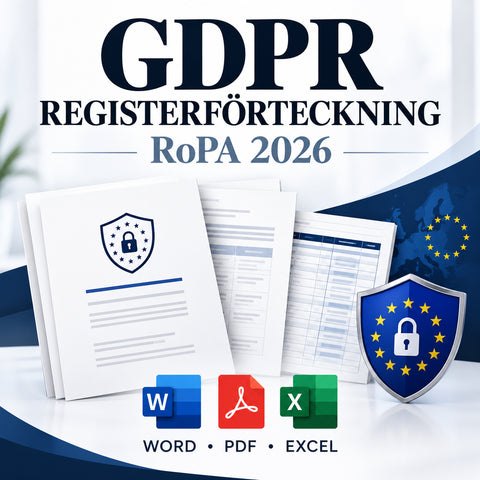
See the Template Store's RoPA package in Word, PDF, and Excel.
RoPA versus DPIA, legitimate-interest assessments and access requests
An Article 30 RoPA documents the organisation's processing activities. It does not replace risk assessments, a lawful-basis assessment, handling an individual's access request or privacy notices.
- High-risk processing: DPIA (data protection impact assessment) template — Article 35 may require a DPIA where processing is likely to result in high risk, not automatically for every RoPA entry.
- Legitimate interests: legitimate interests assessment (LIA) template — use only where legitimate interests under Article 6(1)(f) is an appropriate legal basis.
- Individual access request: data subject access and rights request templates — a personal Article 15 access response is not the same as the internal Article 30 RoPA.
- External transparency: privacy notice and cookie policy templates — Articles 13–14 information and applicable cookie rules need separate assessment.
Templates support documentation but do not establish legal compliance without case-specific checks.
FAQ
Must the record of processing activities be sent to the IMY (Swedish Authority for Privacy Protection)?
It must be made available to the supervisory authority upon request. It is therefore important that it is up to date and understandable.
Does every system need its own row?
Not necessarily. Start from processing activities and choose a structure that clearly shows the purposes, data, and responsibilities.
Who should own the register?
The data protection function can coordinate the work, but business managers need to contribute with accurate information about the processes for which they are responsible.
This article provides general information and does not replace legal advice.
Templates in this article


Explore the topic
 Business guides – contracts, HR, AI & compliance
Privacy policy and cookie policy – what must a website provide information about?
Guide to privacy policy and cookie policy: GDPR articles 13–14, cookie information, consent, withdrawal, third-party cookies, and practical documen...


