

Svenska Dokumentmallar
Business Continuity Plan + BIA Template 2026 – Word/PDF/Excel
Business Continuity Plan + BIA Template 2026 – Word/PDF/Excel
 Downloading the template is available immediately after purchase. Our document templates are always delivered in customizable formats.
 If you are unsure which template is appropriate or how you should complete it, please see the relevant information under the 'Legal Information' tab in our main menu.
 Our templates are designed in accordance with current legislation and practice in each area to ensure that the documents you create are legally correct.


Couldn't load pickup availability
Continuity Plan + BIA 2026 – Complete Template Package for Business Continuity
A serious business disruption does not have to start with a catastrophe. It can be enough for a business-critical IT system to go down, a cloud service to become inaccessible, a supplier to fail to deliver, electricity or the internet to disappear, key personnel to be absent, or for premises to be unusable. This product helps Swedish companies and organizations decide in advance what must function, how quickly operations need to be restored, and which contingency procedures should be used.
The package combines a professional continuity plan, a separate BIA – Business Impact Analysis, an advanced Excel workbook for multiple processes, and a card for the first 60 minutes of a serious disruption.
You receive a total of 18 designed A4 pages in Word/PDF plus an editable Excel workbook with registers, dependencies, action plans, automatic calculations, and a dashboard.
Included in this package
- Continuity_Plan_and_BIA_2026.docx – editable main template
- Continuity_Plan_and_BIA_2026.pdf – finished PDF version
- BIA_analysis_template_2026.docx – separate analysis per process or service
- BIA_analysis_template_2026.pdf
- BIA_workbook_2026.xlsx – Excel register with dashboard
- Continuity_card_first_60_minutes_2026.docx
- Continuity_card_first_60_minutes_2026.pdf
- Instruction file with recommended workflow and sources
The Continuity Plan – From Prioritization to Recovery
The main template is structured for practical use before, during, and after a disruption. It includes, among other things:
- scope, plan owner, approval, and review
- critical products, services, processes, and activities
- Business Impact Analysis and consequences over time
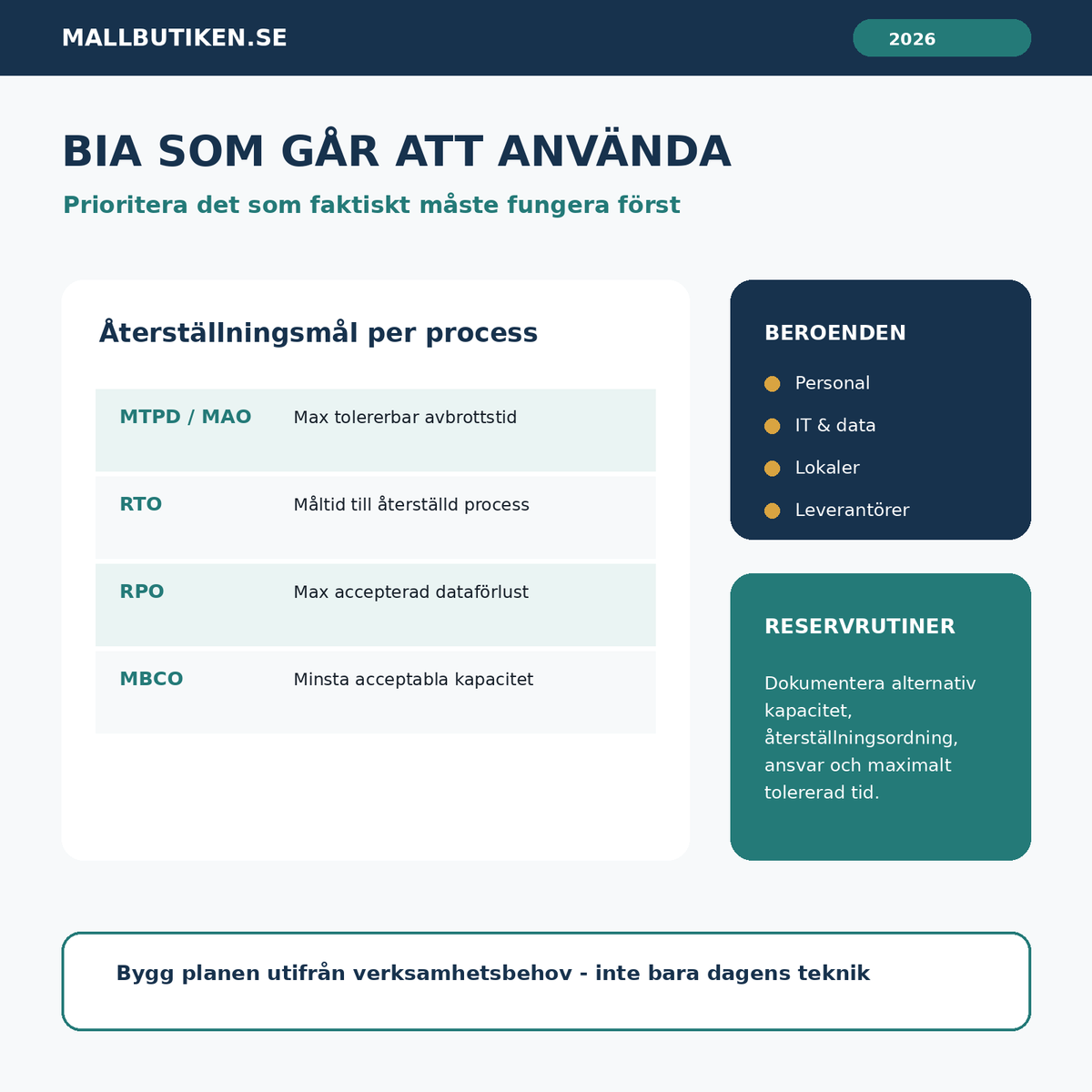
- MTPD/MAO – Maximum Tolerable Period of Disruption
- RTO – Recovery Time Objective
- RPO – Recovery Point Objective (accepted data loss expressed in time)
- MBCO – Minimum Business Continuity Objective
- critical dependencies and single points of failure
- personnel, competence, IT systems, information, premises, and equipment
- electricity, telecommunications, and external suppliers
- contingency procedures and alternative working methods
- activation criteria and escalation levels
- roles, mandates, deputies, and contact channels
- checklist for the first 60 minutes
- status report and decision logic
- IT, backup, restore, and technical recovery
- critical suppliers, SLAs, and alternatives
- controlled return to normal operations
- exercises, testing, improvement plans, and change logs
BIA – Business Impact Analysis
The BIA helps the organization prioritize based on business consequences rather than gut feeling. The template assesses how a disruption evolves over time within areas such as finance, customers/delivery, contracts and legal, security, information/cyber, reputation, and impact on other services.
For each process, the organization can document MTPD/MAO, RTO, RPO, and MBCO, critical resources, contingency solutions, and gaps between business needs and current capabilities.
Excel Workbook with Dashboard
The included XLSX file makes the package usable even for larger organizations with many processes. The workbook contains:
- Overview with KPIs and prioritization charts
- BIA register for up to 50 processes
- automatically calculated maximum consequence
- automatic highlighting of critical processes
- dropdowns for priority and status
- fields for MTPD/MAO, RTO, RPO, and MBCO
- separate register for critical dependencies
- register for action plans, owners, deadlines, and verification
- conditional formatting for criticality and open actions
Three example processes are included to show how the workbook is used and can easily be replaced with your own data.
Separate Continuity Card – First 60 Minutes
In the event of an actual disruption, something much shorter than the entire continuity plan is often needed. Therefore, a separate two-page continuity card is included, which can be printed or saved offline. The card focuses on:
- securing people and stopping immediate damage
- verifying the disruption and starting a log
- assessing critical impact
- comparing downtime against RTO/MTPD
- activating contingency procedures
- creating a situational picture
- contacting the right people
- checking criteria for recovery
NIS2 and the Cybersecurity Act
Continuity management is relevant for many organizations even without an explicit legal requirement. For operators covered by the Cybersecurity Act (2025:1506), continuity management and crisis management are explicitly part of the security measures to be managed according to Chapter 2, Section 3. The package can therefore be used as a practical basis for the organization's work, but it is not in itself a guarantee of full NIS2 or Cybersecurity Act compliance.
Method Support and Legal Status Verified 2026
Version 1.0 has its legal status and central method references verified on September 27, 2026. The package has been designed with consideration for, among others:
- Cybersecurity Act (2025:1506)
- NIS2 Directive (EU) 2022/2555
- MSB's Swedish support material for continuity management
- ISO 22301:2019 – Business Continuity Management Systems
- ISO/TS 22317:2021 – Guidance for Business Impact Analysis
The template does not reproduce protected standard text. ISO 22301:2019 is, at the time of verification, still the published edition, while a new edition is under development.
Who is the template for?
The package is suitable for limited companies, e-commerce companies, industrial companies, SaaS and IT companies, consulting firms, logistics operations, agencies, businesses with critical suppliers, and organizations that want to structure their preparedness for downtime, cyber incidents, or other business disruptions.
Examples of scenarios supported by the template
- IT or cyber interruptions
- data loss or the need for restoration from backup
- cloud service or identity platform being down
- power or telecommunication interruptions
- premises that cannot be used
- extensive personnel shortages
- failure of a critical supplier
- production equipment breakdown
- transport or logistics disruptions
Important regarding customization
Continuity planning must reflect actual operations. RTO, RPO, MTPD/MAO, MBCO, contingency procedures, and supplier requirements must therefore be decided based on the organization's own processes, contracts, risks, and technical capabilities. Sector-specific rules, security protection, DORA, specific regulatory requirements, work environment requirements, or customer contracts may entail additional requirements.
The template is a professional working and governance basis but does not replace individual legal, regulatory, or technical advice when the business has specific requirements.
Digital Delivery
The product is delivered digitally in Word (DOCX), PDF, and Excel (XLSX). No physical product is sent.
Frequently Asked Questions
What is the difference between BIA and a continuity plan?
The BIA analyzes the consequences of interruptions and establishes priorities and recovery requirements. The continuity plan describes how the organization should act to maintain or restore priority operations.
What do RTO and RPO mean?
RTO is the target for how quickly a process or resource should be restored. RPO indicates the maximum amount of data loss expressed in time that is accepted.
Can the template be used for NIS2?
Yes, as a working document for continuity and crisis management. However, the organization must assess all requirements that apply to its own operations; the package is not a complete NIS2 certification or a guarantee of compliance.
Can the Excel file be used for multiple processes?
Yes. The BIA register is prepared for up to 50 processes and can be expanded if necessary.