

Svenska Dokumentmallar
UGC Creator Agreement Template 2026 – Word/PDF | Swedish Law
UGC Creator Agreement Template 2026 – Word/PDF | Swedish Law
 Downloading the template is available immediately after purchase. Our document templates are always delivered in customizable formats.
 If you are unsure which template is appropriate or how you should complete it, please see the relevant information under the 'Legal Information' tab in our main menu.
 Our templates are designed in accordance with current legislation and practice in each area to ensure that the documents you create are legally correct.


Couldn't load pickup availability
UGC Creator Agreement 2026 – professional template for companies, agencies, and content creators
UGC, creator content, and short-form video are used today in everything from organic social media to e-commerce, Meta Ads, TikTok Ads, Spark Ads, Partnership Ads, display, landing pages, and other paid campaigns. A common problem is that the parties agree on what is to be filmed – but not on who may use the material, for how long, in which channels, whether raw material is included, or how many revision rounds are covered.
This professional UGC Creator Agreement template is designed for Swedish companies, agencies, and creators who want to regulate both the content production itself and the commercial usage rights in one and the same agreement. The template is delivered in editable Word format (DOCX) and as a PDF.
The document comprises 10 professionally designed A4 pages, 28 contract areas, and five practical appendices.
What is the difference between a UGC agreement and an influencer agreement?
In a traditional influencer agreement, a large part of the value lies in the influencer publishing the advertisement on their own channels and reaching their own audience. A UGC assignment often works differently: the creator produces, for example, a product demo, testimonial, hook, voice-over, or short-form video that the company itself publishes or uses in advertisements.
The creator does not therefore need to have a large audience and does not even have to publish the material themselves. Consequently, questions regarding license, paid media, editing rights, raw material, name/image/voice, and revision rounds become particularly important.
The Main Agreement – 28 contract areas
The template regulates, among other things:
- parties, contact persons, and the purpose of the assignment
- definition of UGC, final material, and raw material
- independent contractor status
- scope of the assignment and deliverables
- creative brief and script level
- hooks, CTA, formats, and technical requirements
- deadlines and participation
- review and acceptance
- revision rounds
- reshoots and errors
- copyright and rights to the material
- scope, duration, and territory of the license
- raw material and project files
- editing, cutting, and derivatives
- name, image, and voice in advertising
- AI, synthetic media, digital avatar, and voice cloning
- paid media, whitelisting, and creator licensing
- Partnership Ads and TikTok Spark Ads
- music and other third-party material
- participating persons, locations, and property
- marketing rights and product claims
- personal data and GDPR
- confidentiality and embargo
- exclusivity and competing assignments
- compensation, invoicing, and products
- travel, expenses, and props
- liability and rectification
- contract period, cancellation, termination, and dispute
Appendix 1 – UGC brief and delivery specification
To reduce the risk of misunderstandings, the agreement includes a separate production brief. There, the parties can specify the project, target audience, main message, CTA, approved product claims, tone, visual requirements, script level, delivery channel, and deadlines.
There is also a detailed delivery table where, for example, video format, number of versions, length, aspect ratio, raw files, and comments can be documented. Separate fields are provided for hooks, CTA variants, voice-over, versions without text overlay, subtitles, thumbnails, and B-roll.
Appendix 2 – Revision rounds, review and acceptance
A common conflict in creator projects is what is actually included in a revision round. The template therefore distinguishes between normal revision within the original brief and new scope.
Examples of revision could be correcting text, swapping between already recorded takes, or shortening a video. A new target audience, a completely new script, a different product, a new recording location, or an entirely new concept can instead be treated as additional work.
The appendix contains fields for the number of revision rounds, feedback deadline, delivery time for the revised version, acceptance model, extra revision costs, and rules for reshoots.
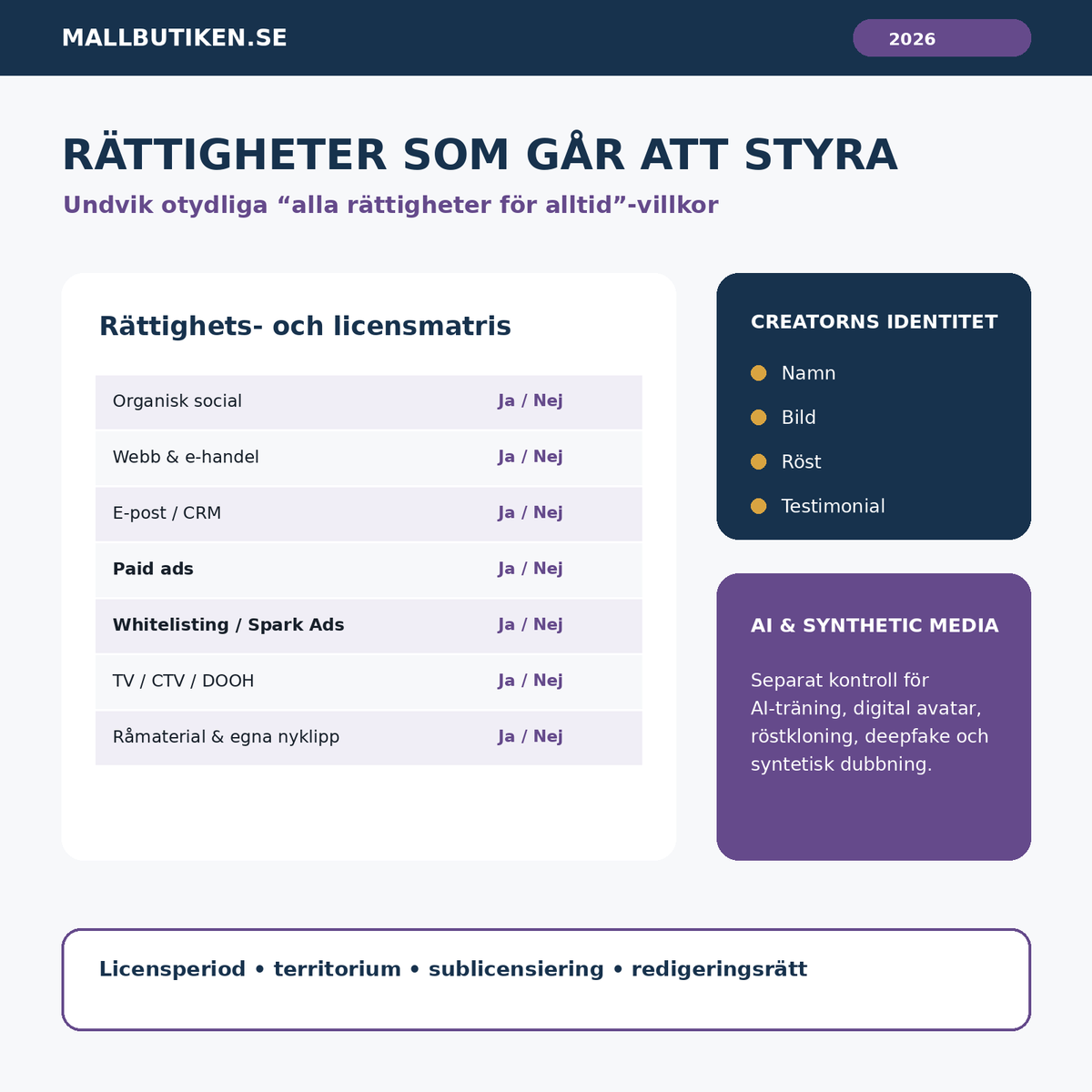
Appendix 3 – Rights and license matrix
This is one of the most important parts of the agreement. The company can separately choose whether the material may be used for:
- organic publishing in own social media
- website, e-commerce, and landing pages
- email, CRM, and newsletters
- in-store, POS material, events, and digital screens
- paid social, display, and video ads
- whitelisting, Partnership Ads, and Spark Ads
- marketplaces and retailers
- TV, CTV, cinema, and digital out-of-home
- raw material and the company's own re-edits
For each use, the parties can specify the license period, territory, channel, and special conditions. There is also separate regulation of sub-licensing, editing rights, and what should happen when the license period expires.
Paid ads, whitelisting, and creator licensing
The right to publish a video organically is not the same as the right to use it in paid advertisements. The template therefore distinguishes clearly between organic use and paid media.
If the company wants to use the creator's identity or account through, for example, Meta Partnership Ads, TikTok Spark Ads, whitelisting, or other creator licensing, the period, authorization, ad account, and separate compensation can be specified. The agreement assumes that passwords should never be shared; the platforms' own authorization features should be used.
Name, image, and voice
When the creator themselves is seen or heard in the material, there is a separate clause and license section for commercial use of name, image, voice, and other personal characteristics. This allows the parties to determine exactly in which media and for how long the creator's identity may be used.
AI, deepfake, and voice cloning
The template includes specific, modern protection for AI and synthetic media use. Unless otherwise expressly agreed, the company's rights may not automatically be used to train models, create digital avatars, voice clones, deepfakes, synthetic dubbing, or new AI-generated material that makes it appear as though the creator participated.
If such use is to be permitted, there is support for agreeing separately on purpose, technology, period, territory, approval, and compensation.
Music and third-party rights
Music that works for a regular organic video does not necessarily need to be licensed for a paid advertisement. Therefore, the agreement contains special conditions regarding music, stock material, graphics, fonts, trademarks, artwork, and other third-party material.
The template also regulates liability for participating persons, private environments, and other rights that may be required for commercial use.
Appendix 4 – Compensation and rights costs
Compensation can be divided between the production itself and the commercial license. The appendix contains fields for:
- production fee
- rights compensation
- paid media add-on
- whitelisting/creator licensing
- raw material
- extra hooks and versions
- extra revision rounds
- new recording after changed brief
- products kept or borrowed
- travel and expenses
- payment terms
- tax classification (F-tax, A-tax, or self-employment)
Appendix 5 – Delivery and rights checklist
The final appendix serves as a practical final check before the company begins using the material. It checks, among other things, delivery format, revision rounds, raw material, music licenses, participants, license period, paid ads, name/image/voice, AI use, product claims, advertising identification, and personal data.
Legal status checked 2026
Version 1.0 has had its legal status checked on September 27, 2026, and has been designed with consideration given to, among other things:
- The Swedish Copyright Act (1960:729)
- The Act on Names and Pictures in Advertising (1978:800)
- The Marketing Act (2008:486)
- The General Data Protection Regulation (EU) 2016/679 (GDPR)
- The Swedish Authority for Privacy Protection (IMY) guidelines on publishing images, film, and sound
- The Swedish Consumer Agency's current work and guidance on influencer marketing and hidden advertising
- The Swedish Tax Agency's guidance on compensation to influencers and creators
Who is the UGC agreement for?
The template is particularly suitable for e-commerce companies, brands, advertising agencies, performance marketing agencies, social media agencies, startups, content creators, UGC creators, and other companies ordering commercial content for digital marketing.
You receive
- UGC_Creator_Agreement_2026.docx – fully editable Word template
- UGC_Creator_Agreement_2026.pdf – ready-to-use PDF version
- 10 professionally designed A4 pages
- 28 contract areas
- 5 practical appendices
- UGC brief and delivery specification
- revision and acceptance model
- rights and license matrix
- compensation appendix
- delivery and rights checklist
- signature section
- legal checklist and central legal sources
Important regarding customization
UGC projects can differ greatly depending on the product, channel, media budget, target audience, whether the creator participates themselves, and what rights the company requires. The template must therefore be adapted to the specific assignment. Minors as creators, international campaigns, regulated product categories, extensive TV/DOOH buys, or complex personal data processing may require additional terms.
The template is a professional contractual basis but does not replace individual legal advice in particularly complex or high-risk situations.
Digital delivery
The product is delivered digitally in Word and PDF formats. No physical product is sent.
Frequently asked questions
Does the creator have to publish the material themselves?
No. The agreement is specifically designed for UGC where the company can use the material in its own channels or advertisements without the creator publishing it themselves.
Are paid ads and Spark Ads included automatically?
No. Appendix 3 makes it possible to choose exactly which uses are to be included. Paid advertising and creator licensing are regulated separately.
Can the company get raw material?
Yes, if the parties choose for raw material to be included. The agreement has specific fields for raw files, B-roll, and the right to create own re-edits.
Can we agree on two revision rounds?
Yes. Appendix 2 allows the parties to specify the number of included revision rounds, response times, and what extra revisions or new recordings cost.
Can the company use the creator's face or voice in AI material?
Not under the standard terms. Such use requires a separate express agreement with defined purpose, scope, and compensation.