

Svenska Dokumentmallar
Work Environment Plan 2026/2027 – Construction & Civil Engineering AFS 2023:3 Word/PDF
Work Environment Plan 2026/2027 – Construction & Civil Engineering AFS 2023:3 Word/PDF
 Downloading the template is available immediately after purchase. Our document templates are always delivered in customizable formats.
 If you are unsure which template is appropriate or how you should complete it, please see the relevant information under the 'Legal Information' tab in our main menu.
 Our templates are designed in accordance with current legislation and practice in each area to ensure that the documents you create are legally correct.


Couldn't load pickup availability
Work Environment Plan 2026/2027 – Construction & Civil Engineering according to AFS 2023:3
This is a complete and professional template package for a work environment plan for building and civil engineering work. The package is designed for developers, Bas-P (Work Environment Coordinator Planning), Bas-U (Work Environment Coordinator Execution), project management, and others who need to structure a construction project's work environment management according to AFS 2023:3 – Design and construction work environment coordination – basic obligations.
The template package is legally reviewed against current Swedish regulations as of October 4, 2026, and developed for practical use during 2026/2027. The master template is project-specific and includes organization, work environment routines, order and safety rules, simultaneous operations, the 13 works with particular risks, contractor risk assignments, clearance before start, emergency procedures, revision log, advance notification, and handover from Bas-P to Bas-U.
Delivery: 2 documents in both Word (DOCX) and PDF – a total of 4 files and 23 A4 pages. The product is delivered digitally. No physical goods are sent.
This includes
- Work Environment Plan Construction & Civil Engineering 2026/2027 – 18 pages with project-specific forms, risk sheets, and control points.
- Detailed User Guide – 5 pages explaining when the plan is required, who is responsible for what, and how to fill in the template step-by-step.
- 13 separate risk sections for work with particular risks according to Chapter 11, Section 12 of AFS 2023:3.
- Handover checklist Bas-P → Bas-U.
- Contractor register and clearance before start.
- Revision log and final check before construction start.
When is a work environment plan required?
A written work environment plan must be drawn up according to AFS 2023:3 if any of the works with particular risks in Chapter 11, Section 12 need to be performed in the construction project, or if the scope of the project requires advance notification.
Advance notification is required when:
- the work is expected to last longer than 30 working days and more than 20 people are employed simultaneously at any time, or
- the total number of person-days is expected to be more than 500.
This means that even a small construction project may require a work environment plan if a single work with a particular risk is present.
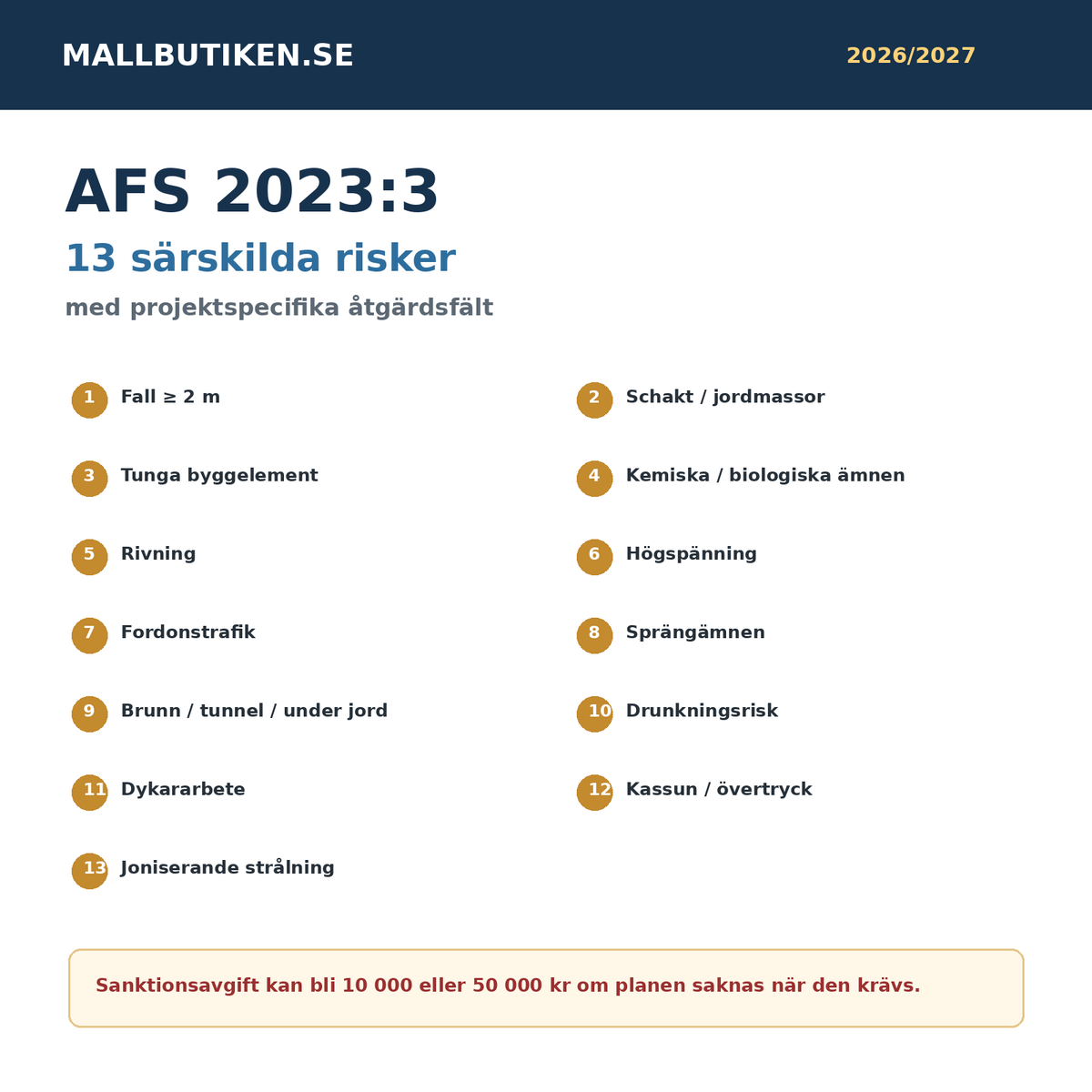
13 works with particular risks
The template contains a structured review of all works with particular risks according to AFS 2023:3:
- work with a risk of falling to a lower level when the height difference is two meters or more,
- work with a risk of being buried under earth masses or sinking into loose ground,
- launching, assembly, or disassembly of heavy building elements or formwork elements,
- work with chemical or biological substances involving particular danger or requirements for medical control,
- demolition of load-bearing structures or hazardous materials and substances,
- work near high-voltage lines,
- work at a site or area where vehicle traffic passes,
- work where explosives are used,
- work in wells and tunnels and civil engineering work underground,
- work with a risk of drowning,
- work underwater with diving equipment,
- work in a caisson under elevated air pressure,
- work near ionizing radiation where a controlled or protected area must be established.
Separate action sheets for every particular risk
It is not enough to simply tick a box that a risk exists. The work environment plan must describe the measures needed to manage the risk. Therefore, each particular risk has its own section with fields for:
- current work task and location,
- when the task occurs in the schedule,
- project-specific risk description,
- technical or organizational protective measure,
- safety device, equipment, or work method,
- competence and authorization requirements,
- cordoning off and coordination with other actors,
- work preparation and instructions,
- control before start,
- person responsible for the measure,
- follow-up and control method.
Fall risk, excavation, heavy building elements, and traffic
The most common construction work environment risks require concrete solutions. The template helps the user go from a general statement like "fall protection is used" to a project-specific decision on which safety device to use, how it is installed, who is responsible, and how the control should be carried out.
Similarly, there are fields for, for example, geotechnically justified slopes or support structures during excavation, stabilization and assembly sequence for heavy elements, as well as traffic arrangements, cordons, and separated flows where vehicle traffic passes the work area.
Organization for developer, Bas-P, and Bas-U
The work environment plan must describe how the work environment management is organized and conducted. The package therefore contains a clear organization section for, among other things:
- developer and the developer's representative,
- any deputy developer,
- Bas-P and Bas-P administrator,
- Bas-U and Bas-U administrator,
- site management and work environment managers,
- safety representatives,
- persons with first aid/CPR competence,
- fire safety and evacuation.
Routines for work environment management
The template includes a specific routine matrix where the project can specify when, how often, and by whom various work environment tasks should be performed. Examples:
- work environment issues at design and construction meetings,
- follow-up and control of the work environment plan,
- safety induction before the first task,
- safety rounds,
- daily start-up meetings when necessary,
- work preparations,
- coordination between contractors,
- control of common safety devices,
- reporting of risk observations and incidents,
- first aid, crisis support, fire, and evacuation,
- change management when design or production planning changes.
Common order and safety rules
AFS 2023:3 requires the work environment plan to contain the common order and safety rules that must apply at the construction site. The master template therefore has a special section for the project's actual rules regarding, among other things:
- personal protective equipment,
- authorization and induction,
- fall protection, scaffolding, and lifts,
- lifting and crane work,
- excavation and ground work,
- electrical safety,
- order, cleaning, and waste,
- material reception and storage,
- pedestrian and vehicle paths,
- risk zones and cordoning off,
- flammable hot work,
- alcohol, drugs, smoking, and distraction.
Coordination with other operations
If construction work is performed at a place where other operations are ongoing simultaneously, the work environment plan must describe how the operations should be coordinated. This could, for example, be work in a factory in operation, a school, a care environment, residential buildings, shops, or at a site where another construction project is ongoing.
The template has fields for interfaces, information channels, cordoning off, separated personnel and vehicle flows, working hours, alarms, evacuation, and emergency routes.
Contractor risk tasks and Bas-U's clearance
Bas-U must provide clearance to contractors before they start working in the project for the first time. Before clearance, relevant risk tasks must be available and work environment risks must be managed or have planned measures.
The package therefore includes a contractor register with separate control fields for:
- risk tasks received,
- safety induction completed,
- clearance from Bas-U and date.
First aid, fire, evacuation, and crisis
The work environment plan contains a ready-made section for the emergency organization with fields for the construction site's address or coordinates, emergency services meeting point, assembly point, first aid equipment, defibrillator, fire equipment, CPR competence, crisis support, and emergency routes.
Incidents, accidents, and risk observations
There are both checklists and a register for risk observations, incidents, and accidents. The user can document the event, immediate action, responsible party, and follow-up.
The work environment plan must be updated
The work environment plan is a living document. When design, production planning, work method, organization, or other work-environment-relevant conditions change, the plan must be updated. Therefore, the template includes a revision log with version, date, reason, responsible party, and information on whom the change has been communicated to.
Structured handover from Bas-P to Bas-U
The handover must take place before the first construction or civil engineering work starts and must be structured. The package includes a special checklist to ensure that:
- the work environment plan has been reviewed,
- remaining serious risks are explained,
- selected and rejected solutions with work environment significance are discussed,
- schedule and simultaneous risky activities are aligned,
- continued design after construction start is handled,
- coordination with other operations is addressed,
- work environment documentation for future work is planned.
Advance notification – control and documentation
The master template contains a specific check for whether advance notification is required, as well as fields for date, responsible party, reference/diary number, and latest update. This complements the Swedish Work Environment Authority's own notification process and helps the project document that the check has been carried out.
Sanction fees for shortcomings
AFS 2023:3 contains sanction fees linked to the work environment plan. If the plan is required but not established before construction starts, the developer and/or Bas-P may be subject to a sanction fee. Bas-U may receive a corresponding fee if the plan is not available at the construction site when required.
The sanction fee is 50,000 SEK if the size of the project requires advance notification and 10,000 SEK if no such notification is required. The regulations contain an exemption from the sanction fee when the entire construction or civil engineering work lasts for no more than two consecutive days.
The work environment plan must be available and understood
From the start of construction, the work environment plan must be available at the construction site in paper format or digitally. Everyone working there should easily be able to access and understand the parts that affect them. At multilingual workplaces, relevant parts may therefore need to be available in Swedish, English, and additional languages.
Detailed User Guide included
The separate guide explains, among other things:
- when a work environment plan is required,
- the difference between developer, Bas-P, Bas-U, designer, and contractor,
- how the template is filled out in 12 practical steps,
- how the 13 particular risks should be handled,
- the difference between a work environment plan, risk assessment, and work preparation,
- when a general work environment plan can be used,
- requirements for accessibility and language,
- common mistakes that make the work environment plan too general or insufficient,
- final checklist before use.
Reviewed for 2026/2027
The legal review is dated October 4, 2026. The documents have been developed based on, among other things:
- the Work Environment Act (1977:1160),
- AFS 2023:3 – Design and construction work environment coordination – basic obligations,
- AFS 2023:13 – Risks in certain types of work, in relevant parts for building and civil engineering work.
AFS 2023:3 entered into force on January 1, 2025. The designation 2026/2027 means that the documents have been reviewed against the legal situation and authority information at the date of the review. In case of later rule changes, a new check must be performed.
Format and delivery
- Word (DOCX) – fully editable.
- PDF – print-ready reference format.
- 2 documents, 4 files, and 23 A4 pages.
- Digital delivery – no physical product is sent.
Frequently asked questions
Is this the same thing as SAM (Systematic Work Environment Management)?
No. A company's systematic work environment management and the project-specific work environment plan serve different functions. The work environment plan focuses on the construction project's coordination and project-specific risks.
Must a work environment plan exist for a small project?
Yes, if any work with a particular risk according to AFS 2023:3 occurs. The size of the project is therefore not the only determining factor.
Who draws up the plan?
The developer must ensure that the plan is drawn up when required. Bas-P must draw it up or have it drawn up during planning and design, and Bas-U takes over and keeps it updated during the construction phase.
Can the plan be digital?
Yes. From the start of construction, it must be available at the construction site in paper format or digitally.
Are all 13 particular risks included?
Yes. All 13 are present both in an overview and as separate project-specific action sections.
Important
The template is a professional general work foundation. It does not replace project-specific risk assessment, design, work preparation, the right competence, or construction work environment coordination. The document must always be adapted to the current construction project's size, complexity, work methods, and risk level.