Svenska Dokumentmallar
Renunciation of Inheritance & Disclaimer of Inheritance 2026/2027 – Children from a Previous Marriage, Estate Inventory & Guide Word/PDF
Renunciation of Inheritance & Disclaimer of Inheritance 2026/2027 – Children from a Previous Marriage, Estate Inventory & Guide Word/PDF
- File format
- DOCX, PDF
- Document language
- Swedish
- Number of files
- 6
Digital download. No physical product is shipped.
Couldn't load pickup availability
About this template
Renunciation of Inheritance & Disclaimer of Inheritance 2026/2027 – Complete Template Package
This is a complete document package for situations where an heir wishes to renounce or disclaim an inheritance, either before or after a death. The package is designed to clearly distinguish between several legal actions that are often confused: disclaimer of inheritance during the testator's lifetime, renunciation of inheritance after death, disclaimer of inheritance after death, specific renunciation by children from previous relationships in favor of the surviving spouse, and transfer of inheritance.
The template package is legally reviewed as of October 5, 2026, against the Swedish Inheritance Code (1958:637), amended up to SFS 2026:251, as well as the Swedish Tax Agency's current legal guidance for estate inventories and inheritance law.
Delivery: 6 documents in both Word (DOCX) and PDF – a total of 12 files and 15 A4 pages per format series.
Included in this package
- Renunciation of inheritance after death – 2 pages.
- Disclaimer of inheritance before death according to Chapter 17, Section 2 of the Inheritance Code – 2 pages.
- Disclaimer of inheritance after death – 2 pages.
- Renunciation by children from previous relationships according to Chapter 3, Section 9 of the Inheritance Code – 2 pages.
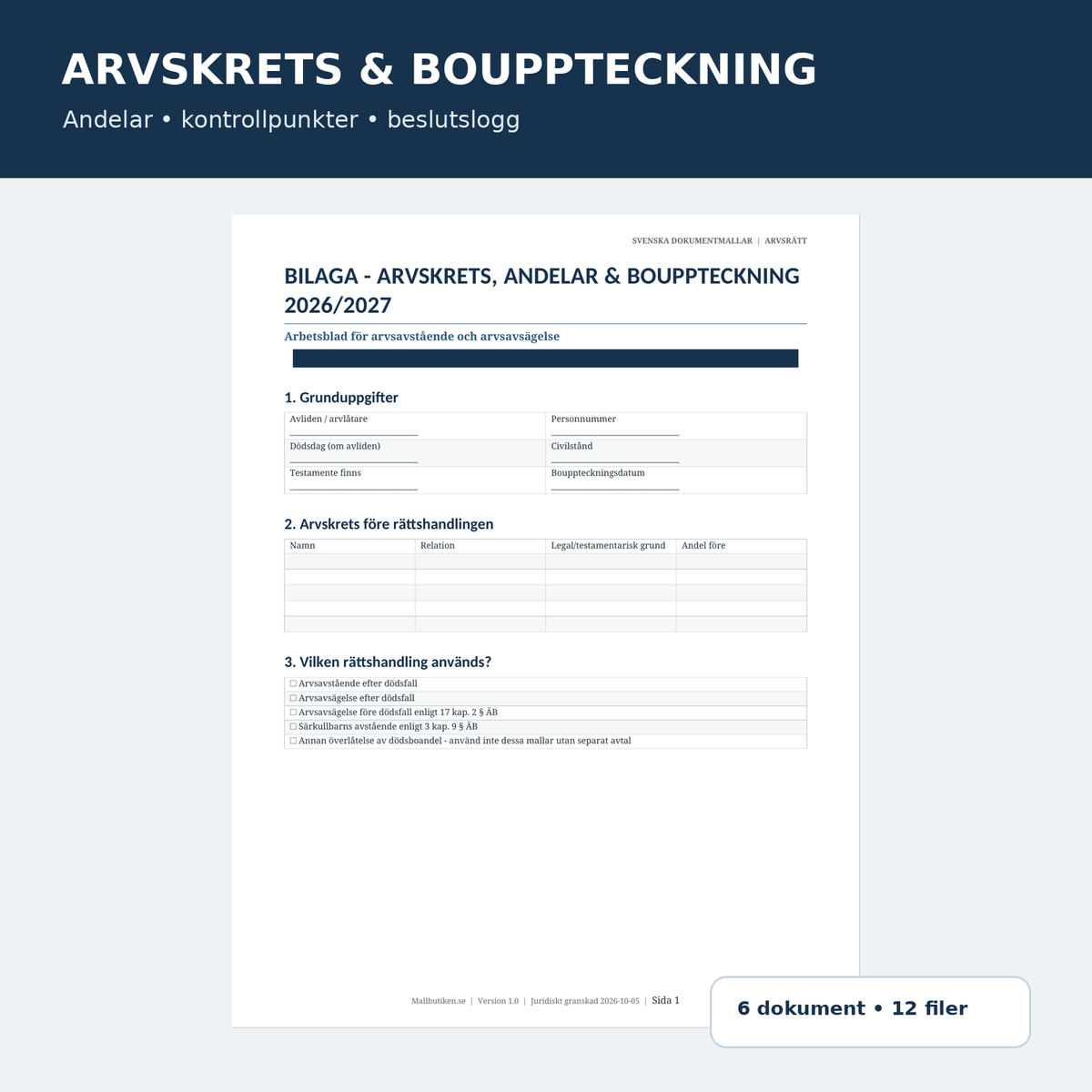
- Appendix – circle of heirs, shares, and estate inventory – 3 pages.
- Detailed user guide – 4 pages.
Why are several different templates needed?
The terms renunciation of inheritance, disclaimer of inheritance, and transfer of inheritance are sometimes used carelessly as if they were the same thing. They are not. The legal effect depends on when the action is taken, who would otherwise inherit, and whether a specific recipient is designated.
An incorrectly formulated document can, for example, have a different effect than intended on the circle of estate beneficiaries or be assessed as a transfer of inheritance instead of a pure renunciation of inheritance. The package is therefore divided into separate documents and contains clear check questions before signing.
Disclaimer of inheritance before death – Chapter 17, Section 2 of the Inheritance Code
An heir may, while the testator is still alive, renounce their future right to an inheritance in writing to the testator. This is regulated in Chapter 17, Section 2 of the Inheritance Code.
The template covers, among other things:
- full or partial disclaimer of inheritance,
- whether the disclaimer shall include the heir's descendants,
- a forced heir's statutory share,
- reasonable compensation,
- minors and guardianship,
- storage of the original document.
A forced heir’s statutory share is specifically protected
A forced heir who disclaims an inheritance before death generally retains their right to their statutory share. For the statutory share to also be included, it is required, among other things, that it has been renounced for reasonable compensation or that the specific family solution stated in Chapter 17, Section 2 of the Inheritance Code is met.
The package therefore does not imply that a parent and a child can freely agree to waive the statutory share without further ado.
Renunciation of inheritance after death
After a death, an heir can in some cases make an unconditional renunciation of inheritance. The Swedish Tax Agency's guidance indicates, among other things, that the renunciation must take place before the person renouncing has taken possession of the property and must be documented in writing in or together with the estate inventory.
Full or partial renunciation of inheritance
If an heir renounces their entire right, the person who steps in after the renunciation may become an estate beneficiary, while the renouncing party leaves the circle of beneficiaries. In the case of a partial renunciation, both the renouncing party and the person stepping in can become estate beneficiaries.
Therefore, the templates contain specific fields for the scope and an appendix where inheritance shares before and after the legal action can be documented.
Disclaimer of inheritance after death
The Swedish Tax Agency also uses the term disclaimer of inheritance for a situation where an heir after death leaves their right of inheritance without designating any recipient themselves. The share that would otherwise have fallen to the heir is then distributed among other heirs according to the order of inheritance or the will.
How such a disclaimer after death is to be made is not specifically regulated by law. Therefore, clear written documentation is important.
Renunciation by children from previous relationships in favor of the surviving spouse – Chapter 3, Section 9 of the Inheritance Code
Children from previous relationships normally have the right to receive their inheritance share immediately when the biological parent dies. However, the child can fully or partially renounce their immediate right of inheritance in favor of the surviving spouse.
When such a renunciation is made according to Chapter 3, Section 9 of the Inheritance Code, the child from a previous relationship receives secondary inheritance rights to a corresponding extent. The package therefore contains a separate template for this specific situation with fields for:
- deceased parent,
- surviving spouse,
- child from a previous relationship,
- full or partial inheritance share,
- calculation basis,
- secondary inheritance quota,
- estate inventory note.
Secondary inheritance is normally a quota part – not a fixed amount
When a child from a previous relationship renounces according to Chapter 3, Section 9, the secondary inheritance right should be carefully documented. Secondary inheritance is normally linked to a quota part of the surviving spouse's future estate and should not be treated as if the child automatically had an unchangeable monetary claim.
The estate inventory is affected
Renunciation and disclaimer of inheritance can change who is an estate beneficiary. This in turn affects who must be summoned to the estate inventory meeting and who must be noted in the estate inventory.
The Swedish Tax Agency states that documents affecting who is an estate beneficiary must be submitted together with the estate inventory. The package's appendix therefore contains a check of:
- circle of heirs before the legal action,
- circle of heirs after the legal action,
- who is to be summoned,
- which document is to be attached,
- any will,
- secondary inheritance.
When a renunciation can instead be a transfer of inheritance
If an heir attempts to direct an estate share to a person who does not have their own right of inheritance after the deceased, the legal action may be a transfer of inheritance instead of a pure renunciation. The same may apply if a specific asset is renounced in a way that does not follow the succession of inheritance.
The title of the document is not decisive. It is the content and the actual legal effect that governs.
Taking possession of the inheritance – important check point
For a pure renunciation of inheritance after death, timing is important. If the heir has already received, sold, used, or otherwise disposed of the property to be renounced, the legal situation may become more complicated and another document type may need to be used.
Minors and persons with legal representatives
A minor may not, according to Chapter 17, Section 2 of the Inheritance Code, renounce a future inheritance. For persons with an administrator, the written consent required by law is necessary. When a minor is affected by an estate after a death, rules regarding guardians, the chief guardian, and conflicts of interest may also arise.
Practical decision-making model
- The testator is alive: use disclaimer of inheritance according to Chapter 17, Section 2 of the Inheritance Code.
- Child from a previous relationship wants to let the surviving spouse have the inheritance now: use the Chapter 3, Section 9 template.
- Heir wants to leave their position without choosing a recipient: use disclaimer of inheritance after death.
- Heir wants to unconditionally renounce so that the next person in the line of succession steps in: use renunciation of inheritance after death.
- Heir wants to give or sell their share to a freely chosen person: this is normally a transfer and requires a different document.
Examples
Example 1 – child wants their own children to step in: If the inheritance succession allows this, a correctly formulated renunciation can mean that grandchildren step in as estate beneficiaries.
When individual legal help is recommended
- a forced heir is to renounce their statutory share before death,
- there are minors, legal guardians, or administrators,
- a will is unclear or contested,
- the estate contains real estate, a business, or international assets,
- the heir has already taken possession of the property,
- the recipient is not clearly in the line of succession,
- secondary inheritance needs to be calculated in a complex family situation.
Format and delivery
- 6 documents.
- 12 files in total.
- Word (DOCX) + PDF.
- 15 A4 pages per format series.
- Digital product – no physical item is sent.
Important
These are general document templates for Swedish inheritance law. Inheritance consequences can be changed by a will, previous renunciations, matrimonial property division, secondary inheritance, minors, and international circumstances. In case of uncertainty, individual legal advice should be obtained before signing the document.
Choose the right document before signing
The difference between renunciation of inheritance, disclaimer of inheritance, and transfer of inheritance can affect both the recipient's right and who is to be listed in the estate inventory. Read the guide to renunciation and disclaimer of inheritance before choosing a document, especially if there are children from previous relationships or forced heirs who are to renounce their statutory share. See also estate distribution with children from previous relationships – secondary inheritance and renunciation.
Note: A renunciation of inheritance can change the circle of estate beneficiaries. If the renunciation is to be taken into account in the estate inventory, the document may need to be attached for the Swedish Tax Agency.