

Svenska Dokumentmallar
Reseller Agreement Template Package 2026/2027 – Word/PDF + English | Swedish Law
Reseller Agreement Template Package 2026/2027 – Word/PDF + English | Swedish Law
 Downloading the template is available immediately after purchase. Our document templates are always delivered in customizable formats.
 If you are unsure which template is appropriate or how you should complete it, please see the relevant information under the 'Legal Information' tab in our main menu.
 Our templates are designed in accordance with current legislation and practice in each area to ensure that the documents you create are legally correct.


Couldn't load pickup availability
Reseller Agreement Template Package 2026/2027 – Word/PDF in Swedish and English
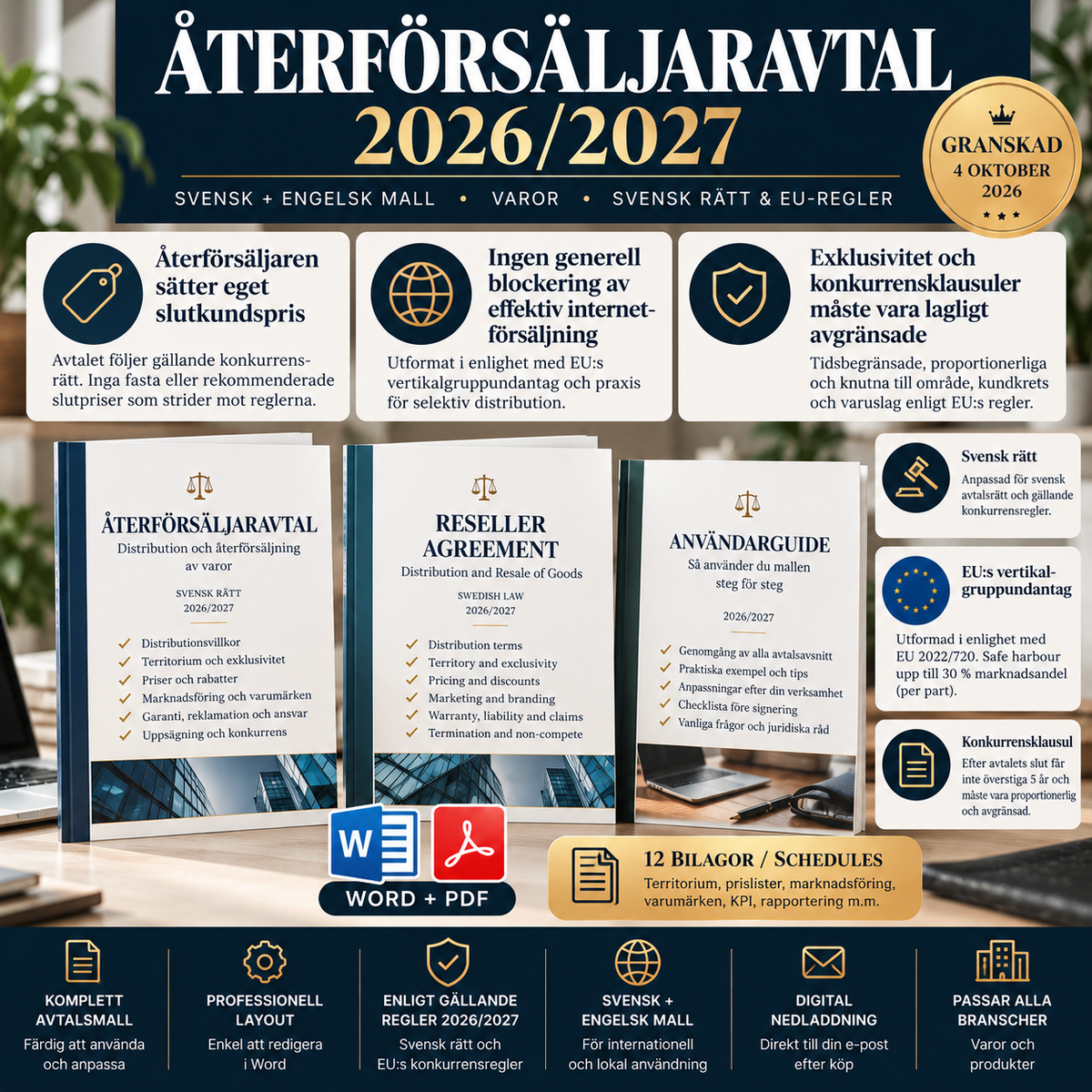
This is a comprehensive and professional reseller agreement for B2B relationships, in which an independent reseller purchases goods from a supplier and resells them in their own name, on their own behalf, and at their own financial risk. The template package is designed to regulate the entire distribution relationship – from products, purchase prices, and delivery to territory, exclusivity, e-commerce, trademarks, warranty, GDPR, liability, non-compete clauses, and termination.
The package is reviewed against applicable Swedish law and relevant EU regulations as of October 4, 2026, and developed for practical use during 2026/2027. It contains both a complete Swedish Reseller Agreement and an English-language Reseller Agreement adapted to Swedish law, as well as a separate detailed user guide.
Delivery: 3 documents in both Word (DOCX) and PDF – a total of 6 files, 40 A4 pages, and 12 appendices/schedules. The product is delivered digitally. No physical goods are sent.
Included in this package
- Reseller Agreement 2026/2027 – Swedish version, 18 pages with 24 contractual sections and 12 appendices.
- Reseller Agreement 2026/2027 – English / Swedish law, 17 pages with corresponding structure and 12 schedules.
- Detailed user guide, 5 pages with step-by-step instructions, competition law checkpoints, and a pre-signature checklist.
When is a reseller agreement appropriate?
The template is intended for situations where the reseller buys products from the supplier and subsequently resells them in their own name and on their own behalf. The reseller normally bears their own inventory, credit, and sales risk, and earns money through their trade margin.
This differs from a commercial agency. A commercial agent acts on behalf of the principal and may, under certain conditions, be covered by the Commercial Agency Act (1991:351). This template is therefore clearly designed as resale/distribution and does not create an agency, employment, franchise, or the right to bind the supplier.
24 contractual sections
The main agreement covers, among other things:
- background and purpose,
- definitions,
- the reseller's independent status,
- products, assortment, and sales channels,
- territory, customer groups, and exclusivity,
- online sales and digital marketing,
- purchase prices, discounts, and payment,
- the reseller's free resale pricing,
- orders, forecasts, and minimum purchases,
- delivery, risk, and title,
- product information and compliance,
- marketing and trademarks,
- warranty, claims, returns, and recall,
- customer data, GDPR, and information security,
- confidentiality and trade secrets,
- compliance, anti-corruption, and sanctions,
- liability and insurance,
- non-compete clause during the agreement period,
- term and termination,
- consequences of termination and sell-off,
- competition law savings clause,
- force majeure,
- notices, assignment, and amendments,
- Swedish law, CISG, and dispute resolution.
12 practical appendices / schedules
- Products and sales channels – exact assortment, SKUs, and approved channels.
- Territory, customer groups, and exclusivity – territory, reserved customers, and permitted active sales restrictions.
- Purchase prices, discounts, and payment – price list, currency, bonus, freight, and payment terms.
- Orders, delivery, and logistics – order point, delivery location, Incoterms, lead time, and passing of risk.
- Trademarks and marketing – graphic profile, campaigns, domains, and approved material.
- E-commerce, online platforms, and digital advertising – website requirements, marketplaces, search advertising, and price comparison sites.
- Forecasts, KPIs, and potential minimum purchases – commercial goals and reporting.
- Warranty, claims, returns, and recall – aftermarket, RMA, spare parts, and recall process.
- GDPR, customer data, and information security – roles, systems, incident reporting, and the need for Data Processing Agreements.
- Compliance, product requirements, liability, and insurance – regulatory requirements, liability caps, and insurance.
- Term, non-compete clause, and termination – duration, notice, remaining stock, and sell-off.
- Notices, assignment, CISG, and dispute – final legal choices and forum.
The reseller sets their own end-customer price
A key element of a legally compliant reseller agreement is that the reseller must be allowed to set their own resale price. The Swedish Competition Authority states that a supplier and a reseller may not agree on fixed or minimum prices that the reseller charges their customers.
The template therefore includes a specific pricing clause where the reseller independently determines the sales price, discounts, and terms towards their customers. The supplier may use a recommended price or maximum price only provided that it truly remains non-binding and is not in practice converted into a fixed or minimum price through pressure, sanctions, bonuses, or other incentives.
Exclusivity, territory, and customer groups
Appendix 2 makes it possible to choose between non-exclusive and exclusive distribution and to describe a territory or specific customer groups. However, such clauses must not be used mechanically.
The EU Vertical Block Exemption Regulation, Commission Regulation (EU) 2022/720, contains detailed rules on which restrictions of active and passive sales may be permitted in exclusive and selective distribution systems. The template therefore contains no general wording stating that the reseller “may not sell outside their territory.” Instead, any restrictions are documented separately and should be used only to the extent permitted by competition law.
Active and passive sales
The distinction between active and passive sales is important in territorial distribution. Active sales can, for example, consist of direct marketing targeted at a specific customer group or area. Passive sales are typically sales occurring after a spontaneous, unsolicited request from the customer.
Under certain conditions, active sales into an exclusive territory can be restricted. A general ban on passive sales, however, is normally a serious competition law restriction. This is reflected directly in Appendix 2 and the agreement's savings clause.
E-commerce and effective use of the internet
The template is specifically adapted for modern e-commerce. The reseller is allowed to use the internet effectively to sell the Products. The supplier can set objective and proportionate quality requirements for, for example, the website, brand presentation, customer service, product information, and security.
Conversely, the agreement must not be structured in a way that prevents the reseller from using the internet effectively in practice. Appendix 6 therefore contains separate fields for website requirements, online marketplaces, search advertising, price comparison services, and digital customer service.
30% market share and VBER
EU Regulation 2022/720 contains a block exemption – a so-called "safe harbour" – for many vertical agreements when, among other things, the supplier's market share in its relevant sales market and the buyer's market share in its relevant purchase market do not exceed 30 percent and the agreement does not contain particularly serious competition restrictions.
An agreement exceeding the 30-percent threshold is not automatically prohibited. However, it cannot rely on the same automatic block exemption and therefore requires a more individual competition law assessment.
Non-compete clause – not an unlimited standard clause
Appendix 11 contains an optional non-compete clause. It is not automatically activated. EU vertical rules imply, among other things, that a direct or indirect non-compete clause that is unlimited or exceeds five years normally falls outside the block exemption, with specific exceptions.
After the termination of the agreement, the possibility of using a non-compete clause is even more limited. Therefore, the agreement instead contains a flexible structure where the clause must be chosen and checked based on the actual distribution.
Orders, delivery, and the Sale of Goods Act
Appendix 4 allows for specifying when an order becomes binding, delivery location, Incoterms, transport liability, lead time, freight, passing of risk, and any retention of title.
For the sale of personal property between businesses, the Sale of Goods Act (1990:931) may become applicable to the extent the parties have not agreed otherwise. The Sale of Goods Act is to a large extent dispositive, and the template is therefore used to create clearer commercial terms than what would otherwise follow from the law's standard rules alone.
Warranty, claims, and product recall
Appendix 8 is used to regulate the warranty period, RMA process, B2B returns, customer support, spare parts, and liability in case of product recall. This allows the supplier and reseller to determine who communicates with customers, who covers costs, and how defective or unsafe products should be handled before a problem occurs.
Trademarks, marketing, and domains
The reseller is permitted to use the supplier's approved trademarks and marketing materials for the sale of the Products during the term of the agreement. Appendix 5 allows for documenting the graphic manual, prior approval, local campaigns, as well as rules for domain names and social media.
The template simultaneously prevents the reseller from registering confusingly similar marks or domains without express approval.
GDPR, CRM, and customer data
Appendix 9 is used to document whether the supplier and reseller are independent data controllers or if one party processes personal data on behalf of the other. If a processor relationship exists, a separate data processing agreement normally needs to be concluded pursuant to Article 28 of the GDPR.
The template also contains fields for shared systems, data, incident reporting, and storage/deletion procedures.
Liability, insurance, and product requirements
Appendix 10 is used to adapt product-specific requirements, anti-corruption, sanctions/export control, liability caps, carve-outs, and insurance. The agreement intentionally leaves commercially sensitive amounts open so that they can be set in relation to the product's risk and the value of the agreement.
What happens when the agreement terminates?
The agreement contains specific rules for the conclusion of the agreement. The reseller shall normally cease using the supplier's marks and stop representing themselves as an authorized reseller. Appendix 11 allows for determining how remaining stock should be handled through, for example, a sell-off period, buy-back, or other solution.
Ongoing warranty, spare parts, and existing customer commitments can also be regulated so that the end of the distribution relationship does not create unnecessary customer or liability disputes.
English Reseller Agreement under Swedish law
The English version is a complete Reseller Agreement with a corresponding contractual structure and 12 schedules. It is intended for relationships where Swedish substantive law is to apply, but where the reseller, supplier, group, or advisors work in English.
It is thus an English-language template according to Swedish law – not a standard agreement according to British or US law.
Detailed user guide included
The user guide helps the user determine whether a reseller agreement is the correct form of agreement and then walks through the most important choices step by step. The guide specifically explains:
- the difference between a reseller and a commercial agent,
- how products and channels should be delimited,
- how exclusivity and territory should be formulated,
- why the reseller must have actual price freedom,
- how e-commerce and marketplace policies should be handled,
- the 30-percent threshold in the VBER,
- non-compete clauses and the five-year limit,
- warranty, recall, and aftermarket,
- GDPR and the need for data processing agreements,
- inventory and sell-off after the agreement terminates.
Reviewed for 2026/2027
The legal review is dated October 4, 2026. The documents have been checked against, among other things:
- the Contracts Act (1915:218),
- the Sale of Goods Act (1990:931),
- the Competition Act (2008:579),
- the Act (2008:581) on Block Exemptions for Vertical Restrictive Agreements,
- Commission Regulation (EU) 2022/720 on vertical agreements and concerted practices,
- the European Commission's Guidelines on Vertical Restraints,
- the General Data Protection Regulation (EU) 2016/679 (GDPR),
- the Act (2018:218) with Supplementary Provisions to the EU General Data Protection Regulation,
- the Trade Secrets Act (2018:558).
The designation 2026/2027 means that the templates have been reviewed against the legal situation at the review date and are prepared for use during these years. In the event of later changes in law or practice, a new check should be performed.
Format and delivery
3 documents • 6 files • 40 pages • 12 appendices/schedules
- Word (DOCX) – fully editable.
- PDF – for reference, printing, and layout check.
- Digital delivery – no physical product is sent.
Important
The template package is a professional general contract basis and does not replace individual legal advice. Competition law assessments depend on, among other things, market shares, distribution systems, geographical market, product, online channels, and the actual application of the agreement. Exclusive or selective distribution, market shares near or above 30%, complicated marketplace rules, or longer non-compete clauses should therefore be assessed separately.