

Svenska Dokumentmallar
Letter of Intent (LOI) Template Package 2026/2027 – Word/PDF + English | Swedish Law
Letter of Intent (LOI) Template Package 2026/2027 – Word/PDF + English | Swedish Law
 Downloading the template is available immediately after purchase. Our document templates are always delivered in customizable formats.
 If you are unsure which template is appropriate or how you should complete it, please see the relevant information under the 'Legal Information' tab in our main menu.
 Our templates are designed in accordance with current legislation and practice in each area to ensure that the documents you create are legally correct.


Couldn't load pickup availability
Letter of Intent (LOI) Template Package 2026/2027 – Word/PDF under Swedish Law
This is a complete and professional LOI package for corporate acquisitions and investments. It is designed for situations where buyers, sellers, or investors wish to document the most important commercial terms for a potential transaction before signing a final binding transfer or investment agreement.
The template package is legally reviewed against current Swedish law and applicable 2026 regulations as of October 4, 2026 and is developed for practical use during 2026/2027. The package includes a Swedish Letter of Intent (Avsiktsförklaring), a complete English-language Letter of Intent under Swedish law, and a separate, detailed user guide.
Delivery: 3 documents in both Word (DOCX) and PDF – a total of 6 files, 40 A4 pages, and 10 appendices/schedules. The product is delivered digitally. No physical goods are sent.
What's included
- Letter of Intent / LOI 2026/2027 – Swedish version, 18 pages with 24 contract sections and 10 appendices.
- Letter of Intent 2026/2027 – English / Swedish law, 18 pages with corresponding structure and 10 schedules.
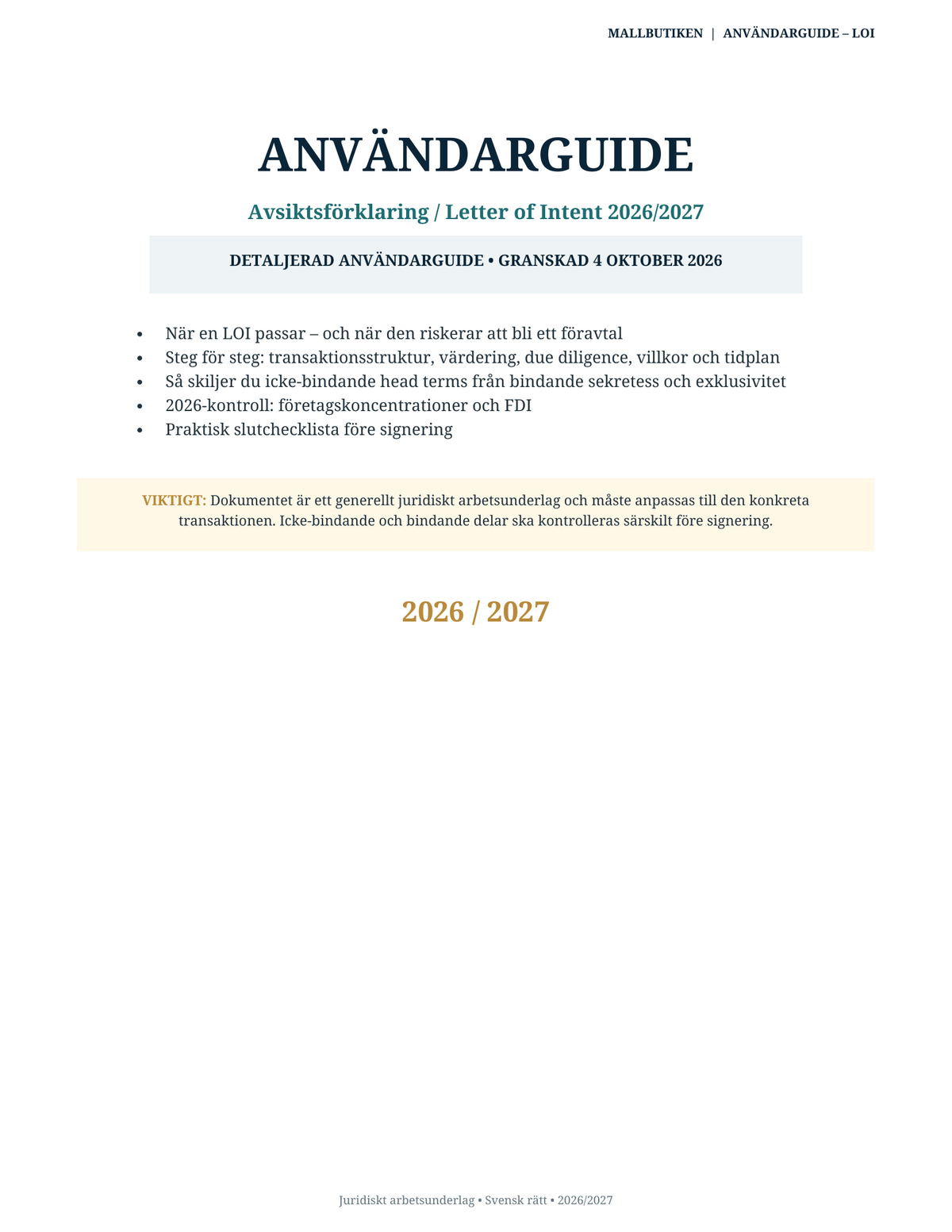
- Detailed user guide, 4 pages with step-by-step instructions, control points, and a checklist before signing.
When is a Letter of Intent used?
A LOI is often used when the parties have progressed sufficiently in an acquisition or investment process to document their preliminary consensus, but are not yet ready to enter into a final binding agreement.
This may apply, for example, to:
- shares acquisition in a company,
- asset transfer or business acquisition,
- new share issue or other investment,
- minority or majority investment,
- corporate acquisition where due diligence remains,
- transaction where financing or regulatory approval needs to be clarified,
- acquisition where the parties wish to agree on exclusivity during the negotiation period.
The most important legal question: what is binding?
A letter of intent is not automatically non-binding just because the document is titled "Letter of Intent" or "Avsiktsförklaring". Under Swedish contract law, the document's actual content, wording, and the intention of the parties are of great importance for the assessment.
This template is therefore structured in two clear parts:
- Part I – Non-binding transaction terms: transaction structure, indicative valuation, purchase price, financing, due diligence, regulatory review, timeline, and preliminary head terms.
- Part II – Binding process provisions: confidentiality, exclusivity/no-shop, costs, announcements, binding clause, certain liability issues, validity, notices, and governing law and dispute resolution.
Section 19 contains a specific binding clause that explicitly states which parts are intended to be binding and which are non-binding. This reduces the risk of a preliminary commercial agreement inadvertently having greater legal effect than the parties intended.
24 contract sections
The main template includes, among other things:
- parties and target company,
- background and purpose,
- indicative transaction structure,
- indicative valuation and purchase price,
- financing,
- due diligence,
- information process and data room,
- indicative conditions for implementation,
- regulatory review and compliance issues,
- timeline and decision points,
- final agreements,
- operation of the business before the final agreement,
- employees, management, and incentives,
- tax and structure,
- confidentiality,
- exclusivity / no-shop,
- costs and advisors,
- announcements and contacts,
- binding effect and explicit absence of obligation to complete the transaction,
- preliminary representations and warranties,
- validity and termination,
- assignment and notices,
- Swedish law and dispute resolution,
- signing.
10 professional appendices / schedules
- Transaction structure – share acquisition, asset acquisition, new issue/investment, or other structure.
- Target company and ownership structure – basic data, owners, operations, subsidiaries, and key personnel.
- Indicative valuation and price bridge – Enterprise Value, Equity Value, net debt, cash, working capital, and any earn-out.
- Due diligence – scope – legal, financial, tax, commercial, IT/cyber/data, HR, and technical/environmental.
- Timeline and decision points – LOI, data room, DD, draft agreements, signing, closing, and LOI termination date.
- Conditions and regulatory control – financing, corporate decisions, third-party consents, competition review, FDI, and sector requirements.
- Exclusivity / No-shop – binding – start, end, prohibited activities, exceptions, and unsolicited bids.
- Confidentiality, data room, and clean team – binding – authorization, sensitive information, clean team, and NDA priority.
- Preliminary head terms – warranties, liability caps, de minimis/basket, indemnities, covenants, and closing.
- Contact, notices, and dispute forum – binding – contact persons, advisors, notices, and forum.
Share acquisition, asset transfer, or investment
Appendix 1 makes it possible to use the same basic template for several types of transactions. Parties can choose between share transfer, asset transfer, new share issue/investment, or other structure.
This is important because the choice of structure affects, among other things, what needs to be reviewed in due diligence, how the price is calculated, what consents may be required, and what final contract documentation is needed.
Indicative valuation and price bridge
Appendix 3 helps the parties document an indicative valuation without creating a binding final price. The template contains separate fields for:
- Enterprise Value,
- Equity Value,
- cash and net debt,
- normalized working capital,
- earn-out or additional purchase price,
- other price adjustments.
This makes it possible to keep the valuation clear while still allowing it to be adjusted after due diligence and final documentation.
Due diligence – complete scope
Appendix 4 contains a broad DD structure to reduce the risk of forgetting important areas. It can be adapted to the size of the transaction and includes, among other things:
- corporate law and ownership,
- material agreements,
- disputes and regulatory matters,
- financing and collateral,
- tax and VAT,
- financial quality, net debt, and working capital,
- customers, market, and suppliers,
- intellectual property rights and licenses,
- IT, cybersecurity, and personal data,
- employees, pension, bonus, and incentives,
- environment, real estate, and technical issues where relevant.
Clean team and competition-sensitive information
An acquisition process may mean that two companies – sometimes competitors – need to share sensitive information. The template therefore contains support for clean teams, limited data room permissions, aggregated data, and special handling of customer-specific prices, strategies, and other competition-sensitive information.
Competition review – updated for 2026
Certain corporate acquisitions must be notified to the Swedish Competition Authority or the European Commission before they can be completed. The main Swedish thresholds are based on the turnover of the companies concerned, but from August 1, 2026, the Swedish Competition Authority has also gained expanded possibilities to obtain information about and, in some cases, require notification of business concentrations that are not covered by the standard two-threshold rule.
Appendix 6 therefore contains an explicit control point for competition review and standstill – instead of just asking if the traditional turnover thresholds are met.
FDI – foreign direct investments
Investments in Swedish protected operations may be covered by the Act (2023:560) on the screening of foreign direct investments. The rules can affect both Swedish and international transactions depending on the investment structure and the nature of the operations.
The template therefore contains a separate FDI screening point in the regulatory appendix. If the transaction is covered, the process and timeline must be adapted to the relevant review.
Exclusivity / No-shop
Appendix 7 makes it possible to choose whether the Seller should be bound by a time-limited exclusivity period during which competing transactions may not be actively initiated or negotiated.
Exclusivity is kept separate from the non-binding business terms and is explicitly marked as binding. The parties can specify the start date, end date, exceptions, and how an unsolicited bid should be handled.
Confidentiality and NDA
The LOI contains a binding confidentiality section for information about the transaction, the target company, and the negotiations. If the parties already have a separate NDA, Appendix 8 can be used to specify which document takes precedence and how the data room should be handled.
No obligation to complete the transaction
A central clause explicitly states that the non-binding parts do not create an obligation to sell, buy, invest, issue shares, or complete the transaction. No party is obliged to enter into a final agreement just because the LOI has been signed.
However, this does not affect the obligation to comply with the parts that have been explicitly made binding, such as confidentiality and exclusivity.
English Letter of Intent under Swedish law
The package contains a complete English-language Letter of Intent with the same legal structure and 10 schedules. It is intended for transactions where Swedish rules are to be applied but where buyers, sellers, investors, group functions, or advisors work in English.
The English version is therefore an English-language transaction document under Swedish law – not a standard document under British or American law.
Detailed user guide included
The separate guide goes through the LOI process step by step and explains, among other things:
- the difference between an LOI and a binding preliminary agreement,
- how transaction structure is chosen,
- how indicative valuation should be formulated,
- how due diligence scope is set,
- how regulatory and FDI issues are checked,
- how exclusivity should be time-limited,
- how NDA and clean teams can be used,
- how the binding clause should be final-checked,
- common mistakes to avoid,
- when individual legal advice should be used.
Reviewed for 2026/2027
The legal review is dated October 4, 2026. The package has been checked against, among other things:
- the Contracts Act (1915:218),
- the Competition Act (2008:579) and the Swedish Competition Authority's current guidance on business concentrations,
- the Act (2023:560) on the screening of foreign direct investments,
- general Swedish contract law principles regarding contract formation, interpretation, and binding effect.
The designation 2026/2027 means that the template has been reviewed against the legal situation at the date of review and developed for use during these years. In the event of later rule changes or significant new practice, a new check should be made.
Format and delivery
3 documents • 6 files • 40 pages • 10 appendices/schedules
- Word (DOCX) – fully editable.
- PDF – for reference, printing, and layout check.
- Digital delivery – no physical product is sent.
Important
The template package is a professional general working document and does not replace individual legal, tax, or financial advice. Larger transactions, listed companies, international acquisitions, earn-outs, management rollovers, W&I insurance, complex financing, competition review, FDI, regulated operations, or situations where the parties want to create binding purchase/investment obligations already in the LOI should be assessed separately.