

Svenska Dokumentmallar
Franchise Agreement Template Package 2026/2027 – Word/PDF + English + Preliminary Information | Swedish Law
Franchise Agreement Template Package 2026/2027 – Word/PDF + English + Preliminary Information | Swedish Law
 Downloading the template is available immediately after purchase. Our document templates are always delivered in customizable formats.
 If you are unsure which template is appropriate or how you should complete it, please see the relevant information under the 'Legal Information' tab in our main menu.
 Our templates are designed in accordance with current legislation and practice in each area to ensure that the documents you create are legally correct.


Couldn't load pickup availability
Franchise Agreement Template Pack 2026/2027 – Word/PDF + English + Pre-contract Disclosure
This is a complete and professional B2B franchise package governed by Swedish law. The package is designed for franchisors and franchisees who need a clear and practical contractual framework for the entire franchise relationship – from the mandatory pre-contractual disclosure to ongoing operations, fees, trademarks, operations manual, e-commerce, quality control, non-compete clauses, assignment, and termination.
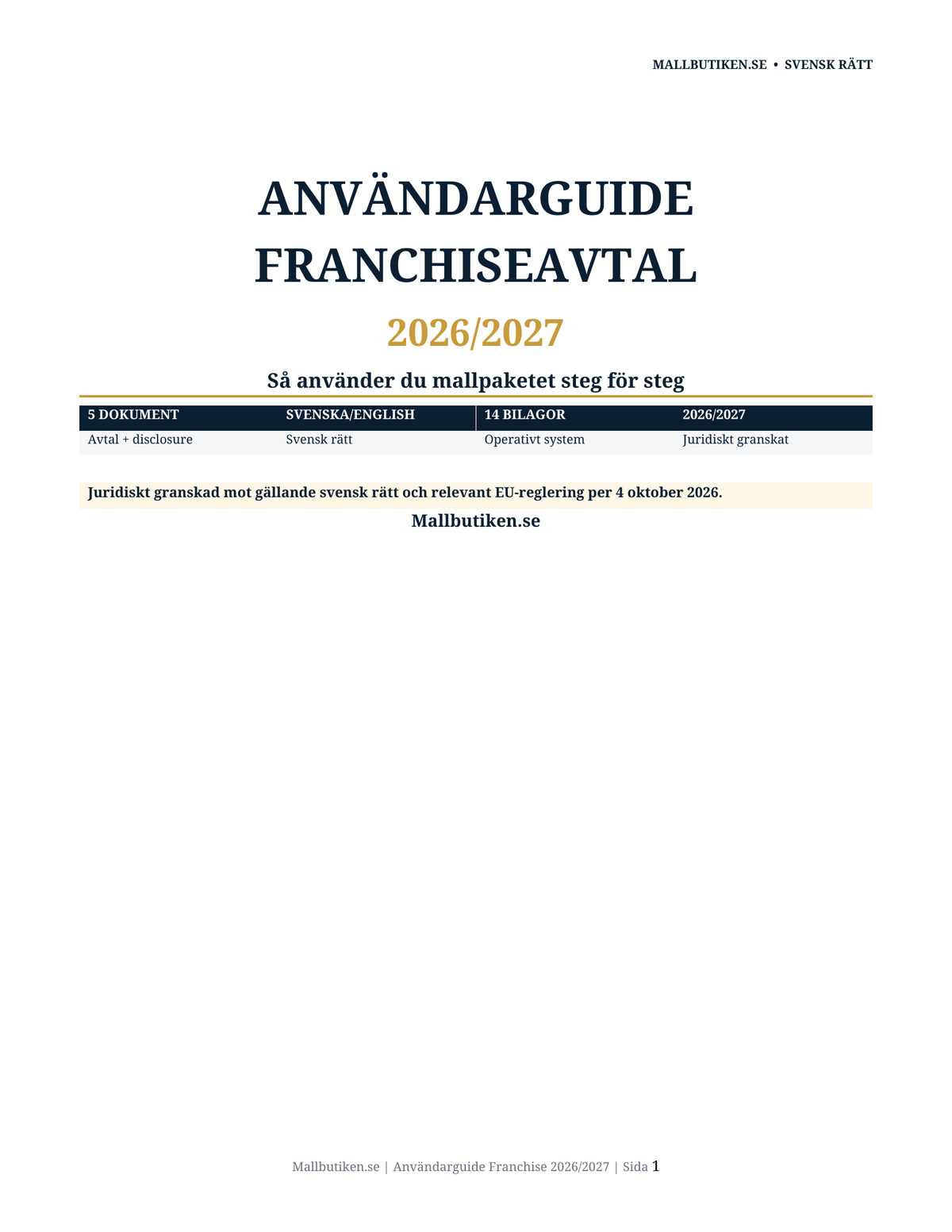
The template package has been legally reviewed against applicable Swedish law and relevant EU competition law as of October 4, 2026, and developed for practical use during 2026/2027. The package includes both Swedish and English versions of the agreement, Swedish and English pre-contractual disclosures, and a separate detailed user guide.
Delivery: 5 documents in both Word (DOCX) and PDF – a total of 10 files, 52 A4 pages, and 14 appendices/schedules. Digital download. No physical product will be shipped.
What is included
- Franchise Agreement 2026/2027 – Swedish version, 20 pages with 26 contract sections and 14 appendices.
- Franchise Agreement 2026/2027 – English / Swedish law, 20 pages with corresponding structure and 14 schedules.
- Pre-contract Franchise Disclosure 2026/2027 – Swedish, 4 pages in accordance with the Act (2006:484) on the Franchisor's Duty to Disclose Information.
- Pre-contract Franchise Disclosure 2026/2027 – English, 4 pages as English-language support for the Swedish disclosure obligation.
- Detailed User Guide, 4 pages with document order, competition law control points, and a final checklist.
When is a Franchise Agreement appropriate?
The template is intended for a B2B relationship where a franchisor allows an independent franchisee to use a specific business concept, a common system, and the franchisor’s trade marks or other intellectual property in exchange for compensation and under recurring system control.
Examples of sectors where franchising can be used include retail, restaurants, services, education, fitness, real estate brokerage, service concepts, retail chains, and other businesses where an established concept, brand, and operational know-how are licensed to independent entrepreneurs.
According to the template, the franchisee is an independent business operator who conducts the business in their own name and at their own financial risk. The agreement does not automatically create an employment relationship, commercial agency, partnership, or the right to represent the other party.
Statutory pre-contractual disclosure obligation
Sweden has a specific Act (2006:484) on the Franchisor's Duty to Disclose Information. The franchisor must, in good time before the franchise agreement is entered into, provide in writing the information about the agreement and other circumstances necessary in light of the circumstances. The information must be clear and understandable.
The law does not specify a fixed number of days before signing. Therefore, the package contains clear fields for:
- date when the information is provided,
- earliest planned date for signing,
- receipt acknowledgment,
- which documents were provided simultaneously.
The 8 minimum requirements in the Swedish Franchise Act
The Swedish disclosure template is specifically structured to cover the information that must at least be provided according to Section 3 of the Act on the Franchisor's Duty to Disclose Information:
- a description of the franchise business the franchisee is to conduct,
- information about other franchisees in the same franchise system and the scope of their business,
- remuneration to the franchisor and other financial terms,
- intellectual property rights being licensed,
- goods or services that the franchisee is obligated to purchase or lease,
- non-compete clauses during or after the contract period,
- contract duration, amendments, renewal, termination, and the financial consequences of termination,
- how disputes are to be resolved and the rules regarding cost liability.
The package also includes fields for other materially important circumstances, such as major system changes, supplier dependencies, and significant risks.
Disclosure obligation also applies to assignments
If an existing franchise agreement is to be assigned to a new franchisee with the franchisor's consent, the disclosure obligation also applies to the new franchisee. Therefore, both the agreement and the disclosure template contain specific control points for assignment and succession.
What happens if the information is not provided?
If the franchisor enters into a franchise agreement without having fulfilled the disclosure obligation, a claim for an injunction may be brought before the Patent and Market Court. As a general rule, such an injunction shall be combined with a conditional fine.
Therefore, the package is not designed with a receipt acknowledgment that attempts to make the franchisee waive statutory rights. The acknowledgment of receipt only documents that the information has been received.
26 Contract Sections
The franchise agreement covers, among other things:
- background and franchise system,
- franchisee's independent status,
- franchise licensing,
- territory, premises, and exclusivity,
- establishment and investment,
- operations manual and system standards,
- training and support,
- trademarks and intellectual property rights,
- know-how and trade secrets,
- start-up fee, royalty, and other fees,
- reporting, bookkeeping, and audit,
- mandatory purchases and approved suppliers,
- pricing and campaigns,
- marketing fund,
- e-commerce and digital sales channels,
- quality control and rectification,
- personnel and employer responsibility,
- GDPR, IT systems, and information security,
- insurance and compliance,
- non-compete during the contract period,
- non-compete after the end of the contract,
- contract term, renewal, and termination,
- assignment and change of ownership,
- consequences of termination,
- hierarchy of contract documents,
- Swedish law and dispute resolution.
14 Professional Appendices
- The franchise business and business concept – target group, processes, know-how, and service requirements.
- Territory, premises, and exclusivity – geography, customer group, and reserved channels.
- Investment, fees, and financial terms – start-up fee, royalty, marketing fee, IT, and investment.
- Mandatory purchases and approved suppliers – including alternative suppliers and supplier rebates.
- Operations manual, training, and support – manual version, training, and change process.
- Trademarks and intellectual property rights – registration details, domains, and graphic manual.
- Marketing and fund – local budget, central fund, and reporting.
- IT, data, and GDPR – systems, data roles, DPA agreements, incidents, and data export.
- Quality, reporting, and audit – KPI, site visits, financial control, and rectification period.
- E-commerce, sales channels, and pricing – marketplaces, advertising, and price recommendations.
- Non-compete, confidentiality, and know-how – during and after the contract period.
- Contract term, renewal, termination, and assignment – including sell-off and removal of signage.
- Insurance, permits, and compliance.
- Notices and dispute resolution.
The franchisee determines their own end-customer price
Franchise agreements are often covered by competition law rules regarding vertical agreements. The template therefore explicitly states that the franchisee independently determines their prices to the customer.
Under the right conditions, the franchisor may provide recommended prices or maximum prices. However, the recommendation must not, through pressure, sanctions, threats, bonuses, or other incentives, in practice become a fixed or minimum price.
VBER 2022/720 – 30% safe harbor
The EU Vertical Block Exemption Regulation (EU) 2022/720 can provide a competition law safe harbor when, among other things:
- the supplier's market share does not exceed 30%,
- the buyer's market share does not exceed 30%,
- the agreement does not contain particularly serious competition restrictions.
An agreement above the 30% threshold is not automatically prohibited but cannot rely on the same automatic block exemption and requires an individual assessment.
E-commerce may not be generally blocked
The franchisor may set quality requirements for websites, brand presentation, customer service, marketplace usage, and digital advertising. The template therefore contains a specific e-commerce appendix.
However, the terms must not be designed in a way that, in violation of competition law, prevents the franchisee from effectively using the internet for sales.
Non-compete during the contract period
Appendix 11 contains an optional non-compete clause. It is not activated automatically.
For the safe harbor of the block exemption, a direct or indirect non-compete clause is generally not covered if it is unlimited or exceeds five years, with special exceptions when the business is conducted from premises or land controlled in the manner specified in the EU regulation.
Non-compete after the end of the contract
For the safe harbor according to VBER, a post-contract non-compete can only be covered when, among other things:
- it applies to goods or services that compete with the franchise business,
- it is limited to the premises and land where the franchisee conducted the business,
- it is necessary to protect know-how transferred by the franchisor,
- it does not exceed one year after the termination of the agreement.
Protection against the use or disclosure of know-how that is still secret may, however, last longer.
Territory and exclusivity
The template allows for the choice of non-exclusive or exclusive franchise. Exclusivity must be defined together with:
- geographical area,
- customer groups,
- central customer agreements,
- e-commerce,
- the franchisor's own sales channels.
In this way, an unclear promise of "sole rights" that later conflicts with central customers or digital sales is avoided.
Start-up fee, royalty, and other fees
Appendix 3 gathers all financial terms. It contains fields for:
- start-up fee,
- ongoing royalty/system fee,
- royalty base,
- marketing fee,
- IT/system fee,
- estimated initial investment,
- payment terms.
The agreement prevents new fees from being introduced without contractual support or subsequent written agreement.
Mandatory purchases and suppliers
The franchisor may need to control certain purchases to protect quality, system identity, security, or know-how. Appendix 4 therefore distinguishes between mandatory products/services, approved suppliers, and the possibility of approving alternative suppliers.
The package also contains fields to transparently describe any bonuses, kickbacks, or other financial benefits that the franchisor or affiliated parties receive from system suppliers.
Operations manual – flexible but not a blank check for changes
The operations manual is central to a functioning franchise system. The template gives the franchisor the opportunity to update system standards but simultaneously makes it clear that the manual should not be used to unilaterally rewrite the financial core of the franchise agreement or impose major new investments without the process agreed upon by the parties.
Trademark, IP, and know-how
Appendix 6 is used to identify the trademarks, domains, software, and other intellectual property rights that the franchisee is allowed to use.
The agreement distinguishes between registered rights and protectable know-how. Confidential know-how may only be used for the franchise business and must be protected even after the termination of the agreement as long as the information remains secret.
Marketing fund
If the franchise system uses a central marketing fund, Appendix 7 can specify:
- the franchisee's contribution,
- the fund's scope of use,
- reporting,
- local marketing budget,
- process for approval of local material.
The template does not promise that every franchisee will receive exactly proportional benefit from every individual campaign.
GDPR and shared IT systems
Franchise systems often use shared POS systems, CRM, loyalty programs, web platforms, and analytical tools. Appendix 8 helps the parties to document:
- mandatory systems,
- who owns or provides the system,
- personal data roles,
- if a data processing agreement is needed,
- incident deadline,
- data export and deletion upon termination.
Contract duration, renewal, and exit
Appendix 12 makes the end of the agreement as clear as the start. It contains fields for:
- initial contract term,
- renewal,
- ordinary termination,
- rectification period,
- assignment fee,
- remaining stock and sell-off,
- removal of signage and cessation of trademark use.
This ties directly into the Swedish law's requirement that the franchisee be informed before the agreement about the contract term and the financial consequences of termination.
English Franchise Agreement according to Swedish law
The English version contains the same contract structure and 14 schedules. It is intended for situations where the franchisor, franchisee, group functions, or advisors work in English, but Swedish substantive law is to be applied.
The package also contains an English-language Pre-contract Franchise Disclosure as support when the prospective franchisee works in English.
Detailed User Guide included
The guide shows the order in which the documents should be used and specifically reviews:
- pre-contractual information before signing,
- all 14 appendices,
- VBER's 30% threshold,
- the franchisee's pricing freedom,
- e-commerce and internet sales,
- the five-year limit for certain non-compete clauses,
- the one-year rule for certain post-term non-competes,
- IP and operations manual,
- GDPR and data processing agreements,
- termination and exit,
- final checklist before signing.
Reviewed for 2026/2027
The legal review is dated October 4, 2026. The package has been checked against, among other things:
- Act (2006:484) on the Franchisor's Duty to Disclose Information,
- Contracts Act (1915:218),
- Competition Act (2008:579) and Article 101 TFEU,
- Commission Regulation (EU) 2022/720 on vertical agreements and concerted practices,
- Trade Marks Act (2010:1877),
- Copyright Act (1960:729),
- Trade Secrets Act (2018:558),
- General Data Protection Regulation (EU) 2016/679 (GDPR).
Format and delivery
5 documents • 10 files • 52 pages • 14 appendices/schedules
- Word (DOCX) – fully editable templates.
- PDF – for reference, printing, and layout control.
- Swedish + English agreement and disclosure versions.
- Digital delivery – no physical product is shipped.
Important
The template package is a professional general contractual framework and does not replace individual legal, tax, or financial advice. Master franchises, international franchises, very large establishment investments, complicated premises/real estate structures, franchisor financing, market shares close to or above 30%, far-reaching exclusivity or non-compete clauses, as well as ongoing franchise disputes should be assessed separately.