

About this template
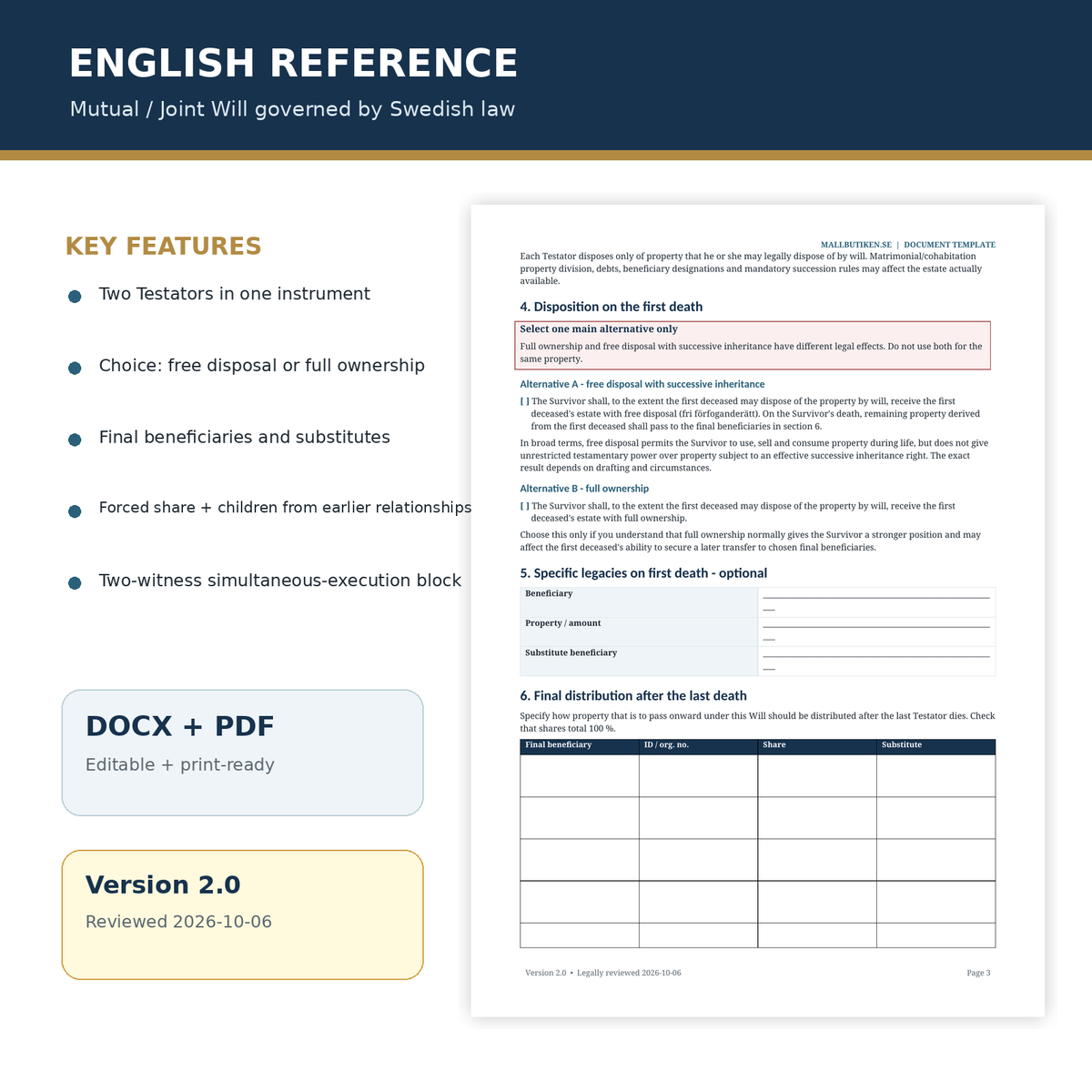
Joint / mutual will under Swedish law for two people who wish to combine their testamentary provisions in a single document. The package is Swedish-first and also includes an English reference version as well as detailed user guides in both languages.
Legally reviewed: October 6, 2026
The review covers, among other things, formal requirements, statutory shares (laglott), mutual wills, revocation and amendment, divorce/separation, secondary inheritance, executors, and relevant rules regarding separate property.
What is included
| Joint will – DOCX | Editable Swedish master template. |
| Joint will – PDF | Print-ready Swedish version. |
| Swedish user guide – DOCX + PDF | Step-by-step guide on template choices, witnesses, statutory shares, and amendments. |
| English reference – DOCX + PDF | English reference version governed by Swedish law. |
| English user guide – DOCX + PDF | English reference guide for the same Swedish legal structure. |
Important: a joint will is not automatically “locked”
The older product text has been corrected. Swedish law does not imply that a mutual will generally becomes completely irrevocable after the first death. A will can be revoked, and a promise not to revoke is not binding. However, a unilateral revocation or amendment of a mutual will may have specific consequences if it substantially disrupts the conditions for the mutual provisions.
The template therefore clearly distinguishes between what can be provided for, what may need to be interpreted, and what should be reviewed individually.
What is a joint or mutual will?
Two people can write their testamentary provisions in the same document. When the provisions are based on the parties giving each other equivalent or related rights, the term mutual will (inbördes testamente) is often used.
It remains each testator’s own provision that is legally assessed. The fact that two people sign the same document does not in itself mean that all parts automatically become irrevocable or that the survivor is always free to dispose of the property in a certain way.
Two main options: limited right of disposal or full ownership
A key improvement in the new template is that the user must choose between two legally distinct constructions rather than mixing them.
Limited right of disposal with secondary inheritance
This option is intended for situations where the surviving spouse should be able to use, sell, and consume the property during their lifetime, while the property remaining from the first deceased should be able to pass to final beneficiaries after the survivor's death.
Full ownership
This gives the survivor a stronger right of ownership. If the first deceased simultaneously wants to ensure that specific property or a certain value passes to specific persons after the survivor's death, greater caution is required. The template therefore explicitly warns against choosing full ownership while assuming that a secondary inheritance is automatically protected.
Statutory shares and heirs (laglott)
Heirs (bröstarvingar) are protected by the statutory share (laglott). The statutory share is half of the inheritance the child would otherwise have been entitled to by law. A will that encroaches on the statutory share does not automatically become entirely void. An heir usually needs to claim adjustment within six months of being served with the will to receive their statutory share.
Therefore, the template contains specific fields for each testator's children and a clear warning regarding children from previous relationships (särkullbarn).
Spouses, cohabitants, and children from previous relationships
The outcome can differ significantly depending on the relationship:
- Married: a surviving spouse has a legal right of inheritance in many situations, but children from previous relationships and other rules may affect the outcome.
- Cohabitants (sambor): a cohabitant has no general legal right of inheritance after their partner. A will can therefore be particularly important.
- Children from previous relationships: can normally receive their inheritance from their parent immediately upon that parent's death and also have statutory share protection.
In cases of children from previous relationships and more advanced planning, individual legal review is recommended before signing.
Formal requirements must be met
As a main rule, a will must be in writing. The testator must sign or acknowledge their signature in the presence of two qualified witnesses who are simultaneously present. The witnesses must sign and be aware that the document is a will, but they do not need to know its content.
For the joint document, the practical main solution in the template is for both testators to sign or acknowledge their signatures in the presence of the same two qualified witnesses, simultaneously present.
Who cannot be a witness to a will?
The Swedish Inheritance Code contains several witness disqualifications. Among others, the testator's spouse or cohabitant, certain close relatives, and certain persons with a personal or related interest in the provisions may not witness in the way prohibited by law. The guide contains a specific witness checklist.
Final beneficiaries and substitutes
The template contains a table for how property that is to pass on after the last survivor's death according to the will should be distributed. It is also possible to specify what should happen if a beneficiary dies before the right to inherit enters into force.
The shares should be checked so that they total 100 percent.
Separate property
There is an optional clause stating that an inheritance a final beneficiary receives through the will shall be the beneficiary's separate property. The template also distinguishes between the property itself, substitute property, and yield, as yield does not automatically acquire the same character unless specified.
Testamentary executor
There is an optional section for a testamentary executor. Such a person can have a significant role in the administration of the estate and should therefore be appointed consciously, not routinely.
Revocation and amendments
Each testator's provision is subject to the rules on revocation and amendment of wills. A codicil must in principle meet the same formal requirements as a will.
For mutual wills, there is also a special rule: if someone, through unilateral revocation or amendment, substantially disturbs the conditions for the mutual provisions, that person may lose their right under the will.
Divorce and separation
A provision for a spouse is void if the marriage is dissolved at the time of the testator's death or if divorce proceedings are ongoing. A provision for a cohabitant is void if the cohabitation relationship has ended before the testator's death.
The will should therefore always be reviewed in the event of separation, filing for divorce, new marriage or cohabitation, new children, or major changes in finances.
After the death
The guide also covers the serving of the will, six-month deadlines for, among other things, statutory share adjustment and challenges, as well as handling in connection with the estate inventory.
English reference included
The English version is an English-language reference governed by Swedish law. It is not a British, American, or general international will template. In cases of foreign residence, citizenship, real estate, or other foreign assets, international inheritance law may need to be analyzed separately.
Would you prefer the English version as your main product? See Joint Will Template – Swedish Law →
Special 2027 rule on agricultural property
As of January 1, 2027, the requirement for an acquisition permit is extended to legal entities' acquisition of Swedish agricultural property through a will. This issue becomes relevant if, for example, a company, association, or foundation is to be the final beneficiary of such property.
Proposals not treated as current law
SOU 2025:91 contains, among other things, proposals for a voluntary state will register, digital wills, and strengthened protection for surviving cohabitants. As of the legal review on October 6, 2026, the legislative process is still ongoing. The package is therefore based on current rules, not on the proposals as if they were already law.
When the template is suitable – and when a lawyer should be hired
The template is primarily intended for spouses and cohabitants who wish to document a relatively clear mutual arrangement according to Swedish law. Individual advice is particularly appropriate in cases of children from previous relationships, large business assets, agricultural property, complicated secondary inheritances, previous mutual wills, large gifts, foreign assets or residence, and foreseeable disputes.
File format and delivery
Format: DOCX, PDF, and ZIP.
Language: Swedish master version + English reference.
Number of files: 8.
Delivery: digital download. No physical product is sent.
Common questions
Is a joint will automatically binding and irrevocable?
No. Wills are subject to revocation rules. A mutual will can simultaneously have specific legal effects if a unilateral amendment substantially disturbs the mutual arrangement.
Can the survivor always inherit everything?
No. Statutory shares, children from previous relationships, division of matrimonial property, debts, and other rules can limit what can be transferred through the will.
Is full ownership the same thing as a limited right of disposal?
No. The two options provide different legal standing and must not be used as if they were synonyms.
Do cohabitants automatically inherit from each other?
No. Cohabitants have no general legal right of inheritance after each other under Swedish law.
Do both testators need two witnesses?
Each testamentary provision must meet the formal requirements. In this joint document, the setup is therefore designed for both testators to sign or acknowledge their signatures before the same two qualified witnesses who are simultaneously present.
The package is a general documentation aid according to Swedish law and does not replace individual legal advice. A will must fit the parties' actual family and property conditions and be executed according to current formal requirements.