

About this template
GPSR Product Safety & Recall Compliance 2026/2027 – complete template package
A complete compliance package for companies that manufacture, import, distribute, or sell consumer products in the EU in accordance with the General Product Safety Regulation (EU) 2023/988 – GPSR. The package is built for practical work with product safety before products are placed on the market and after they have started being sold.
2-in-1 Swedish + English: 7 Swedish and 7 English document templates in Word and PDF, as well as an advanced Excel register for product portfolios, risks, traceability, online offers, accidents, corrective actions, and recalls. A total of 29 delivery files.
The package has been reviewed against the consolidated version of Regulation (EU) 2023/988 and the European Commission's current guidance on product safety. The GPSR has been applied since December 13, 2024. The templates are designed for work during 2026/2027 but must always be adapted to the product category, any sector-specific EU legislation, and the company's economic role.
Included in the package
| Document / tool | Swedish | English | Purpose |
|---|---|---|---|
| Compliance plan & role assessment | Word + PDF | Word + PDF | Scope, economic role, responsible person, release gate, and implementation. |
| Product safety risk assessment | Word + PDF | Word + PDF | Hazards, probability, severity, controls, and residual risk. |
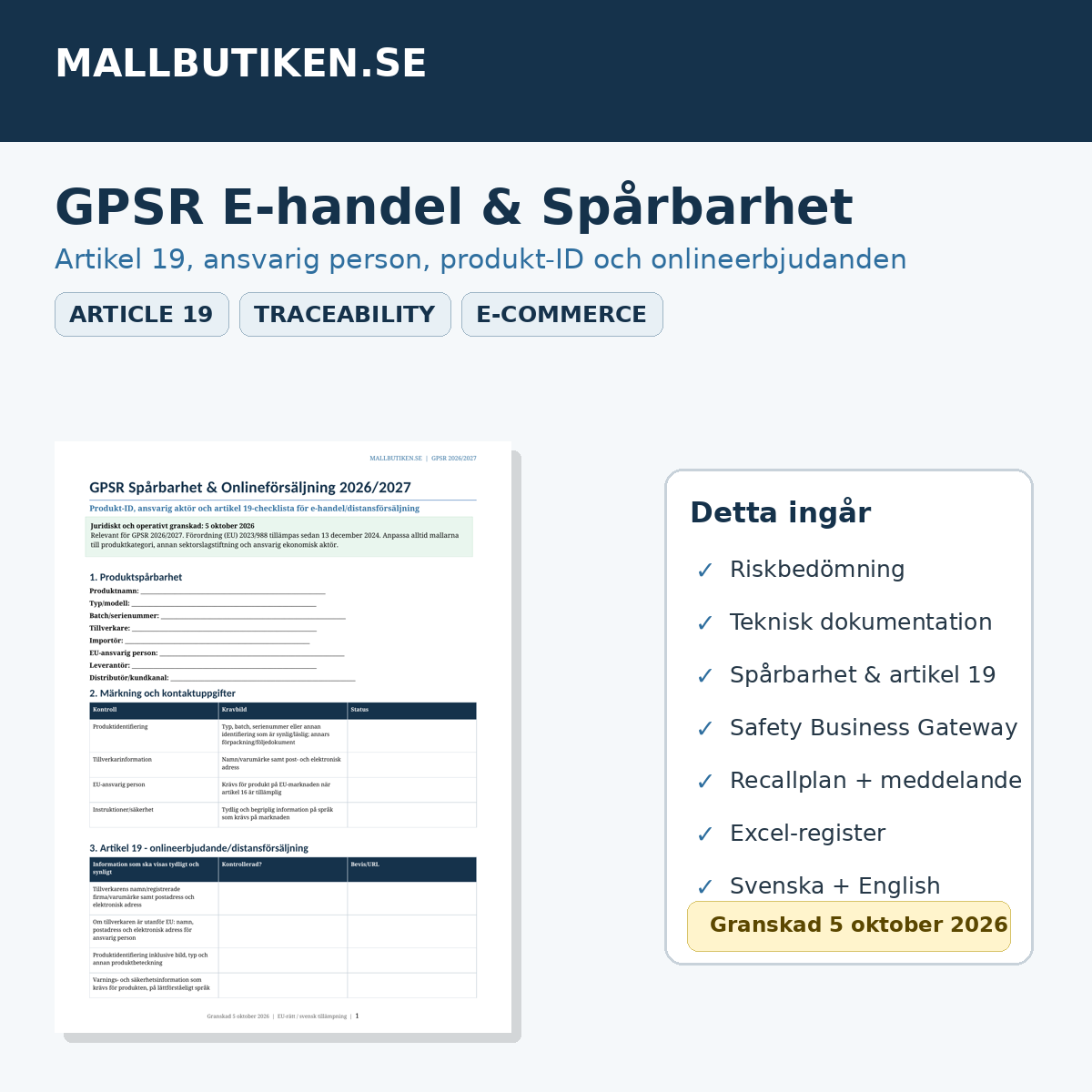
| Traceability & online sales | Word + PDF | Word + PDF | Product ID, economic operators, and Article 19 checklist for e-commerce. |
| Accident report & Safety Business Gateway | Word + PDF | Word + PDF | Article 20 intake, trigger assessment, official reporting, and follow-up. |
| Recall plan & recall notice | Word + PDF | Word + PDF | Direct consumer contact, Article 36 format, remedies, and effectiveness. |
| Technical documentation & evidence checklist | Word + PDF | Word + PDF | Article 9 documentation, test evidence, labeling, complaints, and retention. |
| Detailed user guide | Word + PDF | Word + PDF | Step-by-step from scope to recall and specialist escalation. |
| GPSR Product Safety & Recall Register | Excel (XLSX) | 9 worksheets for KPI, products, risks, traceability, online audit, accidents, corrective actions, recall, and evidence. | |
The GPSR is not just a recall regulation. The regulation requires companies to work in a structured manner even before market release with safety, internal risk analysis, technical documentation, product identification, and responsible economic operators – and subsequently with complaints, accidents, corrective actions, online information, and recalls. The package ties the entire process together in the same document structure.
Which companies can benefit from the package?
- Manufacturers of consumer products,
- Importers from countries outside the EU,
- Distributors and wholesalers,
- E-retailers and D2C brands,
- Companies that sell via marketplaces,
- Compliance, quality, and product safety teams,
- Companies that need to document a responsible economic operator in the EU.
The package is particularly relevant for non-food products where the GPSR applies directly or serves as a safety net alongside other sector-specific product legislation.
The GPSR has applied since December 13, 2024
The General Product Safety Regulation replaced the older General Product Safety Directive and modernized the EU's rules for safe consumer products. The framework explicitly takes greater account of e-commerce, direct imports, digital features, traceability, accident reporting, and more effective recalls.
Companies should therefore not use older product safety routines without verifying that they cover the new GPSR requirements.
Internal risk analysis and technical documentation – Article 9
Before a manufacturer places a product on the market, an internal risk analysis must be conducted and technical documentation established. The documentation must at least contain a general product description and the characteristics relevant for the safety assessment.
When the risks of the product warrant it, the documentation shall, among other things:
- identify hazards and risk scenarios,
- document solutions that eliminate or reduce risk,
- include relevant test results,
- state applied European standards or other relevant safety documentation,
- document residual risk and the decision on an acceptable safety level.
The technical documentation must be kept up to date and be available to market surveillance authorities for 10 years after market release.
Product identification and economic operator in the EU
Products must be identifiable through, for example, type, batch, or serial number or other identifiers. The manufacturer must also provide their name/brand and contact details.
The GPSR also contains requirements that there must be a responsible economic operator established in the EU for products covered by the regulation. When the manufacturer is outside the EU, this control becomes particularly important for importers and e-retailers.
Article 19 – specific requirements for e-commerce and distance selling
The GPSR requires that an online offer clearly and visibly displays certain information. The package's Article 19 audit and Excel register help companies verify that the product listing contains:
- the manufacturer's name/registered trade name or brand,
- the manufacturer's postal address and electronic address,
- if the manufacturer is outside the EU: the name of the responsible person and their postal and electronic address,
- product image, type, and other identification information,
- relevant warnings and safety information in a language that the consumer can understand.
This is particularly relevant for Shopify, marketplaces, and other e-commerce channels because a correct physical label does not automatically mean that the online offer fulfills Article 19.
Complaints and after-market monitoring
Product safety work does not end when the product is launched. Companies need functioning contact paths and internal registers for safety-related complaints and signals from customers, distributors, importers, and other actors.
The package helps link a complaint to the correct product, batch, and risk assessment and determine whether corrective action, sales stop, withdrawal, safety warning, or recall needs to be considered.
Accidents and Safety Business Gateway – Article 20
When a product made available on the market causes a relevant accident, the manufacturer must ensure that the accident is reported via the Safety Business Gateway to the competent authority in the member state where the accident occurred, without undue delay after the manufacturer becomes aware of it.
Article 20 covers, among other things, events that have led to:
- death, or
- serious permanent or temporary adverse effects on a person's health or safety.
Importers and distributors who become aware of such an accident must inform the manufacturer without undue delay. The accident template in the package is therefore structured around time of awareness, product ID, country, injury report, trigger assessment, reporting reference, and corrective action.
Safety Gate and Safety Business Gateway – not the same thing
Safety Gate is the EU's rapid alert system and public ecosystem for dangerous non-food products. Safety Business Gateway is the business-oriented channel for submitting certain product safety information to authorities.
The user guide explains the difference so that regulatory authority reporting is not confused with public consumer communication.
Recall and direct consumer contact – Article 35
In the event of a product safety recall or safety warning, identifiable affected consumers must be contacted directly and without undue delay. Companies that have customer data must use it for recalls and safety warnings in accordance with the conditions stated in the GPSR.
If not all affected consumers can be reached directly, the information must be disseminated clearly through other appropriate channels for the greatest possible reach, for example, websites, social media, newsletters, stores, or other communication channels.
Article 36 – what a recall notice must contain
When written recall information is provided, it must be formulated as a product safety recall notice. The package contains a separate work template that helps the company include:
- the headline Product safety recall,
- product image, name, and brand,
- batch/serial number and instructions on where the identifier is found,
- information on when, where, and by whom the product was sold, when such information is available,
- a clear description of the hazard,
- instructions to immediately stop using the product,
- the remedies offered,
- a toll-free phone number or interactive online service,
- a request to spread the recall information when appropriate.
The GPSR also states that phrasing that downplays the perception of risk should be avoided in the recall notice.
Article 37 – repair, replacement, or refund
In the event of a product safety recall, the consumer must be offered an effective, free, and fast remedy. As a general rule, the consumer must be able to choose between at least two of the following:
- repair of the recalled product,
- replacement with a safe product of the same type and at least the same value and quality,
- adequate refund that at least corresponds to the price the consumer paid.
Exceptions exist when other alternatives are impossible or would entail disproportionate costs in accordance with the regulation's conditions.
Excel register – operational GPSR control
The package's XLSX workbook is built as a living compliance tool and contains nine worksheets:
- Dashboard – KPI for products, open risks, incidents, and recalls.
- Product Register – economic role, markets, and GPSR scope.
- Risk Register – likelihood × severity with automatic risk classification.
- Traceability – suppliers, importers, distributors, and product ID.
- Online Offer Audit – Article 19 control for product listings.
- Accidents & Incidents – time of awareness, Article 20, and Safety Business Gateway.
- Corrective Actions – stop sale, withdrawal, warning, and recall.
- Recall Notice Checklist – Article 36 and Article 37.
- Evidence Checklist / Sources – evidence documentation and legal sources.
The difference between GPSR and CE marking
The GPSR does not automatically replace sector-specific EU harmonization legislation. Many product groups are covered by specific rules, including CE-related requirements. At the same time, the GPSR can serve as a safety net for risks that are not fully regulated by such special legislation.
Therefore, the package's compliance plan always begins with a scope and regulatory assessment before risk checklists are used.
The difference between GPSR and supplier agreements
The template shop's supplier agreements can regulate product compliance, quality requirements, recall, and liability between two companies. This GPSR package has a different purpose: to help the organization document and manage its own regulatory product safety process.
Frequently asked questions about GPSR
When did the GPSR start to apply?
The regulation has been applied since December 13, 2024.
Is the GPSR only for manufacturers?
No. Manufacturers have central obligations, but importers, distributors, responsible persons in the EU, and online marketplaces may also be covered by specific GPSR requirements.
Must we have a risk assessment?
Manufacturers must conduct an internal risk analysis before the product is placed on the market and establish relevant technical documentation.
Does Article 19 also apply to a Shopify store?
If products are offered online or through other distance selling, the offer is covered by Article 19. The product information therefore needs to be reviewed as an online offer, not just as physical labeling.
What is the Safety Business Gateway?
It is the EU's business channel for certain product safety reporting to competent authorities, including relevant accident reporting according to Article 20.
Must we contact customers directly during a recall?
Identifiable affected consumers must be contacted directly and without undue delay during a recall/safety warning according to Article 35.
How long should technical documentation be saved?
The manufacturer's technical documentation must be kept available for market surveillance authorities for 10 years after the product has been placed on the market.
Is Excel included?
Yes. The Excel register is a central part of the package and is used for operational follow-up.
Are English documents included?
Yes. All seven documents are available in both Swedish and English versions.
Format and delivery
- 14 document templates – 7 Swedish + 7 English.
- 28 Word/PDF files.
- 1 Excel register.
- 29 files total.
- 28 A4 pages per format series across both language versions.
- Digital product – no physical item is sent.
Legal basis and official sources
- EUR-Lex – Regulation (EU) 2023/988, consolidated version
- European Commission – Product safety
- Safety Gate