

Svenska Dokumentmallar
Asset Transfer Agreement Template Package 2026/2027 – Word/PDF | Swedish Law
Asset Transfer Agreement Template Package 2026/2027 – Word/PDF | Swedish Law
 Downloading the template is available immediately after purchase. Our document templates are always delivered in customizable formats.
 If you are unsure which template is appropriate or how you should complete it, please see the relevant information under the 'Legal Information' tab in our main menu.
 Our templates are designed in accordance with current legislation and practice in each area to ensure that the documents you create are legally correct.


Couldn't load pickup availability
Asset Purchase Agreement Template Package 2026/2027 – Word/PDF under Swedish Law
This is a professional template package for companies conducting an asset transfer – a transfer where the buyer acquires selected assets, rights, and potentially explicitly specified obligations from a business, rather than purchasing the shares of the company.
The package is reviewed against current Swedish regulations and official guidance as of October 4, 2026, and designed as a working document for use during 2026/2027. It contains both Swedish and English contract versions under Swedish law, as well as a separate detailed user guide.
Delivery: 3 documents in both Word (DOCX) and PDF – a total of 6 files and 27 A4 pages. The product is delivered digitally as a downloadable ZIP file. No physical product is sent.
What is included
- Asset Purchase Agreement 2026/2027 – Swedish, 12 pages with 28 contract sections and 11 practical appendices.
- Asset Purchase Agreement 2026/2027 – English / Swedish law, 9 pages for transactions where the parties wish to use English but apply Swedish law.
- Detailed user guide, 6 pages with step-by-step instructions, checkpoints, and explanations of the most important legal choices.
What does the main agreement regulate?
The main Swedish agreement is structured to be adaptable to both a relatively simple business transfer and a more qualified asset deal. It contains clear fill-in fields, optional clauses, and separate appendices so that the parties can describe exactly what is to be transferred.
The agreement covers, among other things, parties and transaction, definitions, transferred assets, excluded assets, assumed and retained obligations, customer and supplier agreements, third-party consents, purchase price, payment mechanics, VAT, conditions precedent, operation of the business until closing, personnel, GDPR, transfer of title, seller and buyer warranties, claims, liability, specific indemnities, confidentiality, optional non-compete and non-solicitation clauses, optional transition support, accounting records, insurance, notices, assignment of the agreement, and dispute resolution.
11 appendices to reduce the risk of ambiguity
In an asset transfer, it is particularly important not to settle for a general statement that the "business assets" are being transferred. The package therefore contains eleven appendices that make it possible to identify and document the deal concretely:
- fixtures and tangible assets,
- inventory,
- agreements to be transferred,
- intellectual property rights,
- receivables – optional appendix,
- assumed obligations,
- purchase price allocation,
- personnel overview,
- closing checklist,
- disclosures and warranty exceptions,
- specific indemnities.
VAT – updated assessment for 2026
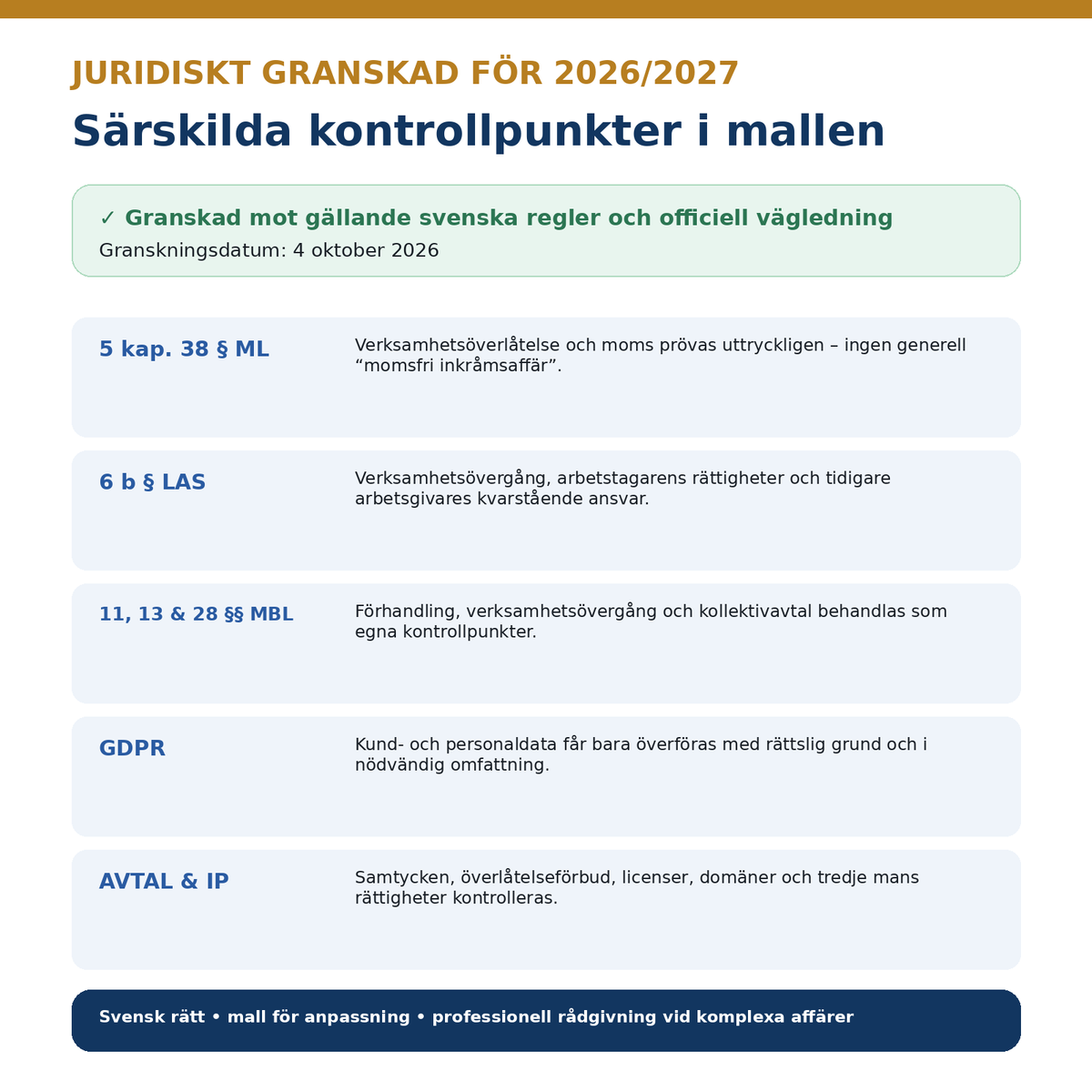
The template contains a specific and cautiously drafted VAT provision based on Chapter 5, Section 38 of the Value Added Tax Act (2023:200). An asset deal is not automatically VAT-exempt simply because it is labeled as a business transfer. The conditions must be assessed based on the specific transaction.
The agreement therefore instructs the parties to assess before closing whether the transfer is wholly or partially covered by the rules on business transfers and to handle the transaction according to that assessment. If the provision is not applicable, statutory VAT must be able to be handled for the part that is subject to VAT. This construction is particularly important because the Swedish Tax Agency's legal guidance on business transfers was updated on, among other dates, July 6 and September 9, 2026.
Personnel and business transfer
If the transaction constitutes a business transfer covered by Section 6 b of the Employment Protection Act (1982:80), rights and obligations under employment contracts may transfer to the buyer in accordance with mandatory rules. The document therefore addresses the personnel issue separately and includes a specific personnel appendix.
The template also draws attention to applicable information and negotiation obligations under Sections 11 and 13 of the Employment (Co-determination in the Workplace) Act (1976:580), as well as the check of Section 28 of the MBL in the event of a business transfer and collective bargaining agreements. The agreement further clarifies that the former employer, pursuant to Section 6 b of the Employment Protection Act, remains responsible to the employee for financial obligations relating to the period prior to the transfer.
Agreements and third-party consent
Rental agreements, licenses, leasing, customer agreements, supplier agreements, and other contracts may contain transfer prohibitions or requirements for consent. The template therefore does not assume that every agreement automatically follows the buyer. Appendix 3 makes it possible to register the counterparty, notice period, change-of-control/transfer requirements, and consent status.
Intellectual property, data, and GDPR
Assets can consist of, for example, trademarks, domain names, program code, copyrights, drawings, manuals, know-how, customer relationships, and other intangible values. Appendix 4 helps the parties identify the rights and who actually owns or licenses them.
Personal data is handled separately. Customer registers and personnel data may not be treated as a standard physical asset but must be transferred and used with a legal basis and in accordance with GDPR, data minimization, information obligations, security, and other applicable data protection requirements.
Purchase price and price allocation
The agreement has fill-in fields for the purchase price and payment mechanics, as well as a specific appendix for allocating the purchase price between different asset classes. The allocation can have accounting and tax consequences and should therefore be factually substantiated. For larger deals, separate tax and accounting checks are recommended.
Warranties, disclosures, and liability
The main agreement contains a basic set of warranties regarding, among other things, authority, title to the transferred assets, encumbrances, material assets and inventory, known disputes, intellectual property, material customer and supplier agreements, personnel information, and disclosures regarding tax and accounting to the extent they are relevant to the buyer.
Appendix 10 is used for concrete disclosures and warranty exceptions. The agreement also contains customizable fields for de minimis, basket/threshold, liability caps, limitation periods for claims, and specific warranties. These levels must be determined based on the actual transaction – not left blank at signing.
Closing checklist and closing
Appendix 9 acts as a closing checklist. There, the parties can document the responsible person, deadline, status, and evidence/documents for each closing action. The main agreement ties the transfer of title to completed closing actions and payment, taking into account that certain rights may require special registration or third-party consent.
English version under Swedish law
The package also includes a separate Asset Purchase Agreement in English. This is not a template under English or American law, but an English-language contract version intended for a transaction where Swedish substantive law is to be applied. It is useful, for example, when buyers, sellers, owners, advisors, or group functions work in English.
Detailed user guide
The separate guide explains how the template is used from preparation to signing and closing. It goes through the difference between share transfers and asset transfers, how assets and liabilities should be specified, how consents are checked, when personnel issues need special handling, how the VAT provision should be read, and how the appendices are used.
The guide also contains common errors to avoid and clear situations where the parties should seek individual legal, tax, or accounting advice.
Reviewed for 2026/2027
The legal review is dated October 4, 2026. The documentation has been checked against, among others:
- the Contracts Act (1915:218),
- the Sale of Goods Act (1990:931),
- the Value Added Tax Act (2023:200), particularly Chapter 5, Section 38,
- the Employment Protection Act (1982:80), particularly Sections 6 b and 7,
- the Employment (Co-determination in the Workplace) Act (1976:580), particularly Sections 11, 13, and 28,
- the EU General Data Protection Regulation (GDPR) and Swedish supplementary data protection legislation,
- the Accounting Act (1999:1078),
- the Trade Secrets Act (2018:558).
Format and delivery
3 documents • 6 files • 27 pages
- Word (DOCX) – fully editable.
- PDF – for reference, printing, and checking the intended layout.
- Digital download – no physical item is sent.
Important to know
This is a professional general contract template and not individual legal advice. Every asset transfer must be adapted to the actual assets, liabilities, agreements, personnel conditions, permits, tax conditions, and other circumstances. Specific advice should be sought for larger or complex transactions, international parties, insolvency, real estate, licensed operations, extensive personnel issues, or advanced tax issues.