

Svenska Dokumentmallar
Joint Venture Agreement 2026/2027 – Word/PDF + English | Swedish Law
Joint Venture Agreement 2026/2027 – Word/PDF + English | Swedish Law
 Downloading the template is available immediately after purchase. Our document templates are always delivered in customizable formats.
 If you are unsure which template is appropriate or how you should complete it, please see the relevant information under the 'Legal Information' tab in our main menu.
 Our templates are designed in accordance with current legislation and practice in each area to ensure that the documents you create are legally correct.


Couldn't load pickup availability
Joint Venture Agreement Template Package 2026/2027 – Word/PDF + English | Swedish Law
This is a complete and professional Joint Venture agreement for collaborative projects, investments, product development, and commercial cooperation between companies. The package is designed for parties who wish to combine capital, expertise, technology, IP, market access, or other resources while clearly regulating governance, financing, intellectual property, customer liability, competition law, deadlock, and exit.
The template package is legally reviewed against applicable Swedish law and relevant EU regulations as of October 4, 2026, and prepared for practical use during 2026/2027. The package contains a Swedish Joint Venture agreement, a complete English-language Joint Venture Agreement under Swedish law, and a separate detailed user guide.
Delivery: 3 documents in both Word (DOCX) and PDF – a total of 6 files, 43 A4 pages, and 14 appendices/schedules. The product is delivered digitally. No physical goods are shipped.
What is included
- Joint Venture Agreement 2026/2027 – Swedish version, 20 pages with 26 contract sections and 14 appendices.
- Joint Venture Agreement 2026/2027 – English / Swedish law, 20 pages with a corresponding structure and 14 schedules.
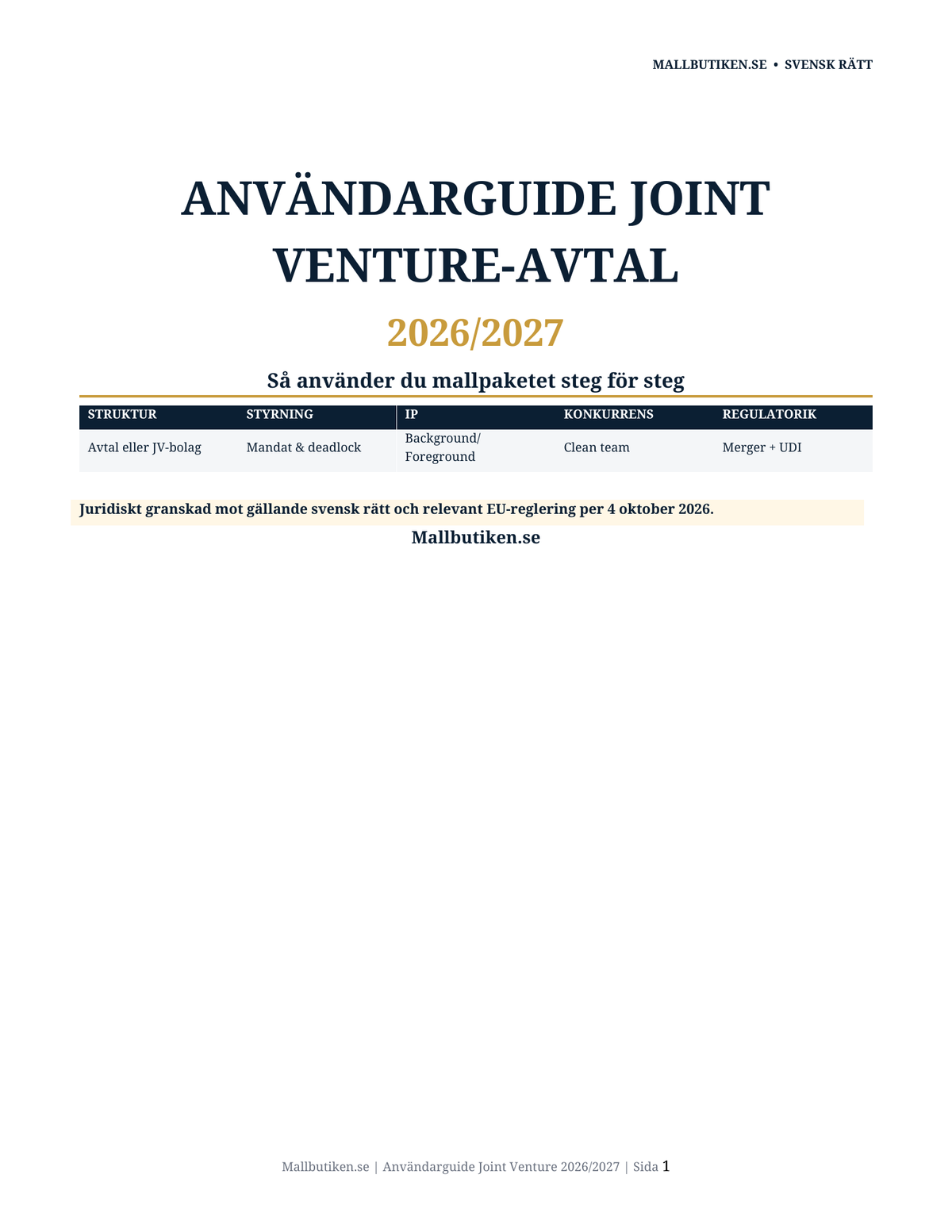
- Detailed user guide, 3 pages with document ordering, competition law checkpoints, UDI/FDI, deadlock, and a final checklist.
When is a Joint Venture agreement appropriate?
The template is suitable when two companies want to cooperate on a clearly defined project or business area without leaving key issues unregulated. Examples:
- joint product or technology development,
- joint market establishment,
- projects where the parties contribute different technology, IP, personnel, or capital,
- joint sales or commercialization of a specific result,
- strategic cooperation ahead of a future investment or joint venture company,
- company-based JV where a separate contractual framework around the operations is also needed.
Contractual JV or separate JV company?
A joint venture is not a specific Swedish corporate form. Therefore, the parties must first choose how the cooperation should be structured.
The package supports two main models:
- Contractual JV – the parties cooperate directly under the agreement without creating a separate limited liability company.
- Company-based JV – the cooperation is conducted through a separate joint company. In that case, necessary corporate law documents, such as articles of association and shareholders' agreements, must be drawn up separately.
The template, therefore, avoids the mistake of assuming that the heading "Joint Venture Agreement" in itself creates a new legal entity.
Important check – simple partnership (enkelt bolag)
According to the Swedish Act (1980:1102) on Trading Partnerships and Simple Partnerships, a simple partnership exists if two or more parties have agreed to conduct business in partnership without a trading partnership (handelsbolag) being formed.
A simple partnership is not a legal entity and cannot itself acquire rights or incur obligations. How a contractual JV is actually organized can therefore have legal significance regardless of what heading the parties have given the agreement.
The template therefore contains clear rules on external representation, authority, customer contracts, assets, and who is actually permitted to bind each party.
26 contract sections
The main agreement covers, among other things:
- background and purpose,
- JV model and legal structure,
- scope and objectives of the project,
- contributions and resources of the parties,
- governance and Joint Venture Committee,
- Reserved Matters and decision rules,
- budget, financing, and cost allocation,
- workstreams, personnel, and key individuals,
- Background IP and licenses,
- Foreground IP, data, and jointly developed results,
- confidentiality and trade secrets,
- information exchange and competition law,
- customers, market, and commercialization,
- revenues, costs, results, and tax,
- bookkeeping, reporting, and audit,
- compliance, anti-corruption, and sanctions,
- GDPR and information security,
- competition review and merger control,
- UDI/FDI and other regulatory approvals,
- warranties and information liability,
- liability and insurance,
- deadlock,
- agreement term and termination,
- winding up and exit,
- assignment and change of control,
- Swedish law and dispute resolution.
14 practical appendices / schedules
- JV model and parties – contractual or separate company, ownership shares, and need for separate SHA.
- Scope, objectives, and milestones – scope, market, customer groups, and explicit exclusions.
- Contributions, resources, and valuation – cash, personnel, assets, IP, and valuation principle.
- Governance and JV Committee – representation, quorum, meeting frequency, and mandate.
- Reserved Matters and deadlock – unanimity issues, escalation, mediation, and exit mechanics.
- Budget, financing, and cost key – cost allocation, additional financing, and budget tolerance.
- Workstreams and key individuals – responsible party, deliverables, and deadlines.
- Background IP and licenses – what each party brings into the JV.
- Foreground IP, data, and results – ownership of newly developed IP, project data, and joint results.
- Competition law, clean team, and GDPR – information limitation, aggregation, and data roles.
- Commercialization, customers, and revenue allocation – who sells, invoices, and bears warranty liability.
- Reporting, audit, and compliance – KPIs, audit, sanctions, and permits.
- Regulatory control and warranties – merger control, UDI/FDI, sector approvals, and warranties.
- Liability, insurance, time, exit, and dispute – liability caps, termination, winding up, and forum.
Governance and Reserved Matters
Joint ventures often fail not because the business idea is bad, but because the decision-making model is unclear. Appendices 4 and 5 therefore contain a specific governance model where the parties can specify:
- number of representatives from each party,
- chairperson,
- quorum,
- normal decision majority,
- which matters require unanimity,
- escalation when the parties cannot agree.
Reserved Matters may include, for example, budget, major investments, new markets, major customer contracts, financing, IP sales, and changes to the JV's fundamental strategy.
Deadlock – stepwise solution instead of immediate conflict
The package contains a specific deadlock structure. The first step is internal escalation to senior decision-makers. Thereafter, the parties can choose between mediation, expert determination on technical issues, replanning, or a specifically agreed exit mechanism.
An aggressive buy-sell clause is not automatically built in. Such mechanisms can have very major financial consequences and should only be activated after separate legal and financial assessment.
Background IP and Foreground IP
One of the most common conflicts in technology and development JVs is who owns what.
The template therefore clearly distinguishes between:
- Background IP – technology, software, patents, know-how, documentation, and other things a party owned or controlled before the JV.
- Foreground IP – results, technology, data, models, software, and other IP created within the JV project.
Appendices 8 and 9 are used to determine licenses, ownership, registration, costs, the right to license third parties, enforcement, and what happens after the JV terminates.
Competition law – especially important when parties are competitors
Joint ventures can create significant efficiency gains through shared risk, lower costs, shared know-how, and faster innovation. At the same time, cooperation between current or potential competitors can restrict competition if the agreement goes further than the project requires.
The template therefore limits information exchange to what is objectively necessary for the JV and specifically flags for:
- future individual prices,
- margins,
- customer-specific terms,
- strategic plans,
- competing bids,
- capacity information.
Appendix 10 can activate clean team, aggregation, and access restrictions so that competitively sensitive information is not spread more widely than necessary.
No price fixing or market division outside the JV
The agreement may not be used to coordinate the parties' independent competitive behavior outside the legitimate JV area. Price fixing, market division, bid coordination, or other prohibited coordination is not permitted just because the parties are simultaneously running a joint project.
Appendices 2 and 11 therefore help the parties distinguish the JV market from activities where each company continues to act independently.
Full-function JV can be a concentration
The Competition Act states that the formation of a joint venture that on a lasting basis performs all the functions of an autonomous economic entity constitutes a merger (concentration).
This means that a company-based JV is not always just a regular cooperation agreement. Before implementation, the parties may need to assess whether the transaction must be notified to the Swedish Competition Authority (Konkurrensverket) or the European Commission.
Swedish notification thresholds 2026
According to the main Swedish rules, a concentration must be notified to the Swedish Competition Authority when:
- the combined turnover in Sweden of the undertakings concerned in the preceding financial year exceeds SEK 1 billion, and
- at least two of the undertakings concerned each have a Swedish turnover exceeding SEK 200 million.
If only the first threshold is exceeded, a voluntary notification or a specific order from the Swedish Competition Authority may also be relevant.
New competition rules from August 1, 2026
From August 1, 2026, the Swedish Competition Authority gained extended possibilities to detect and review concentrations that would otherwise not be caught by the standard two-threshold rule.
The authority can, among other things, order companies to provide information for a limited period on concentrations to which they are a party. The package therefore does not contain a simple checkbox that only asks about 1 billion/200 million, but a broader regulatory control in Appendix 13.
UDI/FDI – investment in security-sensitive activities
If the JV involves investment in or control over Swedish security-sensitive activities, the Swedish Act (2023:560) on the Screening of Foreign Direct Investments may be applicable.
In 2026, both the ISP's notification process and the rules regarding which essential services are covered were updated. Appendix 13 therefore contains a specific UDI/FDI screening point before Closing or other irrevocable implementation measures.
Budget, financing, and additional capital
Appendix 6 makes it possible to agree on:
- annual budget,
- cost allocation,
- invoicing model,
- budget tolerance,
- liquidity reserve,
- process for additional financing.
This makes it clear whether a future capital need actually creates an obligation to contribute more money or only means that the parties must make a new decision.
Customers, invoicing, and warranty liability
A contractual JV needs to clearly state who is actually the contracting party toward the customer. Appendix 11 therefore contains separate choices for:
- who signs customer contracts,
- who invoices,
- who bears warranty liability,
- how revenues and direct customer costs are allocated,
- which customers are outside the JV.
GDPR and joint systems
If personal data is to be shared or processed within the JV, the parties must determine their roles according to GDPR. The parties can be independent data controllers, joint data controllers, or have a data processor relationship depending on the actual setup.
If Article 28 of the GDPR requires a data processing agreement (DPA), this must be entered into separately. Appendix 10 does not replace a full DPA.
Liability, insurance, and external contracts
Appendix 14 contains adaptable liability caps, carve-outs, and insurance levels. The template does not assume that the parties are automatically jointly and severally liable for each other's external contracts. Instead, it must be clear who has actually entered into a customer, supplier, or financing contract and what recourse rules apply between the parties.
Exit and winding up
Upon termination, there must be a practically feasible plan for:
- ongoing customer commitments,
- outstanding receivables and costs,
- joint assets,
- data export and deletion,
- Background IP and Foreground IP,
- any JV company,
- assignment or winding up of the project.
English Joint Venture Agreement under Swedish law
The English version contains the same legal structure and 14 schedules. It is intended when parties, group functions, investors, or advisors work in English but Swedish substantive law is to be applied.
It is, therefore, an English-language version under Swedish law – not a standard agreement under British or US law.
Detailed user guide included
The guide covers:
- contractual JV versus separate JV company,
- the risk of simple partnership,
- how the appendices are filled out in the correct order,
- competition law and information exchange,
- full-function JV and merger control,
- 2026 Swedish concentration rules,
- UDI/FDI,
- IP conflicts,
- deadlock,
- final checklist before signing.
Reviewed for 2026/2027
The legal review is dated October 4, 2026. The package has been checked against, among other things:
- Swedish Contracts Act (1915:218),
- Swedish Act on Trading Partnerships and Simple Partnerships (1980:1102),
- Competition Act (2008:579), including amendments effective from August 1, 2026,
- Article 101 of the TFEU and the European Commission's guidelines on horizontal cooperation agreements,
- Act (2023:560) on the Screening of Foreign Direct Investments,
- Trade Secrets Act (2018:558),
- General Data Protection Regulation (EU) 2016/679 (GDPR).
The designation 2026/2027 means that the documents have been reviewed against the legal situation and regulatory information at the date of review. In the event of later legislative amendments, major changes in practice, or changed regulatory classification, a new check should be performed.
Format and delivery
3 documents • 6 files • 43 pages • 14 appendices/schedules
- Word (DOCX) – fully editable.
- PDF – for reference, printing, and layout control.
- Swedish + English main agreements.
- Digital delivery – no physical product shipped.
Important
The template package is a professional general working document and does not replace individual legal, competition, tax, or regulatory advice. Full-function JVs, large market shares, international joint ventures, joint companies with complex ownership structures, UDI/FDI, large IP values, complicated financing, or advanced buy-sell/deadlock mechanisms should be assessed separately.