

Svenska Dokumentmallar
Commission Agreement 2026/2027 – Word/PDF + English | Swedish Law
Commission Agreement 2026/2027 – Word/PDF + English | Swedish Law
 Downloading the template is available immediately after purchase. Our document templates are always delivered in customizable formats.
 If you are unsure which template is appropriate or how you should complete it, please see the relevant information under the 'Legal Information' tab in our main menu.
 Our templates are designed in accordance with current legislation and practice in each area to ensure that the documents you create are legally correct.


Couldn't load pickup availability
Commission Agreement Template Package 2026/2027 – Word/PDF + English | Swedish Law
This is a complete and professional Commission Agreement for companies in which a commission agent is commissioned to sell or purchase personal property in their own name but on behalf of the principal. The package is designed for commercial B2B relationships where the parties require clear rules regarding goods, inventory, instructions, customer agreements, price, commission, accounting, credit risk, self-dealing, VAT, complaints, confidentiality, liability, termination, and severance pay.
The template package is legally reviewed against applicable Swedish law and current authority guidance as of October 4, 2026, and prepared for practical use during 2026/2027. The package includes a Swedish Commission Agreement, a complete English-language Commission Agreement under Swedish law, and a separate detailed user guide.
Delivery: 3 documents in both Word (DOCX) and PDF – a total of 6 files, 25 A4 pages, and 12 appendices/schedules. The product is delivered digitally. No physical goods are sent.
What is included
- Commission Agreement 2026/2027 – Swedish version, 10 pages with 26 contract sections and 12 appendices.
- Commission Agreement 2026/2027 – English / Swedish law, 10 pages with corresponding structure and 12 schedules.
- Detailed user guide, 5 pages with step-by-step instructions, VAT and contract law checkpoints, and a final checklist.
What is a commission agreement?
According to the Swedish Commission Act (2009:865), a commission is an assignment to sell or purchase personal property on behalf of another person but in one's own name. The person performing the assignment is the commission agent, and the person whose economic interest the business concerns is the principal.
The essential aspect is therefore that the commission agent becomes the visible contracting party toward third parties, while the transaction is economically executed on behalf of the principal.
The difference from commercial agency and resale
The template contains a clear distinction between three common forms of distribution:
- Commission: the intermediary acts in their own name but on behalf of the principal.
- Commercial Agency: the agent acts on behalf of the principal, and the agreement with the customer is concluded in the principal's name or by the agent forwarding offers to the principal.
- Resale: the reseller normally buys the goods and resells them in their own name and for their own economic account.
This distinction affects, among other things, who is the contracting party toward the end customer, who owns the inventory, how credit risk is handled, and which legal rules apply.
Sales commission or purchase commission
Appendix 2 allows for choosing whether the assignment concerns:
- sales commission,
- purchase commission, or
- both.
The Commission Act applies to the purchase and sale of personal property. The package is therefore not intended to be used unchanged as a pure service brokerage agreement or for real estate transfers.
26 contract sections
The main agreement covers, among other things:
- parties and background,
- the legal nature of the commission assignment,
- goods, market, territory, and sales channels,
- instructions, loyalty, and duty to inform,
- inventory, care, and segregation,
- agreements with third parties,
- price, discounts, and commercial instructions,
- self-dealing and combination,
- commission and reimbursement of expenses,
- accounting and settlement,
- credit risk and customer losses,
- VAT and invoicing,
- product liability, complaints, and consumer claims,
- trademarks and marketing,
- confidentiality and trade secrets,
- GDPR and information security,
- compliance and sanctions,
- audit and control,
- insurance and liability,
- right of lien and retention,
- agreement term and ordinary termination,
- immediate termination and bankruptcy,
- severance pay,
- assignment and sub-agent,
- governing law and dispute,
- signatures.
12 practical appendices / schedules
- Parties, contact, and authority – who is authorized to decide on price, discount, and contract changes?
- Assignment, goods, and market – type of commission, products, territory, and channels.
- Inventory, care, and insurance – storage location, inventory taking, shrinkage, segregation, and return.
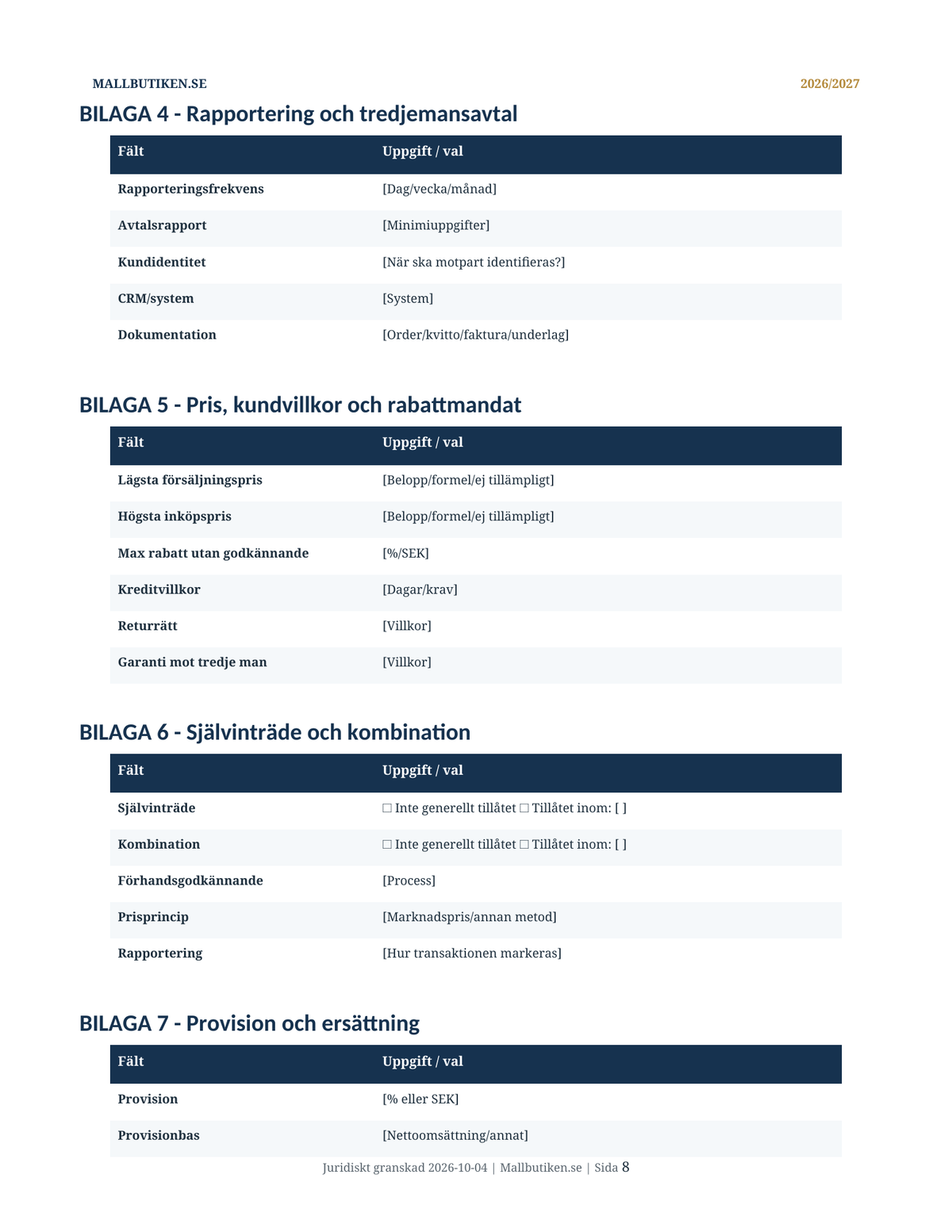
- Reporting and third-party agreements – reporting frequency, customer identity, and systems.
- Price, customer terms, and discount mandate – minimum/maximum price, credit terms, and warranty.
- Self-dealing and combination – express choices for conflict-of-interest situations.
- Commission and compensation – commission percentage, basis, returns, VAT, shipping, and costs.
- Settlement, money, and credit risk – bank account, segregation, debt collection, and receivables takeover.
- VAT and invoicing – VAT number, invoice flow, and international transactions.
- Product, complaints, return, and IP – product specification, consumer sales, and trademarks.
- Confidentiality, GDPR, and audit – roles, incident deadline, and right to audit.
- Liability, insurance, agreement term, and dispute – liability cap, termination, and forum.
The principal normally retains ownership of the commission goods
The Commission Act contains important protection under property law. When goods are delivered to the commission agent for sale, the principal remains the owner as a general rule until ownership transfers to the third party or, in cases of permitted self-dealing, to the commission agent.
The template therefore contains specific rules on:
- marking and identification of commission goods,
- segregation from other goods,
- inventory,
- shrinkage and damages,
- insurance,
- return of unsold goods.
This is particularly important when the commission agent stores goods for several different principals.
The commission agent is the contracting party toward the customer
When the commission agent sells to a third party, it is done in the commission agent's own name. Therefore, as a general rule, the third party acquires rights against the commission agent and not directly against the principal.
This affects how customer terms, invoicing, warranty, complaints, and credit risk should be structured. Appendix 4 and 5 are specifically designed to document these issues.
If the end customer is a consumer
The commission agreement itself is a B2B agreement between principal and commission agent, but the end customer may still be a consumer. In such cases, mandatory consumer law applies toward the party selling to the consumer.
The Commission Act also contains special rules that, under certain conditions, enable a consumer to direct claims for defects against the principal in earlier sales stages. The package therefore marks consumer sales as a separate checkpoint.
Instructions and price
According to the law, the commission agent must protect the principal's interests and follow instructions. The principal can, for example, specify a minimum price for sales commission or a maximum price for purchase commission.
If the instruction cannot or should not be followed, the commission agent must, under the Act's conditions, request new instructions or abandon the assignment, unless there are special reasons to act in another appropriate way.
Appendix 5 therefore contains concrete fields for price, discount mandate, credit period, return, and warranty.
Self-dealing – the commission agent becomes the buyer or seller
Self-dealing means that the commission agent enters as the buyer or seller in the business that was to be carried out on behalf of the principal.
This can create a clear conflict of interest. The Commission Act regulates when self-dealing and so-called combination are permitted. Appendix 6 of the package therefore has the standard choice that self-dealing is not generally approved and must have clear legal support or specific approval.
If self-dealing or combination occurs, this must also be disclosed openly to the principal.
Commission – when is it earned?
According to the Act, a commercial commission agent is entitled to commission on agreements entered into during the term of the assignment on behalf of the principal. In certain territorial or customer-based arrangements, the right to commission may be broader.
Appendix 7 makes the commission model concrete through separate fields for:
- commission percentage or fixed amount,
- commission basis,
- minimum compensation,
- returns and credit notes,
- freight and VAT,
- approved costs,
- payment frequency.
The Commission Act also contains certain mandatory protective rules for the commercial commission agent's right to commission.
Accounting and real price toward third parties
The commission agent must account for the assignment and the price agreed upon with the third party. The template therefore requires traceable documentation showing:
- customer or supplier agreements,
- actual price,
- discounts,
- returns,
- commission,
- reimbursement of costs,
- VAT,
- net amount to the principal.
Appendix 8 also contains audit and documentation points for situations where the principal needs to verify the settlement.
Credit risk and customer identity
The Commission Act contains special rules regarding the commission agent's liability when the agent does not disclose who the third-party agreement was entered with. The package therefore turns the issue of customer identity into an active contract choice rather than leaving it unregulated.
Appendix 8 also specifies who is responsible for credit assessment, debt collection, and customer losses, as well as how any takeover of the commission agent's claims against third parties should be handled.
Right of lien and security interest
The Commission Act may give the commission agent a right of lien in the principal's goods and certain claims as security for commission and other compensation. The commission agent may also, under certain conditions, have the right to withhold materials or stop delivery.
The template therefore does not attempt to write away such statutory rights with a simplified standard clause. Any additional security is documented in Appendix 12.
VAT – important to distinguish from civil law ownership
The Swedish Tax Agency (Skatteverket) treats mediation in one's own name on behalf of another as a separate VAT flow. In relevant situations, the goods or services are considered supplied in two stages: from the principal to the intermediary and from the intermediary to the customer.
This means that the civil law rule regarding who owns the commission goods does not alone determine how invoices and VAT should be handled.
Appendix 9 therefore contains:
- the parties' VAT numbers,
- who invoices the end customer,
- how invoicing/settlement occurs between the parties,
- checkpoint for import/export,
- checkpoint for margin scheme and consignment stock.
Notice periods – specific statutory scale
For a continuous commission agreement for an indefinite period, the Commission Act contains specific notice periods. The basic model is:
- 1 month during the first year of the assignment,
- 2 months during the second year,
- 3 months during the third year,
- thereafter one additional month per commenced year,
- maximum 6 months.
If the parties agree on a longer notice period, the principal's notice period may not be shorter than the commission agent's. Appendix 12 therefore reminds the user to check the law before a standard period is specified.
Severance pay – cannot simply be written away
In the case of a continuous commercial commission, the commission agent may be entitled to severance pay when the agreement ends, for example, if the commission agent has brought in new customers or significantly increased trade and the principal continues to have substantial benefit from this.
According to the law, the severance pay is limited to a maximum of an amount corresponding to one year's average commission according to the statutory calculation model. The claim must be made within one year from the termination of the agreement.
The package therefore does not contain an incorrect standard clause stating that the commission agent always waives severance pay.
Financial instruments – special exclusion
The Commission Act contains special exceptions when the assignment concerns trading in financial instruments. This template is primarily designed for commercial commission regarding other types of personal property and should not be used unchanged for securities trading or regulated financial activities.
English Commission Agreement under Swedish law
The English version contains the same legal structure and 12 schedules. It is intended for when the principal, commission agent, group function, or advisors work in English but Swedish substantive law is to be applied.
It is therefore an English-language Commission Agreement under Swedish law – not a British or American agency agreement.
Detailed user guide included
The guide explains step-by-step:
- how commission differs from agency and resale,
- how sales and purchase commission, respectively, are selected,
- how inventory and ownership are handled,
- how the commission is defined,
- self-dealing and combination,
- notice period and severance pay,
- VAT and invoice flow,
- consumer sales,
- final checklist before signing.
Reviewed for 2026/2027
The legal review is dated October 4, 2026. The package has been checked against, among others:
- Commission Act (2009:865),
- Contracts Act (1915:218),
- Consumer Sales Act (2022:260), where sales occur to consumers,
- VAT Act (2023:200),
- General Data Protection Regulation (EU) 2016/679 (GDPR),
- Trade Secrets Act (2018:558).
The designation 2026/2027 means that the documents have been reviewed against the legal situation and authority information as of the review date. In case of later legislative changes or changed authority practice, a new check should be performed.
Format and delivery
3 documents • 6 files • 25 pages • 12 appendices/schedules
- Word (DOCX) – fully editable.
- PDF – for reference, printing, and layout control.
- Swedish + English main agreements.
- Digital delivery – no physical product is sent.
Important
The template package is a professional general contractual foundation and does not replace individual legal, tax, or accounting advice. Financial instruments, international inventory and import setups, margin schemes, extensive consumer sales, regulated products, or other complex commission structures should be assessed separately.