

Svenska Dokumentmallar
Supplier Agreement 2026/2027 – Word/PDF + English | Swedish Law
Supplier Agreement 2026/2027 – Word/PDF + English | Swedish Law
 Downloading the template is available immediately after purchase. Our document templates are always delivered in customizable formats.
 If you are unsure which template is appropriate or how you should complete it, please see the relevant information under the 'Legal Information' tab in our main menu.
 Our templates are designed in accordance with current legislation and practice in each area to ensure that the documents you create are legally correct.


Couldn't load pickup availability
Supplier Agreement Template Package 2026/2027 – Word/PDF + English | Swedish Law
This is a complete and professional Supplier Agreement for ongoing B2B deliveries of goods and/or services. The package is designed for companies that want to manage their supplier relationship clearly from a purchasing and supply-chain perspective – with concrete rules regarding orders, forecasts, capacity, delivery precision, quality, warranty, product compliance, subcontractors, audits, continuity, GDPR, liability, and termination.
The template package is legally reviewed against applicable Swedish law and current EU regulation as of October 4, 2026 and developed for use during 2026/2027. It contains a Swedish Supplier Agreement, a complete English-language Supplier Agreement based on Swedish law, and a separate detailed user guide.
Delivery: 3 documents in both Word (DOCX) and PDF – a total of 6 files, 37 A4 pages, and 12 appendices/schedules. The product is delivered digitally. No physical goods are shipped.
What is included
- Supplier Agreement 2026/2027 – Swedish version, 17 pages with 26 contract sections and 12 appendices.
- Supplier Agreement 2026/2027 – English / Swedish law, 17 pages with a corresponding structure and 12 schedules.
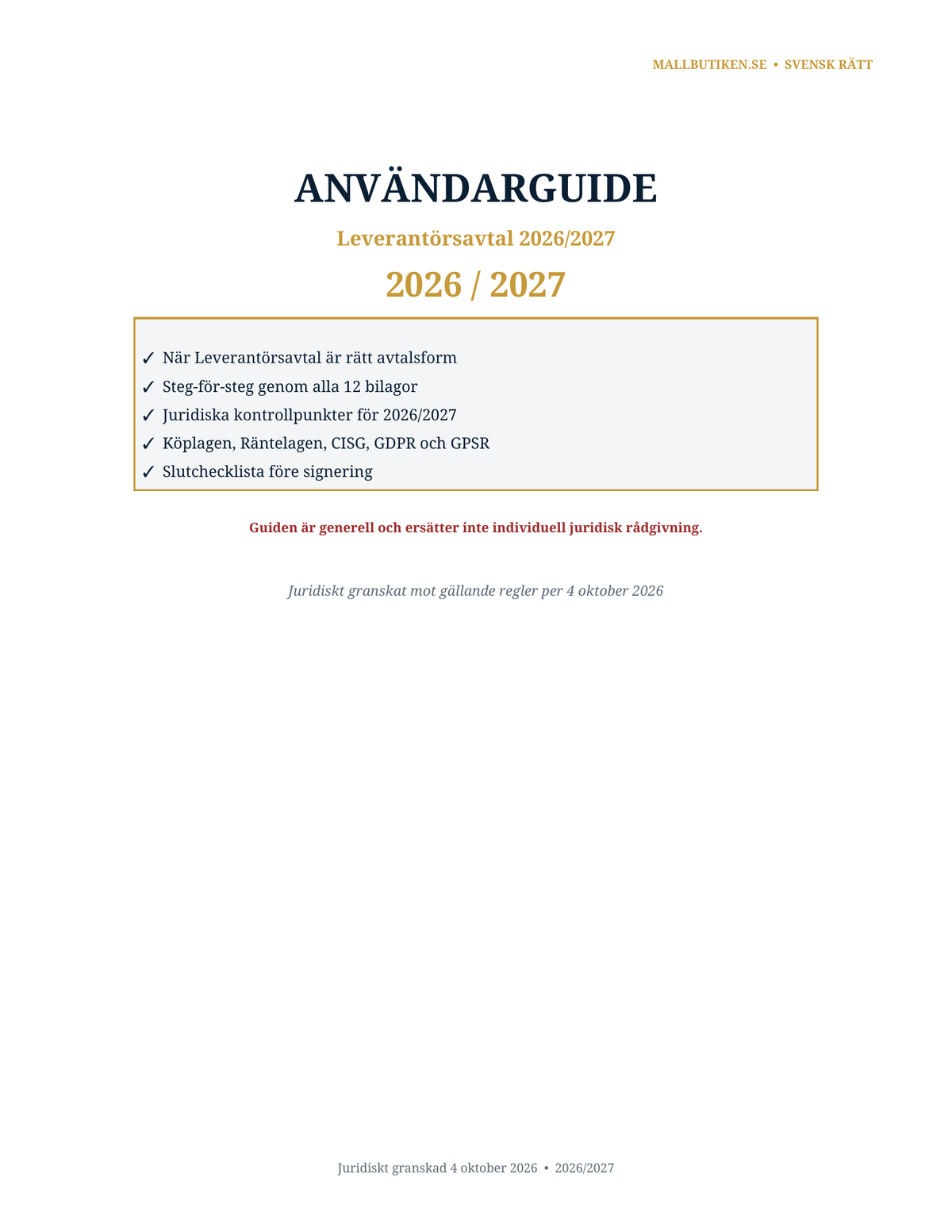
- Detailed user guide, 3 pages with legal checklists, a walkthrough of all appendices, and a final checklist.
When is a Supplier Agreement appropriate?
The template is intended for an identified supplier relationship between companies, for example when a company continuously buys products, components, spare parts, consumables, manufacturing, support, service, or other services from a supplier.
It is particularly suitable when the customer wants more control over the supplier's performance than what is typically covered by a simple purchase or standard purchase order.
Difference from Framework Agreements and Customer Agreements
A Framework Agreement is often more neutral and general between parties. A Customer Agreement typically focuses on a supplier's relationship with its customer. This Supplier Agreement, on the other hand, is structured from the buyer's purchasing and supply chain perspective.
This implies more and clearer clauses regarding, among other things:
- delivery precision and lead time,
- forecasts and reserved capacity,
- change control for factory, material, process, and subcontractor,
- root cause and recurring quality defects,
- product compliance and recalls,
- critical subcontractors,
- audit/inspection,
- business continuity and alternative sources of supply.
26 contract sections
The main agreement includes, among other things:
- background and purpose,
- contract documents and order of priority,
- scope and Orders,
- forecasts, capacity, and minimum commitments,
- prices, costs, and price changes,
- invoicing and payment,
- delivery of goods,
- services and deliverables,
- quality, specification, and change control,
- inspection, acceptance, and claims,
- defects, warranty, and remedy,
- product compliance, traceability, and recalls,
- subcontractors and supply chain,
- business continuity and delivery readiness,
- audit and follow-up,
- intellectual property rights and documentation,
- personal data and information security,
- confidentiality and trade secrets,
- compliance, sanctions, and anti-corruption,
- liability and limitation of liability,
- insurance,
- force majeure,
- term, termination, and exit,
- international purchases and CISG,
- notices, assignment, and amendments,
- governing law and dispute resolution.
12 practical appendices / schedules
- Products, services, and specifications – product/SKU, version, criticality, and documentation.
- Order process, authority, and contacts – order channel, authorized purchasers, and order confirmation.
- Forecasts, volumes, and capacity – forecast horizon, binding portion, minimum purchases, reserved capacity, and safety stock.
- Price list, indexing, and payment – prices, fees, price change mechanisms, and payment terms.
- Delivery, logistics, and Incoterms – delivery location, Incoterms 2020, lead time, delivery precision, and transfer of risk.
- Services, milestones, and acceptance – deliverables, key personnel, and acceptance criteria.
- Quality, change control, and control plan – quality standard, critical characteristics, and prior approval of changes.
- Warranty, claims, and remedy – warranty period, RMA, response times, and root-cause process.
- Product compliance, incidents, and recalls – product-specific rules, traceability, documentation, and recalls.
- Subcontractors, audit, and continuity – critical subcontractors, audit, BCP, and alternative supply.
- IP, data, and information security – intellectual property, GDPR, Data Processing Agreement (DPA), and incident reporting.
- Compliance, liability, term, CISG, and dispute – liability caps, insurance, termination, choice of law, and forum.
Orders and the supplier's standard terms
Appendix 2 is used to determine how an Order becomes binding and exactly who is authorized to place orders. The agreement also contains a clear order of priority between the main agreement, appendices, and Orders.
The supplier's own standard terms do not automatically apply just because they are printed on an order confirmation, invoice, or website. They must be explicitly accepted by the Buyer if they are to take precedence.
Forecasts are not the same as a purchase guarantee
In many supplier relationships, the customer sends rolling forecasts. A common dispute arises when the supplier perceives the forecast as binding while the customer views it as planning information.
Appendix 3 therefore distinguishes between:
- non-binding forecasts,
- potential binding forecast windows,
- minimum purchases,
- reserved capacity,
- safety stock.
If any of these are to be binding, it must be explicitly stated.
Price changes and payment terms
Appendix 4 makes it possible to use fixed prices, indexing, or other clearly defined pricing formulas. The supplier may not automatically refer to a later price list if the agreement does not permit such a price change.
For B2B receivables regarding goods and services, the Swedish Interest Act (Räntelagen) stipulates that payment shall generally be made no later than 30 days after a demand for payment. Between businesses, longer payment terms may be used if the creditor has explicitly approved the longer period.
Therefore, the template uses 30 days as the default and marks longer terms as an active contractual choice.
Delivery precision and Incoterms
For physical goods, Appendix 5 contains fields for:
- delivery location,
- Incoterms 2020,
- lead time,
- delivery precision/KPI,
- packaging and labeling,
- transfer of risk.
It is important not only to write, for example, "FCA" or "DAP" but also to specify the named location to which the chosen Incoterm relates.
The Swedish Sale of Goods Act – dispositive B2B regulation
The Sale of Goods Act (1990:931) applies to the sale of personal property and is largely dispositive (supplementary). This means that the parties can agree on solutions other than the statutory standard rules.
The Supplier Agreement therefore explicitly regulates, among other things, delivery, inspection, defects, warranty, and liability. In mixed contracts where the service constitutes the predominant part of the supplier's commitment, the Sale of Goods Act generally does not apply to the entire performance.
Quality and change control
Appendix 7 is designed for supplier relationships where the Buyer needs control over changes that could affect the product or delivery.
The parties can specify that the supplier must obtain written approval before, for example:
- materials are replaced,
- production processes are changed,
- manufacturing sites are relocated,
- designs are altered,
- critical subcontractors are replaced.
This is particularly relevant in industry, component supply, technology, and regulated products.
Warranty, RMA, and root cause
Appendix 8 contains structured fields for the warranty period, response time for critical failures, RMA/return process, cost liability, and recurring failures.
In this way, the agreement can link a quality problem to a concrete remedy process instead of a general formulation stating that the supplier is "liable for defects."
GPSR and product compliance – correct demarcation
The EU's General Product Safety Regulation (EU) 2023/988 imposes requirements on economic operators that manufacture or supply consumer products within the scope of the regulation. The rules cover, among other things, safety, traceability, technical documentation, and corrective measures.
The template does not claim that the GPSR automatically applies to all B2B goods. Appendix 9 is used instead to identify which product regulatory framework actually applies, for example:
- GPSR,
- CE-related harmonization legislation,
- product-specific EU regulations or directives,
- Swedish special legislation.
Recall and incident management
Appendix 9 contains fields for traceability, batch/serial numbers, technical documentation, incident contacts, and cost principles in the event of a recall.
This makes it possible to determine in advance how the parties will cooperate during a safety incident or product recall, including who bears which costs.
Subcontractors and supply chain
The supplier is fully responsible for its subcontractors. Appendix 10 makes it possible to identify critical supply links and demand prior approval before certain subcontractors or production sites are changed.
Relevant requirements regarding quality, safety, confidentiality, data protection, and compliance can also be passed on through the supply chain.
Business Continuity Plan – delivery readiness
For critical deliveries, the parties can document:
- safety stock,
- alternative production sites,
- alternative supply sources,
- recovery time targets,
- incident contacts,
- how often the continuity plan should be tested.
This makes the agreement useful even for suppliers whose downtime would affect the Buyer's own production or customer deliveries.
Audit – proportional control
The agreement includes provisions for supplier follow-up and, when the parties choose, audits. The audit right is intentionally limited to information necessary to verify, for example, quality, invoicing, or essential compliance.
This avoids a disproportionate audit clause that unnecessarily exposes the supplier's trade secrets.
GDPR and Data Processing Agreement (DPA)
If the supplier processes personal data on the Buyer's behalf, the parties normally need a separate data processing agreement under Article 28 of the GDPR.
Appendix 11 is used to document roles, systems, incident deadlines, storage, and deletion, but it does not replace a full DPA when a processor relationship exists.
Liability and insurance
Appendix 12 contains fill-in fields for liability caps, carve-outs, and insurance levels. The template leaves the amounts open because reasonable liability must be adapted to the contract value, criticality, insurance, and actual risk.
International sales of goods and CISG
For international sales of goods, the CISG and the Act (1987:822) on International Sales of Goods may become applicable. Appendix 12 therefore requires the parties to actively state whether the CISG is to apply or be excluded.
For purchases where both the seller and the buyer have their places of business in Denmark, Finland, Iceland, Norway, or Sweden, the special Nordic rule in Section 2 of the Act on International Sales of Goods applies.
English Supplier Agreement according to Swedish law
The English version contains the same structure and 12 schedules. It is intended for situations where the supplier, customer, group functions, or advisors work in English but Swedish substantive law is to be applied.
It is thus an English-language template based on Swedish law and not a British or American standard agreement.
Detailed user guide included
The separate user guide covers:
- when a Supplier Agreement is the right form of contract,
- the difference between Framework Agreements and Customer Agreements,
- the Sale of Goods Act,
- the 30-day rule in the Interest Act,
- CISG,
- GDPR/DPA,
- GPSR and product-specific regulation,
- all 12 appendices,
- common mistakes to avoid,
- final checklist before signing.
Reviewed for 2026/2027
The legal review is dated October 4, 2026. The package has been checked against, among others:
- the Contracts Act (1915:218),
- the Sale of Goods Act (1990:931),
- the Interest Act (1975:635),
- the Act (1987:822) on International Sales of Goods and CISG,
- the General Data Protection Regulation (EU) 2016/679 (GDPR),
- the Regulation (EU) 2023/988 on General Product Safety (GPSR), where applicable,
- the Trade Secrets Act (2018:558).
Format and delivery
3 documents • 6 files • 37 pages • 12 appendices/schedules
- Word (DOCX) – fully editable.
- PDF – for reference, printing, and layout control.
- Swedish + English main agreements.
- Digital download – no physical product is sent.
Important
The template package is a professional general contractual basis and does not replace individual legal advice. Regulated products, medical technology, food, chemicals, vehicles, defense materiel, extensive IT outsourcing, complex international trade, or other high-risk deliveries may require product-specific or industry-specific clauses.