

Svenska Dokumentmallar
License Agreement 2026/2027 – Word/PDF + English | Swedish Law
License Agreement 2026/2027 – Word/PDF + English | Swedish Law
 Downloading the template is available immediately after purchase. Our document templates are always delivered in customizable formats.
 If you are unsure which template is appropriate or how you should complete it, please see the relevant information under the 'Legal Information' tab in our main menu.
 Our templates are designed in accordance with current legislation and practice in each area to ensure that the documents you create are legally correct.


Couldn't load pickup availability
License Agreement Template Package 2026/2027 – Word/PDF + English | Swedish Law
This is a complete and professional License Agreement for B2B Licensing of Intellectual Property. The package is designed for companies that wish to grant or acquire a clearly defined right of use for, for example, software, copyrighted material, trademarks, patents, technical know-how, or combinations thereof.
The template package is legally reviewed against current Swedish law and relevant EU regulations as of October 4, 2026, and prepared for practical use during 2026/2027. The package includes a Swedish License Agreement, a complete English-language License Agreement governed by Swedish law, and a separate detailed user guide.
Delivery: 3 documents in both Word (DOCX) and PDF – a total of 6 files, 37 A4 pages, and 12 appendices/schedules. Digital download. No physical product will be shipped.
Included in this package
- License Agreement 2026/2027 – Swedish version, 17 pages with 26 contract sections and 12 appendices.
- License Agreement 2026/2027 – English / Swedish law, 17 pages with equivalent structure and 12 schedules.
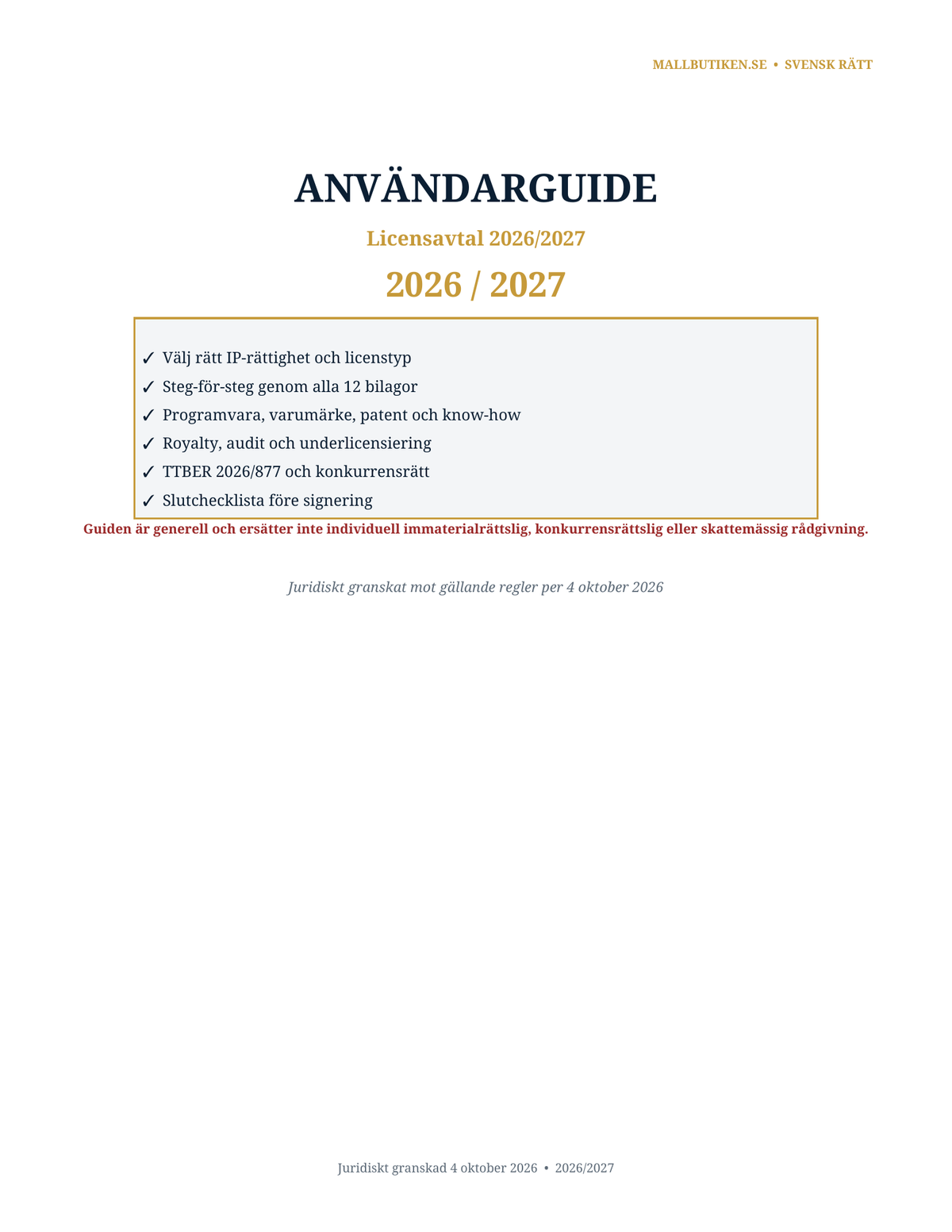
- Detailed user guide, 3 pages with legal sources, competition law checkpoints, and a final checklist.
Which rights can be licensed?
Appendix 1 is used to precisely identify which rights are covered. The template can be adapted for, among other things:
- software and computer programs,
- copyrighted material, such as texts, designs, images, documentation, and educational material,
- registered or unregistered trademarks,
- patents and patent applications,
- know-how and trade secrets,
- technical documentation, drawings, and design material,
- combined technology and trademark licenses.
The agreement does not automatically transfer ownership of the IP rights. It only grants the right of use expressly specified.
26 contract sections
The main agreement covers, among other things:
- background and purpose,
- definitions,
- licensed objects and chain of title,
- scope of the license,
- permitted uses and restrictions,
- sublicensing,
- delivery, access, and technical material,
- license fees, royalties, and minimum payments,
- reporting, accounting, and audit,
- trademarks and quality control,
- software and mandatory user rights,
- know-how and trade secrets,
- improvements, further development, and new IP,
- maintenance and registration of IP,
- infringement and third-party claims,
- Licensor's warranties,
- Licensee's obligations,
- liability and indemnification,
- competition law and technology transfer,
- GDPR and information security,
- confidentiality,
- term and termination,
- effect of termination,
- assignment and change of control,
- notices and amendments,
- Swedish law and dispute resolution.
12 practical appendices / schedules
- Licensed Objects and IP Register – right type, title/version, registration number, and chain of title.
- License Type, Territory, and Field of Use – exclusive, sole, or non-exclusive license.
- Permitted Uses and Restrictions – use, copying, modification, distribution, integration, and reverse engineering.
- Sublicensing – if and how rights may be sublicensed.
- Fees, Royalties, and Minimums – royalty base, percentage, minimum compensation, and payment frequency.
- Reporting and Audit – royalty reports, archiving, and audit rights.
- Trademark, Graphic Profile, and Quality – approved marks, quality standards, and brand guidelines.
- Software, Technology, and Support – delivery model, version, source code, support, and security requirements.
- Know-How, Confidentiality, and Security – protectable know-how, recipients, and deletion.
- Improvements and New IP – ownership, joint development, and grant-back.
- IP Maintenance, Infringement, and Third-Party Claims – renewals, litigation control, and costs.
- Liability, Term, Data, and Dispute – liability caps, termination, sell-off, and forum.
Exclusive, sole, or non-exclusive license
Appendix 2 allows you to choose between three different license models:
- Exclusive license – the exclusivity the parties expressly define within the Territory and Field of Use.
- Sole license – can be used when the Licensor themselves retains certain usage rights but will not grant equivalent rights to others.
- Non-exclusive license – the Licensor can normally grant equivalent rights to multiple licensees.
Territory, products, services, field of use, and sales channels are documented separately so that “exclusivity” does not become an unclear umbrella term.
Royalties – more than just a percentage
Appendix 5 includes support for one-time fees, ongoing royalties, fees per unit/user, and minimum royalties. However, the most important aspect is defining the royalty base itself.
The parties can therefore specify how Net Sales are to be calculated and how, for example, discounts, returns, credits, taxes, freight, intra-group sales, or combination products should be treated.
Audit and royalty control
Appendix 6 contains a proportionate audit model where the parties can specify reporting periods, archiving time, audit notice, frequency, and cost distribution in the event of a significant identified discrepancy.
The audit is designed so that the Licensor can verify royalties while protecting the Licensee's own trade secrets.
Software license – updated according to Swedish copyright law 2026
The Copyright Act expressly protects computer programs. For software, it is simultaneously important that a license agreement does not attempt to contract out of rights that are mandatory by law.
The template therefore pays special attention to Sections 26g and 26h of the Copyright Act. Any person entitled to use a computer program has, under the conditions of the law, certain rights including necessary backup copying, studying the function of the program, and decompilation when necessary for interoperability. Contractual terms restricting some of these rights are invalid.
Therefore, the template does not use an absolute prohibition against all reverse engineering regardless of law, but ties the restriction to what is legally permitted.
SaaS and cloud services
Appendix 8 can be used for SaaS, APIs, and other digital technology, but a SaaS arrangement normally involves more issues than the license itself – such as operations, hosting, SLA, backup, support, data export, and information security.
For comprehensive SaaS services, the License Agreement should therefore be combined with or replaced by a specific SaaS/cloud service agreement.
Trademark license under Swedish law
Chapter 6 of the Trademarks Act (2010:1877) contains special rules regarding licenses. A trademark license can be exclusive or non-exclusive and apply to all or parts of the registration's goods/services and geographic area.
Furthermore, the trademark owner can exercise their exclusive right against a licensee who violates certain key license terms, such as regarding:
- the validity period of the license,
- how the trademark may be used,
- which goods or services the license covers,
- geographic area,
- the quality of the licensee's goods or services.
Appendix 7 therefore contains separate fields for trademark manuals, approval processes, and quality standards.
Patent license – new Patents Act (2024:945)
As of January 1, 2025, Sweden has a new Patents Act (2024:945). Patent licenses are regulated in Chapter 13 of the Act.
According to Chapter 13, Section 2, a licensee may assign or sublicense their patent license only if the patent holder has consented. Appendix 4 therefore contains an explicit choice regarding sublicensing and assignment when patents are included.
A patent license may, upon request, be recorded in the patent register. The package also serves as a reminder regarding patent annual fees, registration maintenance, and who controls infringement proceedings.
Know-how and trade secrets
Know-how is often a central part of commercial technology licenses but is not the same as a registered exclusive right. Protection is dependent on the information actually being treated as secret and worthy of protection.
Appendix 9 therefore contains fields for:
- description of know-how,
- authorized recipients,
- technical security measures,
- confidentiality after the agreement ends,
- return and deletion.
Improvements and further development
Appendix 10 is used to determine who owns:
- the Licensor's improvements,
- the Licensee's improvements,
- joint development,
- customer-specific adaptations,
- new registerable IP rights.
It is also possible to document any grant-back, but this should be checked under competition law before use.
New TTBER 2026 – important update
The European Commission's new Regulation (EU) 2026/877 on technology transfer agreements entered into force on May 1, 2026, replacing the previous Regulation 316/2014.
The block exemption provides a competition law safe harbor for certain technology licenses when the conditions are met. For agreements between competing companies, the market share threshold is normally 20% combined. For parties that are not competitors, the threshold is normally 30% for each party.
This does not mean that a license agreement above these levels is automatically prohibited, but it cannot rely on the same automatic block exemption and must then be assessed individually.
Therefore, the template does not automatically contain far-reaching territorial restrictions, price fixing, or exclusive grant-back clauses without specific review.
Transitional rule until April 30, 2027
For agreements that were already in force on April 30, 2026, and which met the conditions of the previous TTBER regulation, there is a transition period until April 30, 2027, according to the new regulation.
This makes the 2026/2027 version particularly relevant for companies that are both entering into new license agreements and updating older technology licenses.
Infringement and third-party claims
Appendix 11 regulates who:
- pays renewal and annual fees,
- receives infringement notices,
- decides on legal action,
- controls settlements,
- bears the costs,
- has the right to any damages or settlement compensation.
This is particularly important in an exclusive license where the Licensee's commercial value may depend on infringements actually being prosecuted.
Liability and IP warranties
The agreement distinguishes between a warranty that the Licensor has the authority to grant the license and a much broader warranty that the IP right is completely risk-free or can never be attacked.
The template therefore avoids automatically providing an unlimited warranty of validity or non-infringement. Liability caps, carve-outs, and any indemnifications are filled in separately in Appendix 12.
GDPR and information security
If the license involves the processing of personal data, the parties' GDPR roles must be assessed separately. If one party processes personal data on behalf of the other party, a separate data processing agreement normally needs to be entered into pursuant to Article 28 GDPR.
Termination of the agreement and sell-off
Appendix 12 regulates what happens when the license ends. The parties can specify:
- whether all use must cease immediately,
- whether a limited sell-off period shall apply,
- what happens to inventory and licensed products,
- whether data or documentation should be exported,
- whether source code or escrow should be released,
- whether support or transition assistance should continue for a period.
English License Agreement under Swedish law
The English version contains the same legal structure and 12 schedules. It is intended for relationships where licensees, licensors, group functions, or advisors work in English but Swedish substantive law is to apply.
It is therefore an English-language agreement governed by Swedish law – not a standard template according to British or US law.
Detailed user guide included
The guide covers:
- how to identify the right type,
- the difference between ownership and license,
- exclusive/sole/non-exclusive license,
- TTBER 2026/877 and market share thresholds,
- the software's mandatory user rights,
- trademark license and quality,
- patents and sublicensing,
- royalties and audits,
- improvements and new IP,
- infringement and rights maintenance,
- final checklist before signing.
Reviewed for 2026/2027
The legal review is dated October 4, 2026. The package has been checked against, among other things:
- Act (1960:729) on Copyright in Literary and Artistic Works, including the rules on computer programs,
- Trademarks Act (2010:1877), especially Chapter 6 on licenses,
- Patents Act (2024:945), especially Chapter 13 on licenses,
- Trade Secrets Act (2018:558),
- Competition Act (2008:579) and Article 101 TFEU,
- Commission Regulation (EU) 2026/877 on technology transfer agreements,
- General Data Protection Regulation (EU) 2016/679 (GDPR),
- Contracts Act (1915:218) regarding contracts and other legal transactions in the field of property law.
Format and delivery
3 documents • 6 files • 37 pages • 12 appendices/schedules
- Word (DOCX) – fully editable.
- PDF – for reference, printing, and layout control.
- Swedish + English main agreements.
- Digital delivery – no physical product is shipped.
Important
The template package is a professional general contractual basis and does not replace individual intellectual property, competition law, tax, or data protection advice. Patent pools, FRAND/standard-essential patents, complex open-source use, international tax/royalty issues, large exclusive technology licenses, pharmaceuticals, life science, or very high IP values should be assessed separately.