

Svenska Dokumentmallar
Probationary Employment Agreement 2026/2027 – Word/PDF + User Guide | Swedish Law
Probationary Employment Agreement 2026/2027 – Word/PDF + User Guide | Swedish Law
 Downloading the template is available immediately after purchase. Our document templates are always delivered in customizable formats.
 If you are unsure which template is appropriate or how you should complete it, please see the relevant information under the 'Legal Information' tab in our main menu.
 Our templates are designed in accordance with current legislation and practice in each area to ensure that the documents you create are legally correct.


Couldn't load pickup availability
Probationary Employment Agreement 2026/2027 – Word/PDF according to the Employment Protection Act (LAS)
This is a complete and professional template for a probationary employment agreement in accordance with Swedish labor law. The template is designed for employers who want to clearly document a probationary period from day one while simultaneously including the written information on employment terms required by the Employment Protection Act (1982:80), LAS.
The template package was legally reviewed on October 4, 2026, and is intended for use during 2026/2027. The document specifically takes into account the rules on probationary employment in Section 6 of the LAS, the duty to provide information in Section 6 c of the LAS, and the employer's duty to notify and consult under Section 31 of the LAS.
Delivery: Probationary employment agreement in Word and PDF format, as well as a separate, detailed user guide in Word and PDF – a total of 4 files and 8 A4 pages.
This is included
- Probationary Employment Agreement 2026/2027 – 5 pages.
- Detailed User Guide – 3 pages.
- Word (DOCX) for editing.
- PDF for printing and reference.
- Checklist for information according to Section 6 c of the LAS.
- Fields for salary, working hours, workplace, duties, collective agreements, vacation, pension, insurance, and other terms.
What is probationary employment?
Probationary employment is a fixed-term form of employment used to give the employer and the employee the opportunity to test the employment before it transitions into permanent employment.
According to Section 6 of the LAS, the probationary period may normally be no more than six months. If neither party provides notice that the employment shall not continue by the end of the probationary period, the probationary employment transitions into permanent employment.
Collective agreements may contain deviating rules. Therefore, both the agreement and the user guide contain clear reminders to check the collective agreement before using the template.
Clear monitoring of the probationary period's end date
One of the most common practical mistakes in probationary employment is for the employer to miss the end date. The template therefore includes a special agreement overview with:
- agreement date,
- start date,
- last day of the probationary period,
- information on intended transition to permanent employment.
The user guide also recommends that the employer set up an internal reminder several weeks before the end date.
Employer and employee
The agreement includes clear sections for the identification of both parties, including:
- company name and corporate registration number,
- employer's address and contact details,
- contact person,
- employee's name,
- personal identity number or coordination number,
- address, telephone, and email.
Position, duties, and workplace
The LAS requires written information regarding, among other things, duties, job title, and workplace. The template therefore includes separate fields for:
- position or job title,
- main duties,
- immediate supervisor,
- main workplace,
- work at other locations,
- remote or hybrid work.
There is also a balanced standard clause regarding the scope of the duties, ensuring the agreement does not become unnecessarily narrow while keeping the content of the employment clear.
Employment rate and working hours
The template includes fields for:
- employment rate in percent,
- full-time or part-time,
- normal working hours per week,
- regular working hours,
- fixed, scheduled, or varying working hour arrangements,
- minimum notice period for schedule changes,
- shifts, on-call duty, and standby.
Full-time is the baseline according to the LAS unless otherwise agreed. If the employment is part-time, the employment rate should therefore be stated clearly.
Salary and other compensation
The agreement has a separate salary and compensation section where the employer can specify:
- monthly salary or hourly wage,
- salary payment date,
- payment method,
- inconvenient working hours (OB) allowance,
- overtime and additional hours compensation,
- bonus or commission,
- other salary benefits.
This makes it easier to fulfill the LAS requirement that starting salary and other salary benefits must be stated separately.
Vacation and leave
Vacation and vacation pay are regulated by the Annual Leave Act, applicable collective agreements, and any individual agreements. The template includes fields for, among other things:
- vacation benefit,
- vacation year,
- any advance vacation.
Collective agreements, pension, and insurance
Because collective agreements can affect a large part of the employment terms, the template contains its own section for:
- whether a collective agreement exists,
- which collective agreement and sector apply,
- occupational pension,
- collectively agreed or other insurance.
Training and introduction
The LAS information rules also include the right to training provided by the employer, when applicable. The template therefore has fields for introduction, mandatory training, and other training.
Confidentiality and information security
The agreement contains a balanced provision regarding trade secrets, confidentiality, data protection, and information security. The provision is explicitly designed not to limit statutory rights, such as rights under whistleblower regulations or other mandatory law.
Other employment and secondary occupations
The LAS contains protections against general prohibitions on holding other employment. The template follows this principle and states that restrictions may be relevant when the other employment prevents the employee from performing their work, involves harmful competition, or could otherwise harm the employer's business.
How is probationary employment terminated?
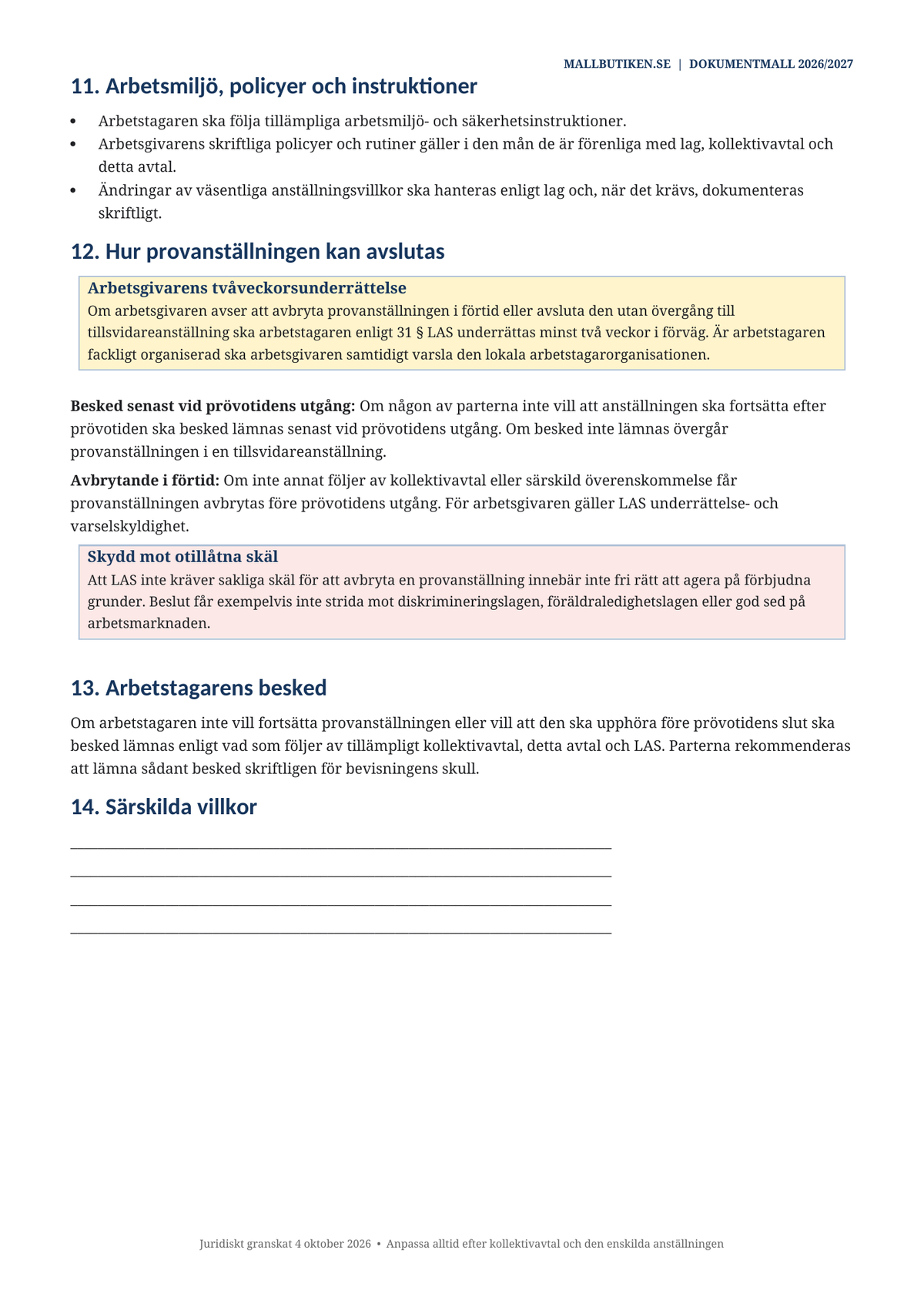
If the employer wants to terminate the probationary employment early or end it without it transitioning into permanent employment, the employee must, according to Section 31 of the LAS, normally be notified at least two weeks in advance.
If the employee is unionized, the employer must simultaneously notify the local employee organization to which the employee belongs. The employee and the organization have the right to consultation.
The template therefore contains a clear warning box regarding the two-week rule and refers to the fact that the employer should use a separate written notice when the probationary employment is to be ended. The Mallbutiken (template shop) already has separate templates for this purpose.
Objective grounds are normally not required – but decisions must not be prohibited
A probationary employment can normally be terminated without the employer needing to demonstrate objective grounds in the same way as with the dismissal of permanent employment. However, this does not mean that the employer has the unrestricted right to end the probationary employment on any grounds whatsoever.
For instance, termination must not conflict with:
- the Discrimination Act,
- the Parental Leave Act,
- other mandatory protective legislation,
- good practice in the labor market.
The agreement and the guide highlight this clearly to reduce the risk of incorrect use of the probationary employment form.
Parental leave and VAB (Temporary Parental Leave) during probation
The employer may not terminate a probationary employment because the employee exercises their statutory right to parental leave or VAB. If an extended parental leave has made it impossible to assess the employee's performance, the legal situation may in certain cases instead necessitate an extension of the probationary period to a corresponding extent.
The user guide addresses this as a specific risk factor.
Checklist for Section 6 c of the LAS
The main agreement contains a special checklist with the key information points according to the LAS, including:
- parties, start date, and workplace,
- duties and job title,
- form of employment and probationary period,
- salary and salary benefits,
- working hours,
- overtime and additional hours,
- scheduling of working hours,
- client company in staffing/agency work,
- training,
- vacation,
- rules for when employment ends,
- social protection,
- collective agreements.
Detailed User Guide included
The separate guide covers, among other things:
- when probationary employment is the right form of employment,
- how the probationary period is calculated and monitored,
- how collective agreements affect the agreement,
- LAS information requirements,
- how to fill in salary, working hours, and benefits,
- duties and workplace,
- how the employer terminates the probationary employment correctly,
- prohibited grounds and risk of discrimination,
- parental leave during the probationary period,
- vacation, illness, and other absences,
- secondary occupations and other employment,
- final checklist before signing.
Legally reviewed for 2026/2027
The documents were reviewed on October 4, 2026, based on, among other things:
- Employment Protection Act (1982:80) (LAS), particularly Sections 4a, 6, 6 c, and 31.
- Annual Leave Act (1977:480).
- Working Hours Act (1982:673), where applicable.
- Discrimination Act (2008:567).
- Parental Leave Act (1995:584).
- Trade Secrets Act (2018:558), where relevant.
Format and delivery
- Word (DOCX) – fully editable.
- PDF – print-ready A4 format.
- 2 documents / 4 files / 8 A4 pages.
- Digital delivery – no physical product is sent.
Frequently asked questions
How long can a probationary period be?
Normally a maximum of six months according to the LAS. Always check the collective agreement as deviating rules may exist.
What happens if the employer misses the end date?
If notice that the employment will not continue is not provided by the end of the probationary period, the probationary employment transitions into permanent employment.
Must the employer have objective grounds?
Not in the same way as when dismissing someone from permanent employment, but the decision must not conflict with the Discrimination Act, the Parental Leave Act, or other mandatory law.
How far in advance must the employer notify?
At least two weeks in advance according to Section 31 of the LAS when the employer wants to terminate the probationary employment early or end it without a transition to permanent employment.
Is information according to Section 6 c of the LAS included?
Yes. The template has been built to collect the majority of the information that the employer must provide in writing.
Can the template be used at workplaces with collective agreements?
Yes, but the collective agreement must be checked, and deviating rules shall take precedence where they are valid.
Important
The template is a professional general document base. Collective agreements, industry rules, and the specific circumstances of the individual employment may require adjustments. In case of complicated labor law conditions, individual advice should be sought.