

Svenska Dokumentmallar
Special Fixed-Term Employment (SÄVA) 2026/2027 – Word/PDF + User Guide
Special Fixed-Term Employment (SÄVA) 2026/2027 – Word/PDF + User Guide
 Downloading the template is available immediately after purchase. Our document templates are always delivered in customizable formats.
 If you are unsure which template is appropriate or how you should complete it, please see the relevant information under the 'Legal Information' tab in our main menu.
 Our templates are designed in accordance with current legislation and practice in each area to ensure that the documents you create are legally correct.


Couldn't load pickup availability
Special Fixed-term Employment (SÄVA) 2026/2027 – Word/PDF + User Guide
This is a complete and professional template for special fixed-term employment (SÄVA) according to Swedish labor law. The template is designed for employers who want to document a fixed-term employment correctly in accordance with the Employment Protection Act (1982:80) (LAS) while simultaneously providing the written information on employment terms required by Section 6 c of the Employment Protection Act.
The template package was legally reviewed on October 4, 2026, and is intended for use during 2026/2027. It specifically takes into account the regulations regarding SÄVA in Sections 5 and 5 a of the Employment Protection Act, the three-employment rule in Section 3, the information requirements in Section 6 c, notice according to Section 15, and priority rights according to Section 25.
Delivery: SÄVA agreement in Word and PDF as well as a separate detailed user guide in Word and PDF – a total of 4 files and 10 A4 pages.
This is included
- Special Fixed-term Employment (SÄVA) 2026/2027 – 6 pages.
- Detailed user guide – 4 pages.
- Word (DOCX) – fully editable.
- PDF – print-ready A4 format.
- History table for previous fixed-term employments.
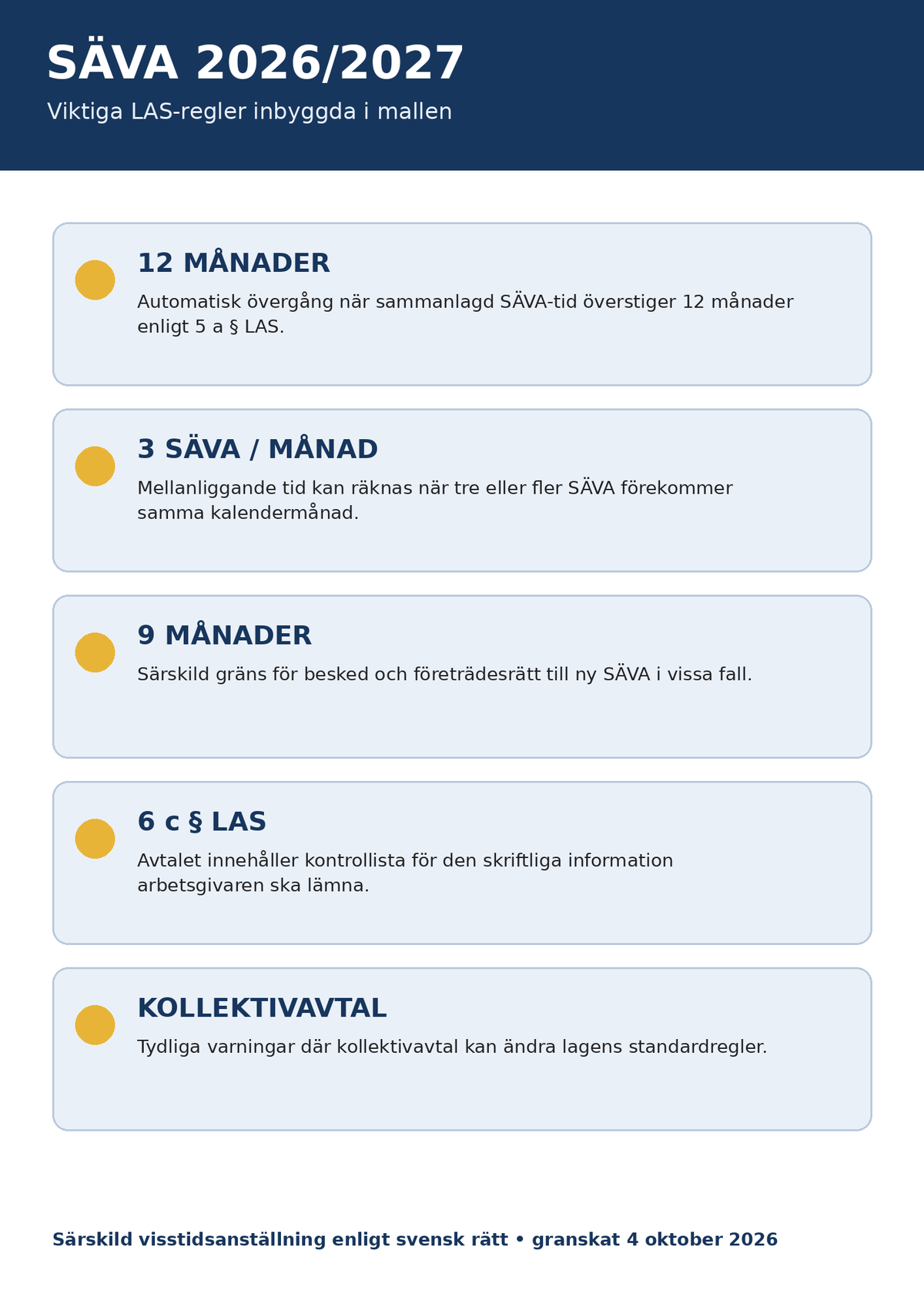
- Check of the 12-month limit, the 9-month limit, and the three-SÄVA rule.
- Checklist according to Section 6 c of the Employment Protection Act.
What is special fixed-term employment?
Special fixed-term employment is one of the types of fixed-term employment that may be used according to Section 5 of the Employment Protection Act. It replaced the previous general fixed-term employment. Unlike, for example, substitute positions, the employer generally does not need to provide a specific objective reason for the SÄVA form itself, but collective agreements may contain other or supplementary rules.
It is important that the form of employment is explicitly stated as special fixed-term employment. The Employment Protection Act requires that the information stating that the employment is SÄVA be provided at the time the employment is entered into, regardless of how short the employment is.
Automatic conversion after more than 12 months
One of the most important rules is that SÄVA automatically converts to permanent employment when the employee has been employed in special fixed-term employment for a total of more than 12 months:
- during a five-year period, or
- during a period where SÄVA, substitute employment, or seasonal work have followed one another.
Employments are considered to have followed one another when the next employment begins within six months of the end date of the previous one.
The template therefore contains a special history table where previous SÄVA, substitute, and seasonal employment can be documented before a new agreement is entered into.
Three or more SÄVA in the same calendar month
If the employee has had three or more special fixed-term employments with the same employer during one and the same calendar month, the time between the employments shall also be counted as SÄVA time when applying several central Employment Protection Act rules.
This rule is particularly important for employers who use short shifts, single days, or recurring short fixed-term periods.
The template contains a special check point for this so that intervening days are not overlooked.
Notice after more than nine months of SÄVA
An employee who is not to receive continued employment may be entitled to notice according to Section 15 of the Employment Protection Act. For SÄVA, a specific time limit applies: the employee is covered by the duty to provide notice if, at the end of the employment, he or she has been employed in SÄVA for a total of more than nine months during the last three years.
The notice should generally be given at least one month before the end of the employment. If the employment is so short that notice cannot be given one month in advance, it should instead be given when the employment begins.
Priority right to new SÄVA
If continued employment is not offered due to redundancy, an employee may gain a priority right to re-employment if the conditions in the Employment Protection Act are met. For a priority right to a new special fixed-term employment, a central time limit is more than nine months of SÄVA during the last three years.
The template therefore contains separate fields for estimated SÄVA time and a check on whether priority rights need to be assessed.
Start and end of employment
SÄVA is a fixed-term employment and as a main rule ends when the agreed time expires, unless otherwise agreed, provided by a collective agreement, or the employment has previously converted to permanent employment.
The template contains a clear selection section regarding whether the parties wish to agree on a possibility of termination during the employment period itself. This reduces the risk of someone mistakenly assuming that a standard notice period automatically applies.
Employer and employee
The agreement has structured fields for, among other things:
- company name and organization number,
- employer's address and contact details,
- contact person,
- employee's name and personal identity number/coordination number,
- address, phone, and email.
Position, duties, and workplace
The template contains clear fields for:
- position/job title,
- main duties,
- immediate supervisor,
- primary workplace,
- work at other locations,
- remote or hybrid work.
Employment rate and working hours
The agreement documents, among other things:
- employment rate,
- full-time or part-time,
- normal working hours per week,
- regular working hours or schedule,
- varying working hours,
- lead time for schedule changes,
- shifts, on-call duty, and readiness.
The Employment Protection Act assumes full-time unless otherwise agreed. If the employment is part-time, the employment rate should therefore be stated clearly.
Salary and other compensation
The template contains separate fields for:
- monthly or hourly salary,
- salary payment date,
- payment method,
- inconvenient working hours (OB) compensation,
- overtime and additional hours compensation,
- bonus or commission,
- other salary benefits.
Vacation, pension, and insurance
The agreement has special sections for vacation, occupational pension, insurance, and social security. The terms shall be adapted according to the Annual Leave Act, collective agreements, and the individual employment.
Collective agreements can change standard rules
The Employment Protection Act allows for collective agreement deviations from, among other things, Sections 5 and 5 a. A collective agreement can therefore affect which fixed-term employment forms may be used and how conversion rules should be calculated.
Both the main agreement and the user guide contain clear reminders that the employer must check the correct collective agreement before employment begins.
Union information
If the employer is bound by a collective agreement, the relevant local employee organization should generally be notified when an agreement for fixed-term employment is concluded for work within the scope of the agreement. Notification according to Section 28 of the Employment Protection Act does not generally need to be provided if the employment period is a maximum of one month.
When the employer gives notice according to Section 15 that a fixed-term employment will not continue, the local employee organization to which the employee belongs should generally be notified at the same time according to Section 30 a of the Employment Protection Act.
Checklist according to Section 6 c of the Employment Protection Act
The agreement contains a complete checklist for the written information that the employer must provide regarding essential employment terms, including:
- parties, workplace, and start date,
- duties and job title,
- SÄVA form and end date,
- salary and salary benefits,
- working hours, overtime, and additional hours,
- scheduling of working hours,
- client company for temporary agency work,
- training,
- vacation,
- rules for termination of employment,
- social protection,
- collective agreements.
Detailed user guide included
The separate user guide explains step-by-step:
- when SÄVA can be used,
- why the employment form must be stated explicitly,
- how previous employments are checked,
- how the 12-month limit works,
- how the three-SÄVA rule works,
- how employment time is counted,
- when the 9-month limit becomes relevant,
- priority right to a new SÄVA,
- how a SÄVA ends,
- union obligations,
- Section 6 c of the Employment Protection Act,
- collective agreement deviations,
- common mistakes and final checklist.
Legally reviewed for 2026/2027
The documents were reviewed on October 4, 2026, based on, among other things:
- The Employment Protection Act (1982:80) (LAS), especially Sections 2 b, 3, 4, 4 a, 5, 5 a, 6 c, 6 f, 6 g, 15, 16, 25, 28, and 30 a.
- The Annual Leave Act (1977:480).
- The Working Hours Act (1982:673), where applicable.
- The Discrimination Act (2008:567), where relevant.
- The Parental Leave Act (1995:584), where relevant.
- The Trade Secrets Act (2018:558), where relevant.
Format and digital delivery
- Word (DOCX) – fully editable.
- PDF – print-ready A4 format.
- 2 documents / 4 files / 10 A4 pages.
- Digital product – no physical goods are shipped.
Frequently asked questions
How long can SÄVA be used?
SÄVA normally converts to permanent employment when the total SÄVA time exceeds 12 months according to Section 5 a of the Employment Protection Act, also taking into account the special chain and calculation rules.
Does the employer need to provide a specific reason?
The Employment Protection Act generally does not require a specific objective reason for the SÄVA form itself, but collective agreements and other rules must always be checked.
What does the three-SÄVA rule mean?
For three or more SÄVA in the same calendar month, the time between employments may also be counted as SÄVA time for several central Employment Protection Act rules.
When does the employer need to provide notice?
Among other times, when the employee has more than nine months of SÄVA during the last three years and will not receive continued employment.
Is there an automatic notice period?
A fixed-term SÄVA normally ends at the end time without termination. If the parties want the opportunity to terminate the agreement during the period, it should be regulated explicitly or follow from a collective agreement.
Can collective agreements change the rules?
Yes. Collective agreements can make valid deviations from several Employment Protection Act provisions, including Sections 5 and 5 a.
Important
The template is a professional general document foundation. Collective agreements, previous employment history, and the individual workplace's terms may require adjustments. In complex labor law matters, individual advice should be obtained.