
Mileage log 2026 – what must it contain according to the Swedish Tax Agency?
Guide to mileage logs for companies and company cars: what information the Swedish Tax Agency recommends, 1000 km/10 occasions, 3,000 business kilometers, and fuel benefits.

Short answer: A continuous and accurate mileage log is one of the most important pieces of documentation for showing how a company car is used. The Swedish Tax Agency recommends including the odometer reading, date, distance, start and end address, and the purpose of business trips, among other things.
When is a mileage log particularly important?
The mileage log is often used as evidence when an employer or employee needs to distinguish private driving from business driving. For private use of an employer's car to be considered minor, it must remain within both a maximum of 10 private occasions and a maximum of 1,000 kilometers during the calendar year. Trips between home and the regular place of work are normally counted as private trips.
What should the mileage log contain?
- odometer reading at the beginning and end of the year
- car registration number
- current year
- date of each trip
- odometer reading at start and end
- kilometers driven
- start and end address
- errand or purpose of the business trip
- companies visited, locations, or contact persons for business trips
- preferably the driver as well as refueling or charging
Mileage log for a sole trader – private car or business car?
For a Swedish sole trader (enskild firma), the tax treatment depends on whether you use your own private car for business journeys or a car recorded or leased in the business. Keeping a mileage log helps prove business travel, but no particular official form is universally prescribed.
| Own private car, including privately leased cars | Car recorded as an asset or leased in the sole-trader business |
|---|---|
| Own private car, including privately leased cars | Business journeys using your own private car normally qualify for a deduction of SEK 25 per Swedish mil (10 km), equivalent to SEK 2.50 per kilometre. Record dates, routes, mileage and business purposes. This is a tax deduction, not a cash reimbursement. |
| Car recorded as an asset or leased in the sole-trader business | Business-related running costs and, depending on the arrangement, lease payments or depreciation follow the rules for cars in the business. More than insignificant private use may give rise to a taxable car benefit, recorded as income in the sole-trader business. Private fuel must be treated separately. |
What counts as insignificant private driving?
For a car in the business, you generally need to show BOTH at most 10 private occasions and at most 1,000 km (100 Swedish mil) of private driving per calendar year to avoid a car benefit for private use. Driving between home and the business premises normally counts as private for this assessment. Exceeding either threshold requires a benefit assessment.
Can I also claim SEK 25 per mil for a car held in the business?
Not on top of business-car operating costs. The SEK 25 per mil standard deduction concerns your own private car driven in the business. Cars recorded or leased in the business are assessed under business-car cost and private-use rules. A benefit car provided by a separate employment has different fuel-related rules.
How should I document journeys in my privately owned car?
Keep a timely record of each journey's date, origin, destination, mileage and purpose, such as a customer visit. Distinguish journeys in the business from personal journeys and trips between home and the ordinary business premises, which may have separate rules.
Official Swedish Tax Agency sources: Skatteverket – resor i näringsverksamheten, Skatteverket – bilkostnader, Skatteverket – uttag och förmåner. For a limited company and employment car rules, see the guide to company-car policy and benefits.
30,000 km (3,000 Swedish mil) in business driving
For a taxable company car benefit, business driving of at least 30,000 kilometres (3,000 Swedish mil, 1 mil = 10 km) in a calendar year can reduce the benefit value to 75% of the full value if the conditions are met. The employer normally assesses driving within the current employment; the employee may in some cases aggregate benefit-car business travel across employers in their own tax return. Maintain an accurate log.
Fuel and congestion taxes
If the employer pays for fuel for private driving, a fuel benefit normally arises. The mileage log makes it possible to distinguish between private and business driving. The same principle is important when the employer pays congestion taxes or infrastructure charges that relate to private trips.
Paper, Excel, or electronic mileage log?
The Swedish Tax Agency accepts that a mileage log is kept on paper, on a computer, or electronically. The crucial factor is that the information is sufficiently detailed and maintained on an ongoing basis. An electronic solution often needs to be supplemented with the purpose and customer or location for the business trip.
Electronic mileage log and GDPR – GPS rules for company vehicles
The Swedish Tax Agency accepts electronic and paper mileage logs. GPS can record trips automatically, but business purpose and customers visited may still need to be entered. Tracking employees' locations is also subject to GDPR. Skatteverket.
May an employer use mileage-log GPS data for employee monitoring?
Data collected for tax reporting must not be reused to monitor breaks, working patterns or performance. Processing needs a lawful, necessary purpose. Legal obligation may support the tax records that are necessary; employee consent is generally not a suitable basis for workplace surveillance. IMY – GPS.
What should the company check before introducing electronic logs?
Document purpose, legal basis and necessity. Collect only relevant data, restrict access and retention of raw GPS traces, and protect private-trip information. Inform drivers what is collected, why, who may see it and how long it is kept. Ensure the log includes the trip details recommended by the Swedish Tax Agency. IMY – GDPR.
Common mistakes
- trips are filled in long after the fact
- purpose is missing
- commuting to the workplace is registered as a business trip
- odometer reading is missing
- private trips are confused with business driving
- the documentation is not saved together with other accounting records
See the Mallbutiken mileage log in Excel, Word, and PDF.
Mileage logs: practical Swedish tax questions
Is a mileage log legally required for every company car?
No particular official form is required for every company car, but reliable records can be essential for taxation. To demonstrate insignificant private use, BOTH no more than 10 private occasions and no more than 1,000 km (100 Swedish mil) in a calendar year must be satisfied. Home-to-ordinary-workplace journeys normally count as private.
What is the 3,000 Swedish mil threshold?
3,000 Swedish mil means 30,000 km of business use in a calendar year, not 3,000 km. The car benefit value may be reduced to 75% of its full value when the conditions are met. The employer generally assesses mileage in its own employment; an employee may sometimes aggregate travel across employers in their tax return.
Are automatic GPS logs sufficient?
Not always. GPS data may show route and distance but not why the trip took place, which client was visited or who drove. Add business purpose, odometer readings and classification as private or business where needed.
Is a mileage log the same as a travel expense claim?
No. A mileage log documents vehicle use, while a travel expense claim records reimbursement, allowances and expenses. These documents may support but do not replace each other.
Travel expense claim and mileage allowance guide.
Official sources: Skatteverket – körjournal · Skatteverket – arbetsgivare · Skatteverket – bilförmån.
FAQ
Is a mileage log required by law in all situations?
No, but it is a very important evidentiary basis for several tax issues regarding car benefits and business driving.
Is GPS data sufficient?
Not always. Automatic driving data often needs to be supplemented with the business purpose of the trip and the customer or location visited.
How often should it be updated?
Ideally, immediately in connection with each trip.
This article provides general information and does not replace tax or accounting advice.
Mileage log: example and sources
Illustrative example (not a real trip): 5 October 2026, fictitious registration ABC 123, Stockholm–Solna, odometer 12,430–12,446 km, 16 km, purpose: customer meeting. Enter your actual addresses, route and business contact. A log is evidence, not a mandatory government form.
Templates in this article
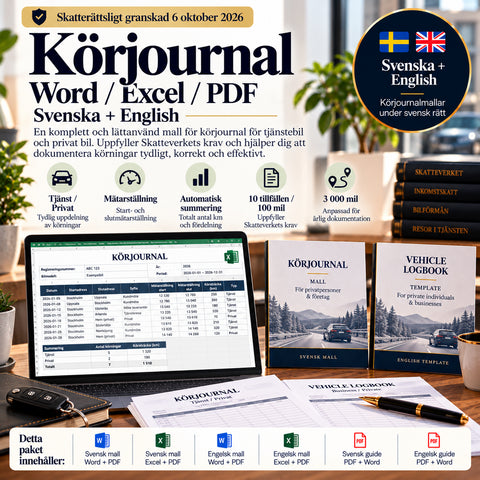
Mileage log – Excel/Word/PDF + English + guide
XLSX, DOCX, PDF, ZIP
29 SEK
View template: Mileage log – Excel/Word/PDF + English + guide
Explore the topic
 Business guides – contracts, HR, AI & compliance
Company car policy and benefits 2026 – tax, mileage log, and return
Employer's guide to car policy and company cars 2026: private driving, mileage log, fuel, 3,000 business kilometers, charging electricity, and return.
 Business guides – contracts, HR, AI & compliance
Travel Expenses 2026/2027 – per diem, mileage reimbursement and checklist
Practical guide to travel expenses, per diem and mileage reimbursement with 2026 tax-free amounts, requirements for documentation, receipts and che...


