
Engagement agreement for accounting and financial services – what should be regulated?
Guide to engagement letters for accounting firms and financial consultants: scope, division of responsibilities, deadlines, fees, GDPR, KYC, and termination.

Short answer: An engagement letter for accounting and financial services should clearly describe the services the consultant is to perform, what the customer is responsible for, deadlines, reporting, fees, personal data processing, and how the engagement is amended or terminated. Unclear allocation of responsibility is a common source of disputes.
Why is a separate engagement letter needed?
Accounting services rely on an ongoing flow of information between the customer and the consultant. FAR describes the engagement letter as essential for both parties to have the same understanding of the scope, rights, and obligations of the engagement. For FAR members, a written engagement letter is also a requirement.
What should the engagement describe?
- ongoing bookkeeping
- accounts payable and accounts receivable
- payroll management
- VAT and employer declarations
- closing of accounts and annual reports
- income tax returns
- reporting and advice
- which services are expressly excluded
The allocation of responsibility must be concrete
The agreement should state who provides the source documents, when the consultant must be available, and who approves payments, payroll, tax returns, and closing of accounts. The customer retains responsibility for the company's accounting and for ensuring that the information provided is complete and accurate.
Fees and additional work
State whether the price is fixed, hourly, or volume-based, and how work outside the agreed scope is charged. Additional work due to late or incomplete source documents should be addressed in advance.
GDPR and data processing
Accounting firms often process personal data on behalf of customers. The role must be assessed, and a data processing agreement may be required when the conditions in the GDPR are met. Instructions, security, and sub-processors should be documented.
Customer due diligence and money laundering
For accounting firms covered by the Anti-Money Laundering Act, PEP checks may be relevant for the customer and the ultimate beneficial owner. Read our practical guide on PEP status, documentation, and enhanced customer due diligence measures.
Professional bookkeeping is covered by anti-money laundering regulations. The start of the engagement must therefore be coordinated with customer due diligence, risk assessment, and the firm's internal procedures.
Common mistakes
- no clear list of what is and is not included
- deadlines for the customer's source documents are missing
- responsibility for tax returns and approvals is unclear
- data processing agreements or instructions are missing
- the price for additional work is not regulated
See Mallbutikens engagement letter for financial services.
FAQ
Does the accounting firm take over the customer's responsibility for bookkeeping?
No. The allocation of responsibility should be clear, but the company management retains its statutory obligations.
Is a new agreement needed every year?
Not necessarily, but the agreement should be updated when the scope of the engagement or important conditions change.
Can accounting services and advice be included in the same agreement?
Yes, but the scope and responsibility for each service should be clearly stated.
Changing accounting firms – what source documents, tax returns, and permissions should be handed over? Read the separate practical checklist for implementation.
This article provides general information and does not replace legal or professional advice.
Templates in this article

Explore the topic
 Business guides – contracts, HR, AI & compliance
PEP check 2026 – enhanced customer due diligence, 18 months and AML checklist
PEP screening 2026 according to the Swedish Anti-Money Laundering Act: family members, known associates, enhanced customer due diligence measures, ...
 Business guides – contracts, HR, AI & compliance
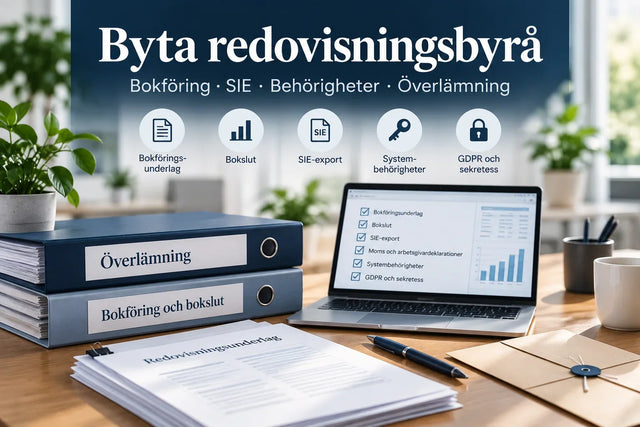
Changing Accounting Firms in Sweden – Records, SIE & Access
Switching accounting firms in Sweden? Review SIE exports, invoices, payroll and VAT/AGI responsibilities, statutory archives, Tax Agency authorisat...


