About this template
Transfer Agreement for the conversion from sole proprietorship to a limited company (Aktiebolag) – an updated 2026/2027 package for business asset transfers under Swedish law. The package includes a main Swedish template in Word/PDF, an English reference, and user guides in Swedish and English.
Legally and tax reviewed: October 6, 2026
Updated with current regulations regarding transfer at under-value, tax allocation reserves, expansion funds, business transfers under the Value Added Tax Act, accounting, and transfer of undertakings for employees.
What is included
| Transfer Agreement – DOCX | Editable Swedish master template for business asset transfers. |
| Transfer Agreement – PDF | Print-ready Swedish version. |
| Swedish user guide – DOCX + PDF | Explains tax, VAT, reserves, liabilities, agreements, staff, and accounting. |
| English reference – DOCX + PDF | Business Transfer Agreement governed by Swedish law. |
| English user guide – DOCX + PDF | English guidance on the same Swedish regulatory framework. |
Important: conversion is more than just an agreement
A sole proprietorship is not a separate legal entity from the individual business owner, whereas a limited company is a separate legal entity. Therefore, assets, liabilities, agreements, permits, personnel, tax registrations, and accounting must be handled explicitly.
The new agreement therefore distinguishes between what is transferred under civil law, what requires the consent of third parties, and which tax conditions must be checked separately.
Business transfer or contribution in kind?
A conversion can usually be carried out by the registered limited company purchasing the assets of the business, or by contribution in kind (apport) at the time of company formation. This product is primarily designed for business asset transfers.
Contributions in kind require specific corporate legal documents and an auditor's certificate. The standard template should therefore not be used as a substitute for contribution-in-kind documentation.
Assets and value distribution
The template contains separate tables for fixtures, inventory, goodwill, intellectual property, accounts receivable, and other assets. Book/tax values and agreed transfer values are kept separate to facilitate accounting and tax assessment.
Liabilities – the company cannot unilaterally release you from personal liability
The old product described liabilities as if they could simply be “taken over” by the limited company. That is too simplistic.
The limited company can internally undertake to carry a debt, but the sole trader is not automatically released from the bank, lessor, or other creditor. If an actual change of debtor is to take place, the creditor's consent must normally be documented.
The new template therefore has a specific appendix for liabilities, collateral, and creditor consents.
Agreements and permits are not automatically transferred
Leasing agreements, rental agreements, supplier contracts, customer agreements, software licenses, domains, and government permits may contain prohibitions against transfer or requirements for consent. Certain permits must be applied for again when the business is moved to a new legal entity.
The template includes a specific checklist for agreements, permits, and intellectual property.
Transfer at under-value and withdrawal taxation
If business assets are transferred to the limited company at a price below market value, withdrawal taxation may normally apply. However, in the case of conversion, there are rules that, under certain conditions, make it possible to transfer assets at tax value without withdrawal taxation.
The Swedish Tax Agency’s guidance states, for the typical conversion situation, that the entire business or an entire branch of business must be transferred, that the shares must be qualified, and that the limited company should not have previous deficits.
Assumed liabilities are also counted as part of the consideration for the assets.
Tax allocation reserve
Tax allocation reserves can, under specific conditions, be taken over by the limited company. The transfer must not, among other things, trigger withdrawal taxation, and the sole trader must make a capital contribution to the limited company corresponding to the tax allocation reserves being transferred.
The limited company must also make a corresponding provision in its accounts. The package includes specific fields for reserve amounts, years, and contributions.
Expansion fund – 79.4%
Other requirements apply to the expansion fund. According to current rules, the expansion fund can cease without reversal if, among other things, all real assets are transferred to the limited company, the business owner requests that the fund not be reversed, and a contribution equivalent to at least 79.4% of the expansion fund is made to the company.
This is now explicitly built into both the agreement template and the user guide.
VAT on business transfers
The older product text described business transfers as generally VAT-free. The new version is more accurate.
According to Chapter 5, Section 38 of the Value Added Tax Act, a qualified transfer of assets in connection with a business transfer is not treated as a supply of goods or a provision of services, but only when the Act's conditions are met. Among other things, the VAT that would otherwise have been charged must be deductible or refundable for the recipient.
Investment goods and real estate may require further VAT assessment.
Employees and transfer of undertakings
If the transfer falls under Section 6 b of the Employment Protection Act, rights and obligations under employment relationships may transfer to the limited company. An employee may object to the transfer, and the previous employer may still be liable for financial obligations relating to the time before the transfer.
Any MBL (Co-determination Act) negotiations, collective agreements, and staff-related liabilities must therefore be assessed separately. The template includes a specific staff appendix.
Accounting and cut-off date
The agreement now has fields for a clear cut-off date, customer and supplier invoices around the transition, inventory, accounts receivable, liabilities, and the practical handover of accounting materials.
As a general rule, accounting information must be preserved for seven years after the end of the calendar year in which the financial year ended. A conversion does not mean that historical archiving responsibility disappears.
Real estate requires separate handling
If the business includes commercial real estate, this standard template should not be used alone. Real estate transfers have specific formal requirements and may involve issues regarding title registration, stamp duty, capital taxation, and VAT adjustments.
Company names, domains, trademarks, and customer registries
Intellectual and digital assets also need to be identified explicitly. Customer registries and other personal data may not be moved casually but must be handled in accordance with applicable data protection regulations.
Seven separate appendix types
- Asset inventory and value distribution
- Liabilities, collateral, and creditor consents
- Agreements, permits, IP, and consents
- Employees and staff-related liabilities
- Tax allocation reserve, expansion fund, and tax basis
- VAT assessment and any investment goods
- Accounting, cut-off date, and practical handover
English reference included
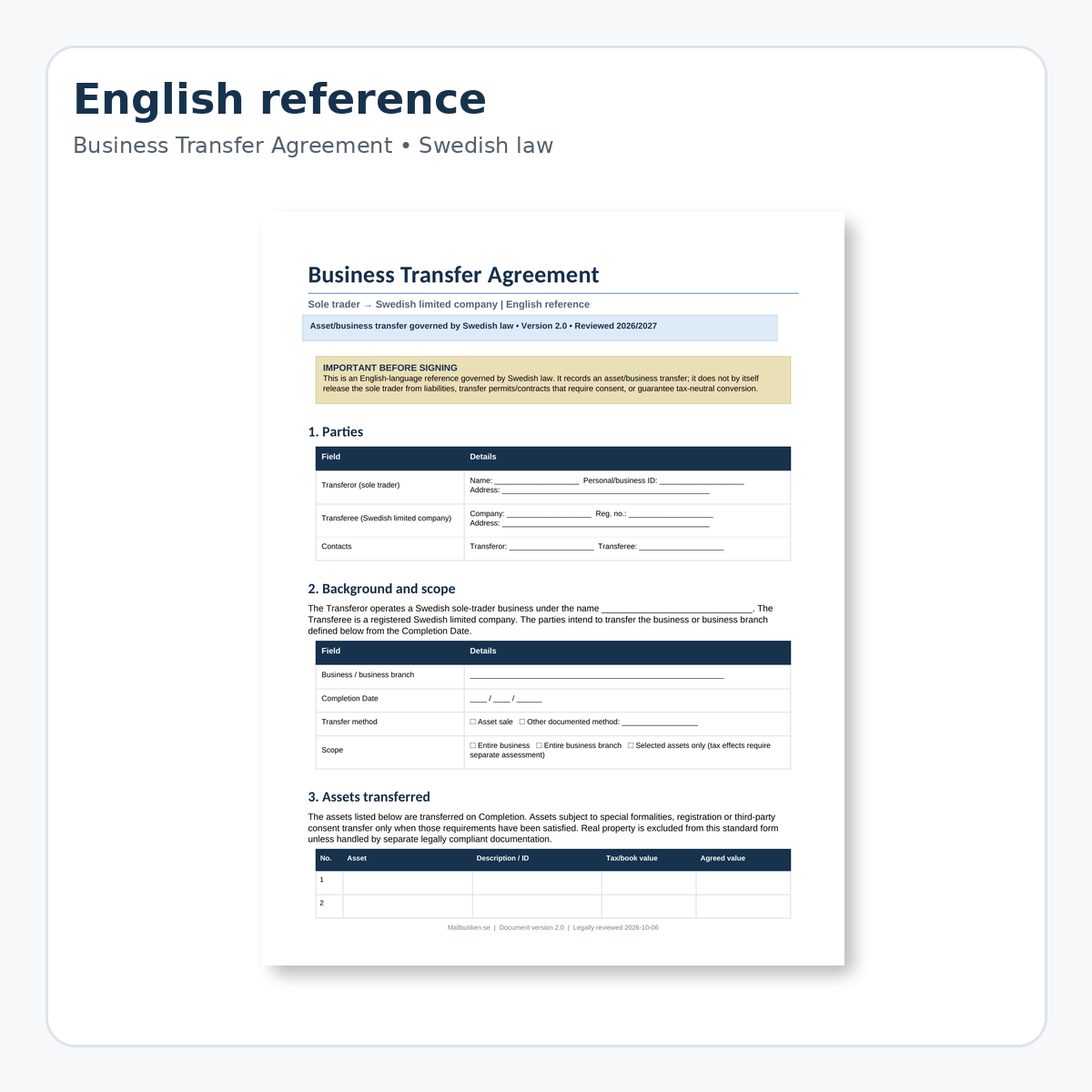
The package also includes a complete Business Transfer Agreement – Sole Trader to Swedish Limited Company in English. The English version is a reference version and is explicitly governed by Swedish law.
When professional advice is particularly appropriate
Seek individual tax, accounting, or legal advice in cases involving significant goodwill, real estate, tax allocation/expansion funds, multiple business branches, large loans/leasing, employees, negative tax capital, complex VAT, or significant financial values.
File formats and delivery
Format: DOCX, PDF, and ZIP.
Language: Swedish master version + English reference.
Number of files: 8.
Total: 17 pages across the four documents.
Delivery: Digital download. No physical product is sent.
Frequently asked questions
Can I transfer everything at book value without tax?
Not automatically. The rules on withdrawal taxation and under-value must be met. For larger values, the structure should be checked by a tax advisor or accounting consultant.
Do my old debts disappear when the limited company takes them over?
No, not automatically. An internal agreement with the limited company does not normally release you from the original creditor. Check if the creditor accepts the change of debtor.
Can tax allocation reserves and expansion funds be treated the same way?
No. They are subject to different rules. The expansion fund, among other things, has a current contribution requirement of at least 79.4% of the fund's amount.
Should VAT be charged on the transfer?
It depends on whether the business transfer rule in the Value Added Tax Act is applicable. The assessment must be made before invoicing and accounting for the transfer.
Is the agreement suitable if the business contains real estate?
Not as a sole document. Real property requires specific documentation and a separate legal and tax assessment.
This package is a general documentation aid and does not replace individual legal, tax, or accounting advice.