About this template
Power of attorney to the other parent – Word/PDF/Excel with guides
Does one parent need to help the other with a specific practical matter concerning their child? This modernized power of attorney to the other parent is a template for limited practical representation and documentation of specific consents. The package includes both Swedish and English versions, a checklist, a revocation form, and an Excel register for follow-up.
Important distinction: A standard power of attorney cannot transfer custody or replace a decision that, under Swedish law, must be made by the child’s legal custodian. In cases of joint custody, custodians must normally decide together on important issues. Certain authorities, schools, and healthcare providers require their own consents and forms.
Review date: October 12, 2026. Edition: 2.0. The English version is an English-language version governed by Swedish law.
Included – 21 files
| Document | Swedish | English |
|---|---|---|
| Limited power of attorney to the other parent | DOCX + PDF | DOCX + PDF |
| Appendix for specific parental consent | DOCX + PDF | DOCX + PDF |
| Checklist for recipient requirements | DOCX + PDF | DOCX + PDF |
| Revocation of power of attorney | DOCX + PDF | DOCX + PDF |
| Detailed user guide | DOCX + PDF | DOCX + PDF |
| Excel register with status and controls | 1 XLSX with Swedish sheets | |
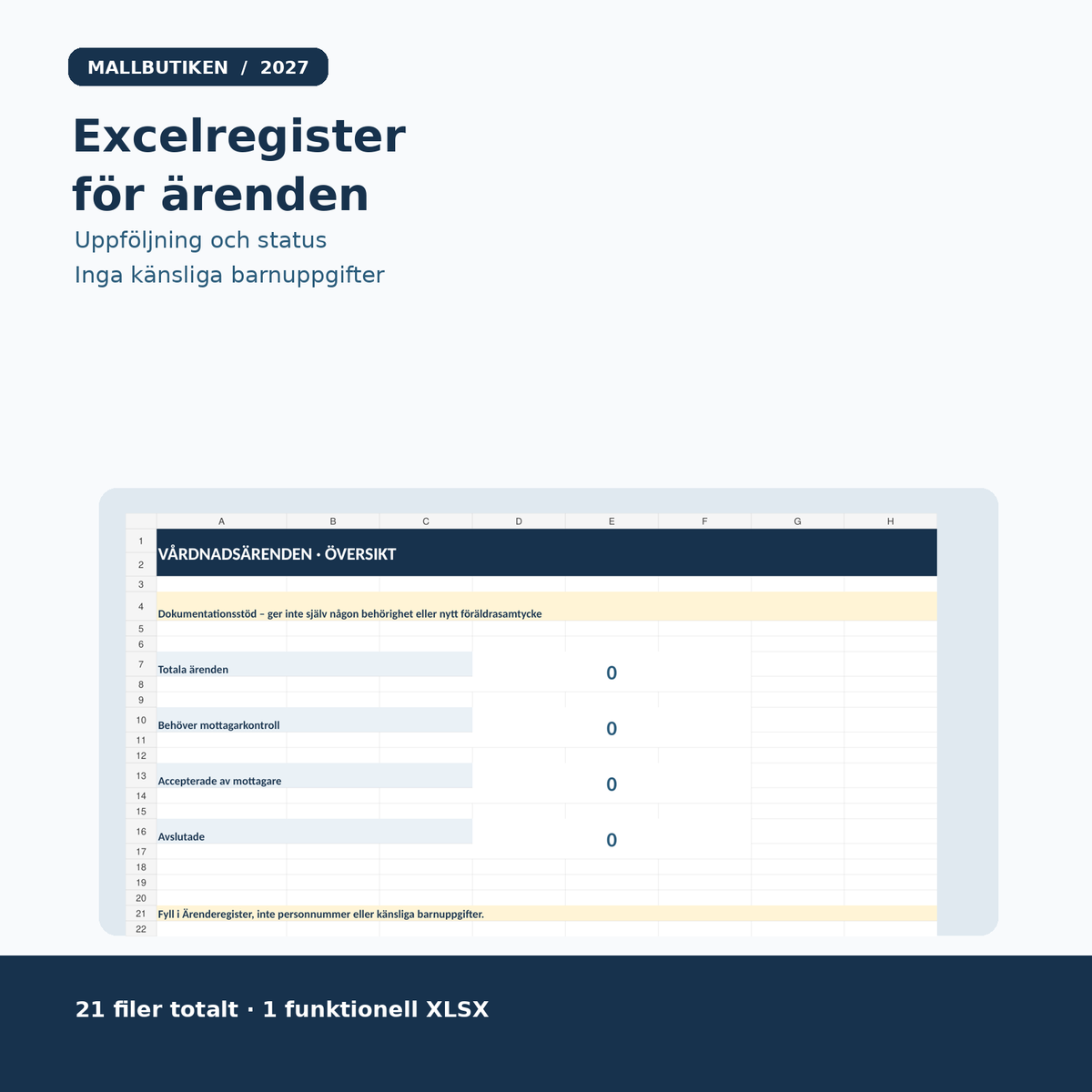
The delivery includes 10 editable Word documents, 10 searchable A4 PDFs, and a functional Excel register. The Excel workbook features an Overview, Case Register, and Instructions, with status selections and control signals. It does not perform any automatic legal assessment of custodial authority.
When is this template suitable?
It is primarily useful when one parent wishes to give the other parent a clearly defined mandate to handle practical tasks, such as submitting or retrieving documents, coordinating meetings, or representing them in a specific administrative contact, provided that the recipient accepts this and the action can legally be performed in this manner.
The document can also be used to record the position taken by the custodians in a concrete matter. However, separate consent requirements must always be checked.
When should the template not be used as the sole document?
- School choice or school transfer: as a general rule, two custodians must reach a joint decision; the municipality's or school's own procedure may be required.
- Passport or national ID card: The Police's specific consent from all custodians is required according to the agency's regulations.
- Notice of relocation for a child: The Swedish Tax Agency has specific procedures and consent requirements.
- Important healthcare decisions: consent depends on the intervention, the child's age and maturity, as well as the healthcare provider's assessment and applicable law.
- Transfer of custody or ongoing dispute: a standard power of attorney does not replace custody decisions, approved agreements, or court rulings.
Legal basis: the difference between custody and power of attorney
The Children and Parents Code, Chapter 6, Sections 11 and 13
According to the Children and Parents Code (1949:381), the custodian has the right and obligation to make decisions regarding the child’s personal affairs. Where there are two custodians, this generally applies to them jointly. The child's own will shall be taken into account increasingly with advancing age and maturity.
There are limited exceptions when a custodian is prevented from participating in a decision that cannot be postponed without inconvenience. Such exceptions cannot be expanded through a standard power of attorney.
School matters
The Swedish National Agency for Education states that, as a general rule, school choice and transfers require a joint decision when there are two custodians. This document is not a general substitute for the approval of both custodians.
Passports, ID cards, and relocation
For passports and national ID cards, the Police specifically describe how all custodians must provide their consent. The Swedish Tax Agency outlines which consents are needed when children move, depending on custody and residential arrangements.
Standard power of attorney and revocation
General rules regarding power of attorney in civil law contexts are found in, among others, the Contracts Act (1915:218), Sections 10–27. These rules do not in themselves provide an opportunity to contract out of the custody regulations of the Children and Parents Code or mandatory consent requirements.
How to complete and use the package
- Check custody status: establish who actually holds legal custody. Being a biological parent does not automatically mean having legal custody.
- Define the task: specify exactly which practical action is needed and which organization is the recipient.
- Contact the recipient: ask if a power of attorney is accepted or if a specific consent form is required.
- Fill in identity and limitations: provide necessary information, limited powers, end dates, and any monetary limits.
- Sign: the correct party granting the power of attorney signs; check if the recipient has their own requirements for identification or witnessing.
- Document consents: use the appendix only where it is an appropriate, accepted supporting document; always use the authority's own procedure when required.
- Follow up and archive: register case code, response, and validity in Excel without storing unnecessary sensitive data about the child.
Practical example
Two custodians agree that one parent will handle practical contacts with the child’s leisure activities while the other is away. The power of attorney can describe this assignment. If, instead, a school transfer is involved, they must check the school's requirements for each custodian’s own decision-making.
Frequently asked questions
Can a parent transfer full custody to the other via power of attorney?
No. Changes in custody must be carried out according to the specific regulations of the Children and Parents Code. This template applies to limited representation and specific consents, not the transfer of custody.
Can one parent unilaterally change the child's school?
In cases of joint custody, custodians must generally agree on school choice and transfers. The school's or municipality's own procedure must be followed.
Is the template sufficient to apply for a passport for the child?
No. Use the Police's specific process for parental consent.
Can it be used to consent to all medical care?
No. Healthcare issues must be assessed according to applicable consent rules and with consideration for the child's age and maturity. Ask the healthcare provider about the correct procedure.
Does it apply if the other parent lacks custody?
Parenthood does not in itself grant the same powers as legal custody. Verify the legal status and the recipient's requirements before any mandate is used.
Can the power of attorney be revoked?
Yes. A revocation template is included. The revocation must be communicated in a manner relevant to how the power of attorney was originally issued and used. Already provided separate consents may need to be handled with the recipient.
Are two witnesses required?
There is no general two-witness requirement for such a limited, standard power of attorney. A specific recipient may, however, have their own formal requirements.
Can the English version be used in the USA or the UK?
No, it is only an English-language version based on Swedish law. Foreign requirements must be checked separately.
Related documents
For consent to a child’s travel, you can also see Parental Consent / Travel Consent for Child. For a broader overview of powers of attorney linked to children, there is Power of Attorney for Child Custody. These documents do not in themselves change legal custody relationships either.
File format, delivery, and disclaimer
Format: 10 DOCX, 10 PDF, and 1 XLSX. Language: Swedish and English based on Swedish law. Delivery: digital ZIP after the new delivery has been manually linked to the product. Reviewed: October 12, 2026.
This material is a general documentation aid that may need to be adapted to the circumstances. It does not replace individual legal advice, custody decisions, or authorities' own routines. A recipient may request other documents or refuse to accept a particular power of attorney.