

About this template
Internal Audit ISO 9001 2026/2027 is a complete, editable template package for companies that need to plan, conduct, document, and follow up on internal audits of their quality management system. The package includes an audit program, audit plan, audit checklist, internal audit report, a separate user guide, an English working document, and an Excel register with six worksheets.
The templates are designed for Swedish business operations and take into account the new standard editions ISO 9001:2026 and ISO 19011:2026. Use them to create a structured internal audit process instead of starting with blank documents or standalone lists.
Version 1.0, relevant for 2026/2027. The methodology has been checked against official information from ISO, ISO/TC 176, and SIS. The package does not contain the copyrighted ISO standard text and is not a government- or certification-audited product.
What is included in the audit package
| Document | What is included? | File format |
|---|---|---|
| Internal Audit Program & Audit Plan | Audit period, processes, risk-based selection, prioritization, responsibility, impartiality, scope, criteria, methods, and reporting. | Word + PDF |
| Audit Checklist & Audit Report | Interview questions, basis for objective evidence, findings, non-conformities, summary for management, and follow-up. | Word + PDF |
| Detailed Swedish User Guide | Ten practical steps, preparations, archiving, Excel instructions, common errors, audit competence, and current sources. | Word + PDF |
| Internal Audit Working Sheet (English) | Supplementary English-language working sheet for international staff in Swedish operations; not a complete translation of the main documents. | Word + PDF |
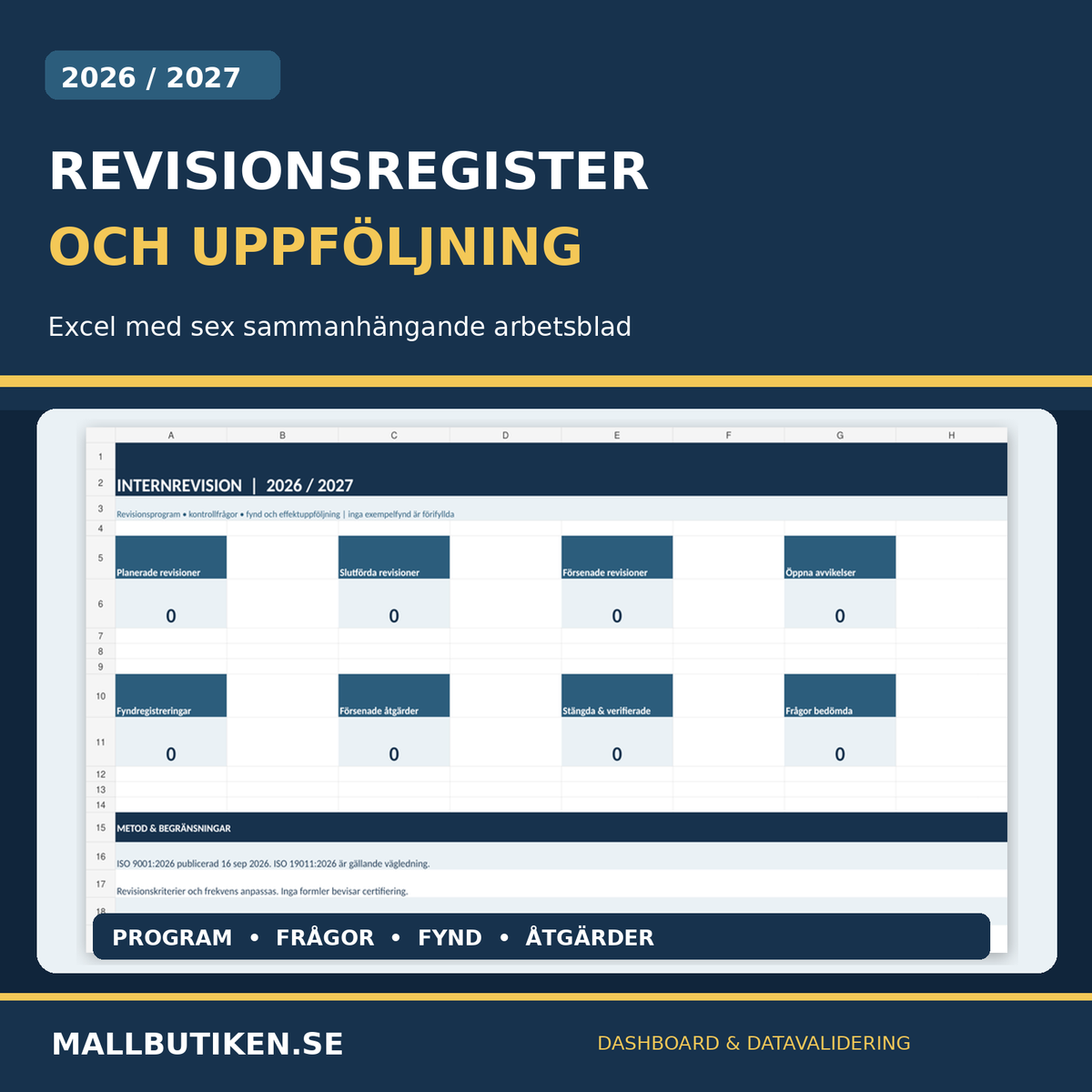
| Internal Audit – Excel Tool | Dashboard, audit program, audit questions, findings and actions register, audit log, and instructions with sources. | Excel (XLSX) |
Total of 9 files in ZIP: 4 DOCX, 4 searchable PDF, and 1 XLSX. Swedish is the primary language of the product, with a supplementary English working sheet. All delivered documents are editable in compatible software where the format permits.
Who is this internal audit template suitable for?
The product is suitable for quality managers, internal auditors, process owners, consulting firms, smaller manufacturing companies, and other businesses working with quality management systems. It can be used to organize a risk-based audit cycle or to improve documentation ahead of follow-up, management reviews, and external audits.
For organizations in the transition between ISO 9001:2015 and ISO 9001:2026, the documents include space to specify which edition and which concrete audit criteria are used for each review.
Excel with six worksheets for audit planning and follow-up
| Worksheet | Function |
|---|---|
| Overview | Automatic KPIs for registered audits, completed and overdue audits, open non-conformities, overdue actions, verified closures, and assessed questions. |
| Audit Program | 100 prepared rows for audit ID, process, scope, priority, auditor, planned date, status, criteria, and calendar-based follow-up. |
| Audit Questions | 100 rows for custom review questions, criteria, sampling, objective evidence, and assessment. |
| Findings and Actions | 120 rows for non-conformity/finding, criterion, actual observations, risk priority, responsible party, corrective action, deadline, and effectiveness verification. |
| Audit Log | 90 rows for audits, report versions, communication to management, conclusions, and future audit needs. |
| Instructions | Usage help, limitations, definitions, and official links to relevant standard information. |
The Excel tool has filters, data validation, clear editing fields, and formula-based indicators. A status of overdue is a planning signal—not a decision on regulatory compliance. An action is only considered verified when the status is closed and effectiveness verification has been explicitly marked as completed.
How to use the package – step by step
- Determine purpose and scope: document what is to be audited, the importance of the processes, and the boundaries of the management system.
- Identify audit criteria: specify the exact ISO 9001 edition, internal governing documents, customer requirements, and any other applicable requirements. Use the licensed standard text.
- Prioritize based on risk: let changes, previous audit findings, process risks, and past results influence the audit program.
- Appoint auditors: document relevant competence and how objectivity and impartiality are ensured.
- Plan a concrete audit: establish methods, sampling, audited functions, timing, and how results should be reported.
- Conduct and document: interview, observe, and examine documentation. Record only actual observations and evidence.
- Report findings: link observations to concrete criteria and distinguish non-conformities from positive observations and improvement suggestions.
- Follow up on actions: specify the responsible person and deadline, document the root cause where relevant, and verify the effectiveness of completed actions.
- Inform management: document conclusions, limitations, areas for improvement, and any decisions.
- Update the program: use results and changed circumstances to determine future audits.
ISO 9001:2026, ISO 19011:2026, and transition rules
ISO 9001:2026 was published on September 16, 2026. The new standard has, among other things, a clearer focus on leadership, quality culture, accountability, and risks and opportunities. ISO 19011:2026 was published in May 2026 and provides guidance on audit principles, audit programs, conduct, and auditor competence. It replaces ISO 19011:2018 as the standard edition. ISO 19011 is guidance and does not in itself constitute a certification requirement.
According to information published by ISO/TC 176, organizations already certified according to ISO 9001:2015 have until September 30, 2029, to complete the transition. From March 31, 2028, new and initial accredited certifications may only be issued according to ISO 9001:2026. Always check the certification body's current transition plan and rules.
ISO 9001 is a voluntary quality management standard, but use may be required by contracts, customer demands, and certification terms. These templates do not replace the standard text, a certification body's requirements, or an actual audit engagement.
Common mistakes and pitfalls
- Setting the same audit interval for all processes without assessing changes and risks.
- Allowing an auditor to review their own work in a way that undermines impartiality.
- Using generic sample questions as if they represented the entire requirements of the ISO standard.
- Documenting a non-conformity without a clear criterion and verifiable evidence.
- Mixing older and newer standard requirements without noting which edition was actually reviewed.
- Closing a corrective action before the effectiveness has been checked.
- Confusing an internal audit of a management system with an external statutory financial audit.
Frequently asked questions
Is an internal audit mandatory according to ISO 9001?
Organizations that need to comply with ISO 9001 must conduct internal audits within the management system. There is, however, no general Swedish legal requirement for ISO 9001 certification for all companies.
Can the package be used during the transition from ISO 9001:2015?
Yes. For each audit, there is space to specify the current and applied standard edition as well as your own audit criteria. Check with your certification body on how the transition should be carried out.
How often should internal audits be conducted?
Frequency and scope should be planned based on the organization's actual processes, importance, changes, risks, and previous results. The template does not prescribe a universal monthly interval.
Do I get an official ISO certificate?
No. The package is a documentation aid for your own internal audits. Certification requires a specific assessment by a competent certification body.
Can Excel approve a non-conformity automatically?
No. Excel summarizes data and marks calendar status. Actual assessment, decided action, and documented effectiveness checks are required before closure.
Is there an English version?
Yes, an English Internal Audit Working Sheet is included as a supplement for Swedish operations. The main documents and the detailed guide are in Swedish.
Can I use the package for ISO 14001 or ISO 45001?
The methodology can provide inspiration for other management systems as well, but the content is specifically described for ISO 9001. Other standards and industry requirements must be reviewed separately and may require supplementary material.
Format, digital delivery, and price
One-time price 79 SEK. Digital ZIP package with four Word files (DOCX), four searchable A4 PDFs, and one Excel workbook (XLSX). The files are intended for offline use in compatible software. No physical shipping. Automatic file delivery after purchase requires the ZIP file to be linked to the product variant in Shopify Digital Products.
Official sources
- ISO – launch of ISO 9001:2026 (September 16, 2026)
- ISO/TC 176 – information on the transition to ISO 9001:2026
- ISO – ISO 19011:2026, Guidelines for auditing management systems
- SIS – SS-EN ISO 19011:2026
Disclaimer: The product is a general editable template. It does not constitute a licensed standard text, legal advice, external audit, certification, or guarantee of compliance. The organization must adapt the audit criteria to its own and contractual requirements.