

About this template
Assess the profitability of an investment before capital is tied up. This complete template package helps companies analyze machinery, equipment, software, automation, energy measures, and expansion projects using NPV/Net Present Value, IRR/Internal Rate of Return, payback, discounted payback, profitability index, scenarios, and sensitivity analysis.
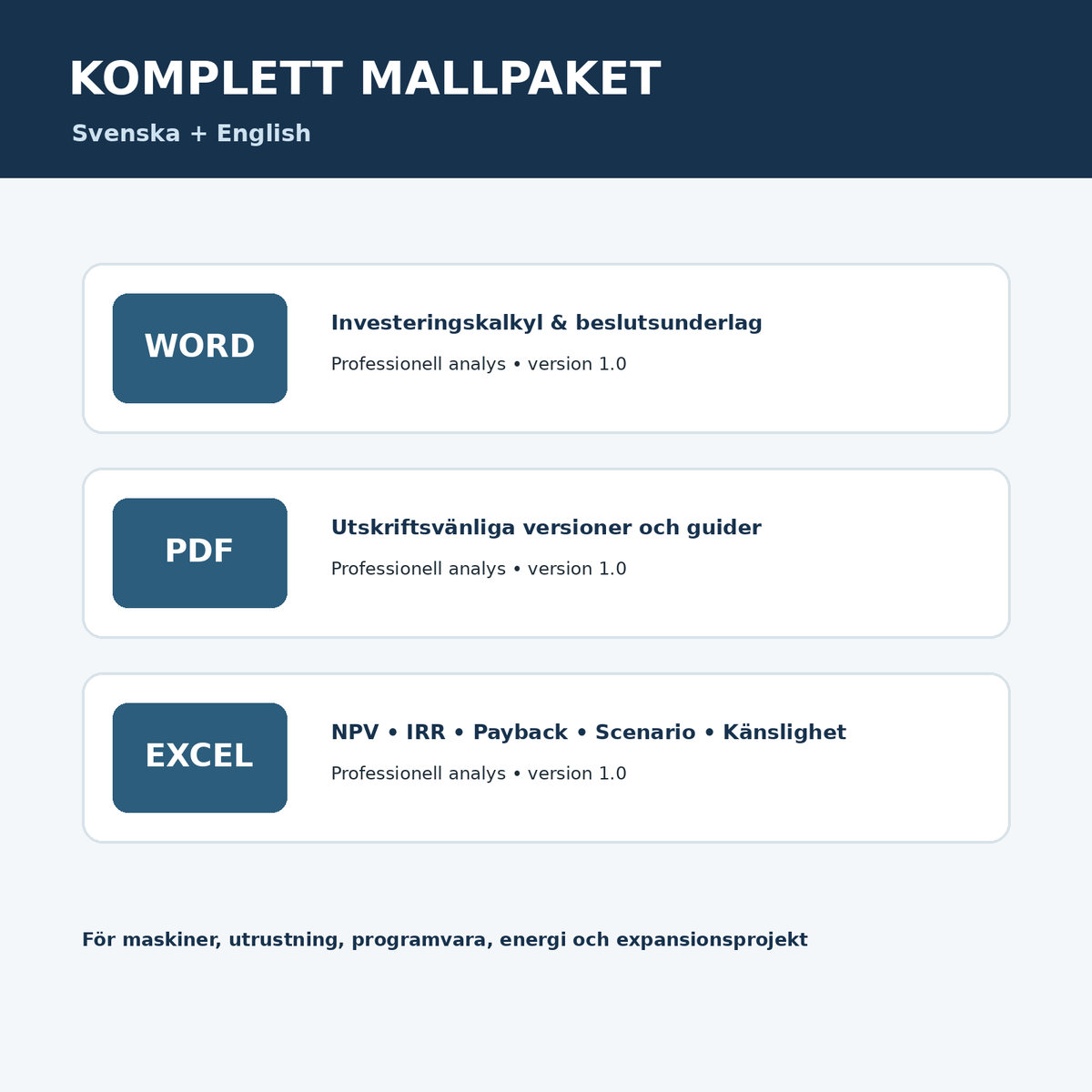
What is included
| Document | Format | Content |
|---|---|---|
| Investment Appraisal – Swedish | Word + PDF | Decision template with cash flows, NPV, IRR, payback, risk, and decision |
| Investment Appraisal – English | Word + PDF | English reference/work version for Swedish businesses |
| User Guide – Swedish | Word + PDF | Explanations, workflow, and common errors |
| User Guide – English | Word + PDF | English step-by-step guide |
| Investment Tool | Excel | Up to 20 years, NPV, IRR, payback, scenario, sensitivity, and dashboard |
The Excel tool
- Up to 20 years of cash flows including receipts, operating payments, working capital, and other investment flows.
- NPV/Net Present Value based on the user's own discount rate.
- IRR/Internal Rate of Return as a supplementary measure of return.
- Payback and discounted payback.
- Profitability index for relative assessment.
- Downside/Base/Upside with separate factors for revenue, costs, investment, discount rate, and residual value.
- Sensitivity analysis showing how NPV changes when the discount rate is adjusted.
- Decision tab for financing, liquidity, and non-financial decision factors.
How to use the template
- Enter the initial investment, economic life, discount rate, and any residual value.
- Fill in the investment's annual incremental cash flows.
- Register changes in working capital as the project ties up or releases capital.
- Review NPV, IRR, payback, and profitability index on the dashboard.
- Test downside/upside and sensitivity to the discount rate.
- Analyze financing and liquidity separately before the final decision.
Key principles
The investment calculation is based on cash flows, not accounting depreciation. Depreciation is therefore not a separate cash outflow in the basic calculation. A positive change in working capital is treated as tied-up capital. Residual value should only be used when there is a reasonable basis for it.
A project may show a positive NPV but still create a financing or liquidity problem. Therefore, the investment calculation should be supplemented with a liquidity budget and financing plan. No general discount rate, tax rate, or tax depreciation is hard-coded.
Frequently asked questions
What does a positive NPV mean?
That the discounted future net cash flows, according to the calculation's assumptions, exceed the initial investment at the chosen discount rate.
Is IRR the same as profitability?
IRR is a supplementary measure of return. For complex cash flows and comparisons between projects, NPV should normally be used as the primary measure.
What is the difference between payback and discounted payback?
Standard payback uses undiscounted cash flows. Discounted payback accounts for the time value of money through the chosen discount rate.
Can I change the discount rate?
Yes. The discount rate is a user-defined input, and the sensitivity tab shows how NPV is affected by other interest rate levels.
Can I use the template for a machine investment?
Yes, as well as for software, automation, energy investments, capacity increases, premises, and other projects with identifiable future cash flows.
Format and delivery
Format: DOCX, PDF, and XLSX. Language: Swedish + English. Version: 1.0. Reviewed: 2026-10-08. Delivered digitally when the ZIP file is linked to the product in Shopify Digital Products.
Sources: Almi's current financing guidance 2026 and Verksamt.se's guidance on financing, capital requirements, and business loans.