About this template
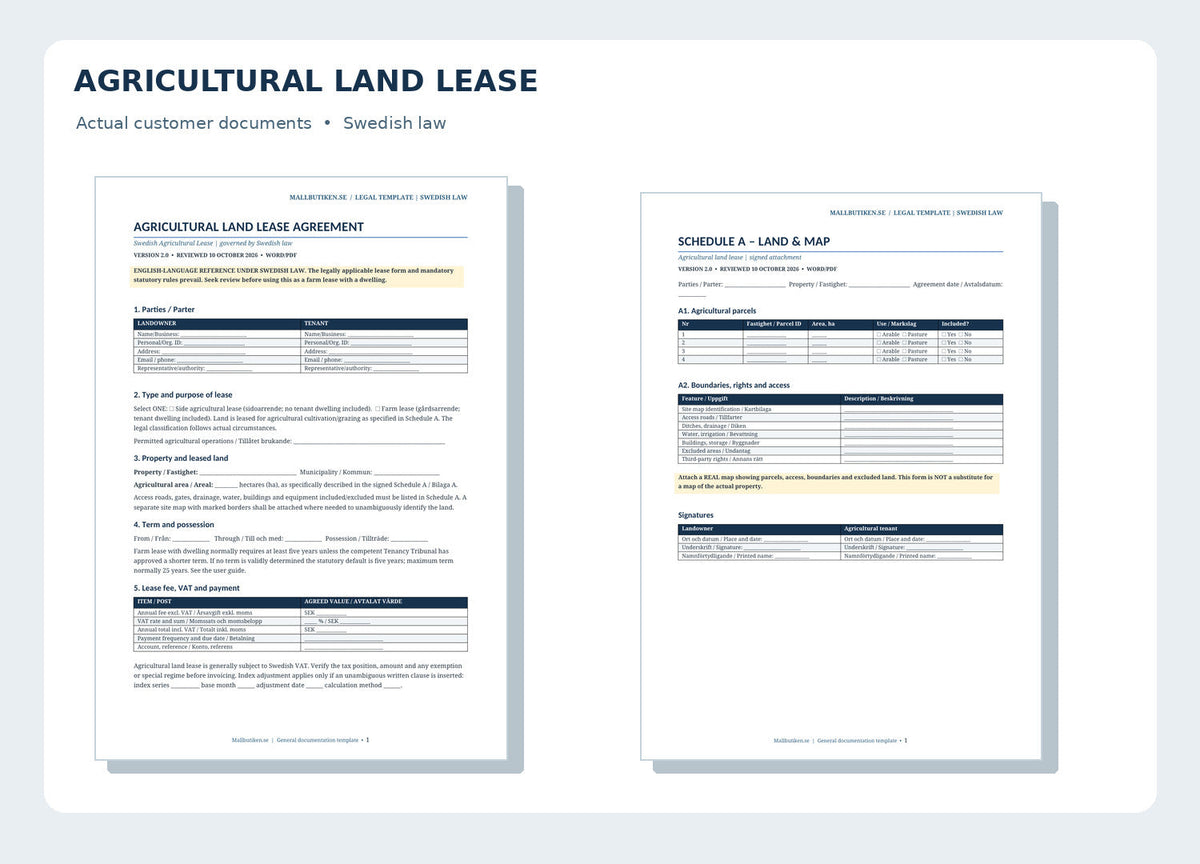
Agricultural lease agreement – template in Word and PDF for the lease of agricultural land under Swedish law. Are you leasing out or farming arable land, pasture, or other agricultural land? With this document package, landowners and tenants can document the lease term, rent, land parcels, land use, maintenance, environmental liability, and termination terms. You receive the main Swedish version, English reference documents, and product-specific guides.
What do you get? 20 customer files in Word and PDF
| Document Group | Content |
|---|---|
| 1. Agricultural Lease Agreement | Main Swedish agreement including parties, type of agriculture, parcels, term, fee, termination, security of tenure, usage, transfer, inspection, and signatures. |
| 2. Appendix A – Leased land parcels | Table for parcels, property designation, area, arable/pasture, ditches, access, and rights. To be supplemented with an actual map. |
| 3. Appendix B – Condition and inventory | Handover/takeover protocol covering condition, ditches, roads, buildings, photos, and equipment. Does not replace a formal inspection when required. |
| 4. Appendix C – Cultivation, environment and subsidies | Cultivation plan, management responsibility, agricultural subsidies, environmental commitments, and practical division of responsibilities. |
| 5. Swedish user guide | Step-by-step guidance, legal prerequisites, common errors, termination, Land and Tenancy Court, and sources. |
| 6–10. English-language reference set | English equivalents of the main agreement, three appendices, and guide. English-language version governed by Swedish law. |
Each document is available as an editable DOCX and searchable A4-PDF – a total of 10 Word files and 10 PDF files. No Excel file is included. The finalized ZIP package is connected manually by the shop owner. Until then, Digital Products still provides the older original files.
What is an agricultural lease?
An agricultural lease is the letting of land for cultivation in exchange for payment. The lease must be in writing. The fee should normally be stated in money or determined based on a general index. The actual purpose of the land determines whether the lease is an agricultural lease or another type of lease – the title of the agreement is not sufficient. The agreement should identify the landowner's right to lease the land and the tenant's authority to enter into the agreement.
Farm lease or secondary lease?
Farm lease (Gårdsarrende): A residence for the tenant is included in the lease. According to Chapter 9, Section 2 of the Land Code, the agreed term is normally at least five years; a shorter period may require the approval of the Land and Tenancy Court. The landowner's specific responsibility for the condition of the residence and other protection rules must be analyzed individually.
Secondary lease (Sidoarrende): No residence for the tenant is included. Such a lease may concern, for example, arable land or pasture without a house. There is no general minimum term. A secondary lease agreed for a maximum of one year generally lacks statutory security of tenure, whereas longer agreements often have it.
Contract term, termination and extension
Agricultural leases should normally be agreed upon for a fixed term. If the time has not been determined, the default rule is five years. The maximum term is generally 25 years. For agricultural leases of at least one year, written notice is as a rule required for the agreement to cease at the end of the term. For agreements of five years or longer, notice must usually be given at least one year before the end date; for agreements shorter than five years but at least one year, eight months generally apply. For shorter leases, special rules apply and notice is normally not required.
If notice is not given in time, the agreement may be extended according to Chapter 9, Section 3 of the Land Code. For tenants with security of tenure, the landowner may also need to refer a dispute regarding extension to the Land and Tenancy Court within a certain time limit. The agreement should not use a general clause claiming that security of tenure can be waived without further ado. Certain deviations require a waiver from the Land and Tenancy Court.
Lease fee and VAT
The template includes separate fields for annual fee excluding VAT, VAT rate, VAT amount and total amount, payment term, payment account, and an optional index clause with a specified base month and calculation method. Agricultural leases are in principle subject to VAT according to Chapter 10, Section 36 of the Value Added Tax Act (2023:200). Which VAT rate and invoicing applies must be checked in the specific case. Neither VAT nor index should be filled in without factual verification.
Land parcels, ditches and access
In Appendix A, the parties can list each agricultural parcel, area in hectares, usage, map reference, existing buildings, ditches, facilities, and roads. Attach an actual map from a reliable source where the leased area and any exclusions can be identified. The provided appendix is a blank list; it is not a finished map of any customer's property.
Maintenance, inspection and settlement
The tenant is normally responsible for ongoing care and maintenance, while the landowner in some cases is responsible for larger, worn-out buildings and facilities. For agricultural leases, there are special rules regarding inspections and settlements, primarily Chapter 9, Sections 23–28 of the Land Code. Appendix B is only a documentation basis and does not replace a formal lease inspection where legal rules require such. Investments and improvements can raise specific compensation issues at settlement and should be handled in writing in advance.
Environment, cultivation and public agricultural subsidies
In Appendix C, responsibilities are allocated for soil management, ditches, fencing, crop rotation, plant nutrition, water protection, and documentation. The parties can also note who plans to apply for agricultural subsidies and what commitments apply to the land. A private lease agreement does not in itself grant the right to EU or national subsidies and cannot override environmental legislation. Check the regulations with the Swedish Board of Agriculture (Jordbruksverket) and relevant authorities.
How to use the template – step by step
- Determine the lease type. Check if a residence is included and if the lease truly pertains to agricultural purposes.
- Check the parties. Enter the landowner's and tenant's full names, identification numbers, and authorized signatories.
- Describe the leased property. State property designation, parcels, area, access, granted rights, and exceptions in Appendix A.
- Determine the valid term. Check minimum terms, maximum allowed time, and the planned end date.
- Fill in the fee. State the amount, correct VAT, due date, payment method, and any clear index adjustment.
- Check the protective rules. Review security of tenure, notice period, condition changes, and any necessary waivers.
- Fill in Appendix B and C. Document condition, inventory, management responsibility, and known environmental and subsidy conditions.
- Sign. Sign the main agreement and the appendices that are part of the agreement. Save both digital and signed copies.
- Follow up. Calendar termination deadlines, payments, inspections, commitments, permits, and any Land and Tenancy Court matters.
When is the standard template not suitable?
Seek legal assistance for large farm leases with a residence, uncertain lease classification, departures from mandatory rules, negotiations on security of tenure, long-term investments, building issues, soil contamination, environmental commitments, high subsidy values, multiple property owners, or disputes. A written template does not mean that an actual setup is automatically valid.
Common questions about agricultural leases
Must an agricultural lease be in writing?
Yes, according to the special lease rules, an agricultural lease agreement must be in writing. Oral agreements should not be used as a substitute for the required written documentation.
Can one lease arable land for a single year?
Yes, a secondary lease without a residence can be agreed for a shorter period. Such a secondary lease of at most one year generally lacks security of tenure. If a residence is included, other minimum term rules apply.
What notice period applies?
For leases of at least one year, the main rule is one year's notice for at least a five-year term, and eight months otherwise. For shorter agreements, special rules apply. Always check if protective rules, approved deviations, and referral deadlines are relevant.
Is an agricultural lease subject to VAT?
Yes, as a main rule. Check which VAT rules, invoice details, and any special conditions apply to your lease.
Can we waive the security of tenure?
Not freely. In certain situations, a waiver may require approval from the Land and Tenancy Court. Secondary leases of at most one year are normally not covered by the security of tenure.
Is a lease inspection required?
The rules on inspections and settlements are specific to agricultural leases and must be checked against the situation. A self-prepared handover protocol is not the same as a formal inspection according to the Land Code.
What is the difference from a "lägenhetsarrende" (apartment/other lease)?
Agricultural leases apply to land let for cultivation. "Lägenhetsarrende" applies to other types of land use that do not qualify as other forms of leases. The type of agreement governs which legal rules apply.
Are English documents included?
Yes. You receive an English-language version governed by Swedish law, including the agreement, three appendices, and a guide. It is not intended to be a British, American, or universal foreign lease agreement.
Related document templates
- Lägenhetsarrende – land lease for other purposes
- Bostadsarrende – land for residential housing
- Anläggningsarrende – land with a building for business operations
Legal basis and sources
- Swedish Land Code (1970:994), especially Chapters 7–9.
- Swedish Courts – Agreements, time and fees for agricultural leases
- Swedish Courts – Security of tenure for agricultural leases
- Swedish Tax Agency – Legal guidance on value added tax
Document version 2.0. Legally reviewed October 10, 2026. The material is a general documentation aid, not an individual legal, tax, or subsidy-related assessment. Check current regulations and your specific circumstances before signing. The new ZIP delivery is connected manually by the shop owner; original digital delivery files remain unchanged.