About this template
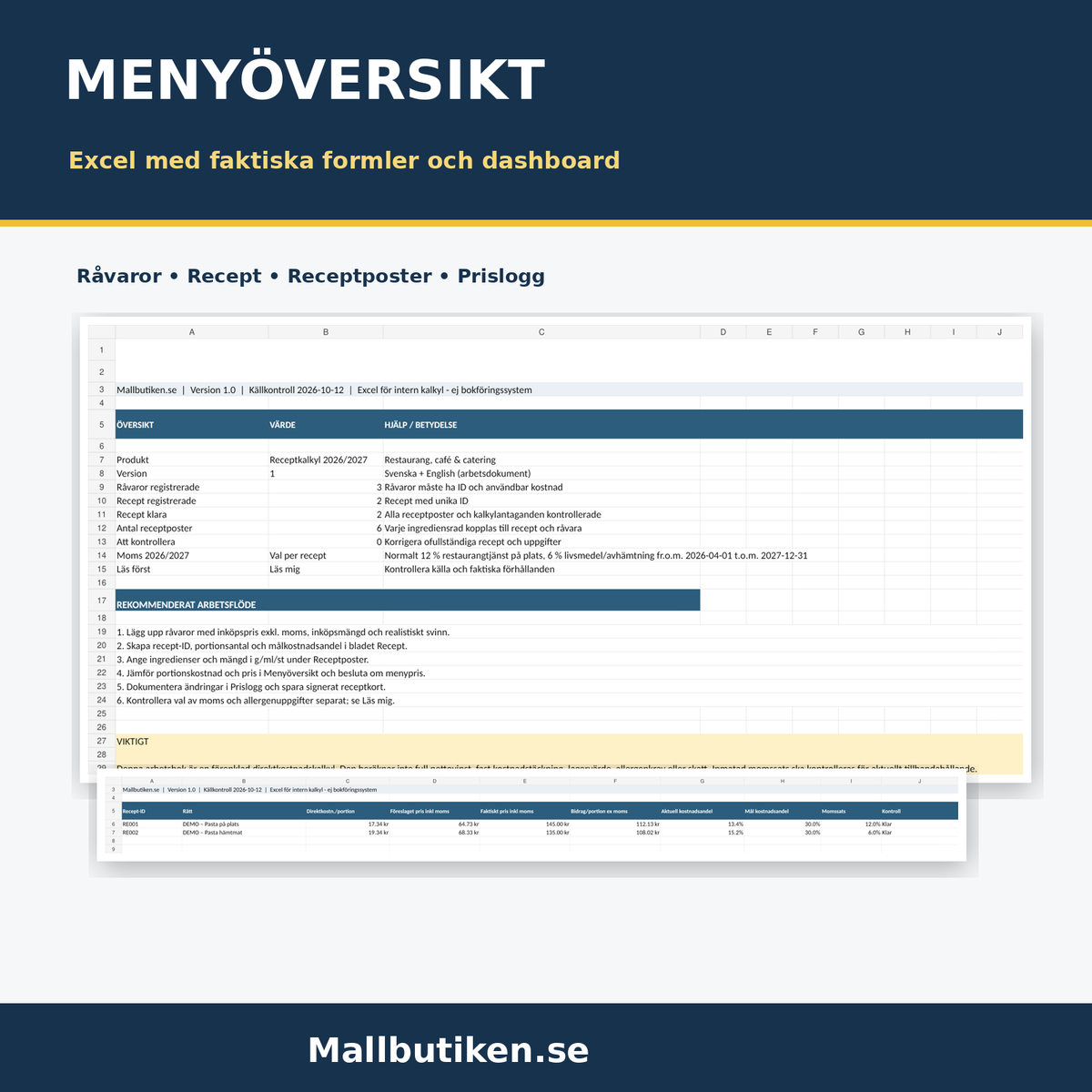
Calculate the actual cost of your dishes – from raw material prices and waste to portion cost and suggested menu prices. Recipe Costing & Menu Pricing 2026/2027 is a professional Excel tool for restaurants, cafés, catering, and smaller food service businesses. Unlike a general price calculator, this workbook links ingredients to recipes and recalculates costs whenever you update purchase prices.
What's included in the package
| Content | Format | Function |
|---|---|---|
| Recipe Costing & Menu Pricing | Excel (.xlsx) | 7 worksheets, raw material register, recipe entries, cost calculations, menu overview, and price log. |
| Recipe Card & Price Decision – Swedish | Word (.docx) + PDF | Editable recipe card for ingredients, portions, price decisions, review, and signing. |
| Recipe Card & Price Approval – English | Word (.docx) + PDF | English working version for Swedish restaurant conditions. |
| Detailed Swedish User Guide | Word (.docx) + PDF | Walkthrough of calculations, waste, units, VAT, allergen limitations, and follow-up. |
| English User Guide | Word (.docx) + PDF | Step-by-step instructions for multilingual kitchens. |
A total of 9 delivery files in one ZIP. The Word files are editable and the PDF versions are searchable. The Excel file is offline-based and requires no subscription.
What does the Excel calculator do?
- Raw materials: 60 raw material rows with purchase price excluding deductible VAT, purchase quantity, unit, supplier, and verified waste percentage. Calculates cost per usable gram, milliliter, or piece.
- Recipes: 30 recipes with number of portions, other direct costs, target cost percentage, selectable output VAT, menu price, final contribution per portion, and control status.
- Recipe entries: 150 ingredient rows with automatic lookup of raw material prices and costs, as well as clear error status for missing IDs or incorrect quantities.
- Menu overview: summarizes calculated portion price, suggested price, and actual direct cost percentage for each recipe.
- Price log: space to document decisions on price changes and the basis used.
- Start and Read me: workflow, key figures, explanations, relevant government sources, and important limitations.
How to use the template
- Fill in the raw material register with actual invoice prices and unique raw material IDs.
- Create recipes and specify the number of portions, target direct cost percentage, and relevant sales channel.
- Add ingredient rows in grams, milliliters, or pieces and link them to registered raw materials.
- Review the automatically calculated portion cost and suggested menu price.
- Enter the actual menu price, check for applicable VAT, and document the decision.
- Update prices and recipes when there are changes in invoice prices, waste, or portion sizes.
Calculation example – simplified calculation
If a batch of 10 portions costs a total of 300 SEK in direct costs, the cost is 30 SEK per portion. With a target cost percentage of 30 percent, the model suggests a price excluding VAT of 100 SEK. With, for example, 12 percent relevant sales VAT, the price including VAT becomes 112 SEK. The example is educational and does not determine which VAT rate applies to your specific product.
Food VAT 2026 and 2027
From April 1, 2026, through December 31, 2027, 6 percent VAT generally applies to food, including takeaway food. Restaurant services where the customer eats on-site are still generally subject to 12 percent. The Swedish Tax Agency (Skatteverket) emphasizes that an overall assessment is required to determine what is actually being sold. The template therefore has one VAT rate per recipe or sales variant and does not choose automatically for the customer.
Allergen information and food safety
The Swedish Food Agency's (Livsmedelsverket) guidelines and EU Regulation 1169/2011 require information on allergenic ingredients, also for food that is not pre-packaged. This product calculates economic costs and is not an allergen matrix, label template, or HACCP system. For that, there is a separate HACCP & Self-monitoring Food 2026/2027 available at Mallbutiken.
Who should use this package?
Restaurant owners, chefs, head chefs, café owners, catering businesses, and companies that need to compare recipe costs and see when supplier prices affect the economic calculation.
Common pitfalls
- Using purchase price including deductible input VAT instead of the relevant net cost.
- Mixing kilograms and grams or liters and milliliters.
- Misjudging waste or counting the same waste twice.
- Using the wrong VAT rate for the sales channel.
- Interpreting simplified contribution margin as the company's net profit.
- Forgetting to update recipes when raw material prices and portions change.
Frequently Asked Questions
Is the raw material price calculated automatically when the purchase price changes?
Yes. Linked ingredient rows are recalculated after updating the raw material register. No prices are automatically retrieved from external invoice systems.
Can I account for waste?
Yes. You can specify a waste percentage per raw material. The calculator distributes the purchase cost over the usable amount according to the specified percentage.
Does it work for both restaurants and takeaway?
Yes. Separate recipe or sales variants can be assigned different VAT rates when correct according to the Swedish Tax Agency's rules.
Is it an accounting template or allergen list?
No. It is a recipe-based direct cost calculator, not complete accounting or food documentation.
Are English documents included?
Yes. Recipe cards and a user guide are included in both Swedish and English. The English version is intended for Swedish operations.
Format, delivery, and government sources
Format: DOCX, PDF, XLSX. Language: Swedish + English. Version: 1.0 – 2026/2027. Reviewed: 2026-10-12. The package includes nine final files in a ZIP archive.
Sources: Swedish Tax Agency – Food VAT reduced, Swedish Tax Agency – VAT rates and exemptions, Swedish Food Agency – Mandatory information.
Disclaimer: The person responsible for the business must personally assess the current price basis, right of deduction, VAT rate, allergen information, and applicable law. Consult an accounting specialist or food specialist if necessary.