
Change of ownership in a limited company 2026 – share register, beneficial owner, and notifications

Change of ownership in a limited company does not mean that the buyer has automatically completed all administrative steps once the share transfer agreement has been signed and the purchase price paid. After the closing, the company needs to check the share register, assess whether the beneficial owner has changed and, in closely held companies, report new shareholder details to the Swedish Tax Agency. If the board of directors, authorized signatories, or address change, separate filings with the Swedish Companies Registration Office (Bolagsverket) may also be required. Which steps are applicable depends on the ownership structure, share classes, articles of association, and the terms of the transaction.
Legally fact-checked: October 19, 2026, against the Swedish Companies Act (2005:551), the Act (2017:631) on Registration of Beneficial Owners, as well as official guidance from the Swedish Companies Registration Office and the Swedish Tax Agency. The article primarily applies to private limited companies that are not central securities depository (CSD) companies; different procedures may apply to CSD companies, listed companies, and special transactions.
- Share register: The board of directors is responsible for the share register and should normally immediately register an acquirer who has substantiated their acquisition (Chapter 5, Section 9 of the Companies Act). Special rules apply, among other things, in the case of right of first refusal (hembud).
- Beneficial owner: The company must investigate whether the ultimate ownership or control has changed and, when registered circumstances have changed, report this without delay (Chapter 2, Sections 1 and 3 of Act 2017:631).
- Swedish Tax Agency: Changed shareholder relationships in closely held companies must be reported to the Swedish Tax Agency; this is not the same register as the share register or the beneficial ownership register.
- Board of directors and authorized signatories: If new owners also implement changes to registered representatives, these need to be handled through separate corporate decisions and registration filings.
What should be done after a share transfer?
The first step is to determine whether and when the acquisition has actually been completed according to the agreement. Signing and closing may occur on different days. The buyer's payment, the seller's fulfillment, share certificates if issued, and provisions in the articles of association can be important. This is a different issue than which filings must be made afterwards.
If you need support before the transaction is executed, read what the share transfer agreement should contain and the due diligence checklist. This article focuses on actions after the change of ownership rather than price, warranties, and negotiations.
| What? | Who is responsible? | When and where? |
|---|---|---|
| Check restrictions and fulfillment | Parties and, if necessary, the company's board | Based on articles of association and transfer agreement |
| Update share register | Board or its authorized agent | Normally immediately upon substantiated acquisition; consider right of first refusal rules |
| Investigate changed beneficial owner | The legal entity | Upon change of control; report to Bolagsverket without delay if registered information has changed |
| Change shareholder details in closely held companies | The closely held company | Report change to Swedish Tax Agency according to their routines |
| Change board, authorized signatories, and addresses | Competent corporate bodies/representatives | Separate decision and filing where details have changed |
| Declare share sale | Relevant seller/shareholder | According to applicable income tax rules and annual tax return |
Check for right of first refusal, pre-emption, and consent before final registration
The starting point in Chapter 4, Section 7 of the Companies Act is that shares are freely transferable, but the articles of association may contain special restrictions. Consent restrictions mean that consent must be sought before a transfer, pre-emption clauses may give someone the right to buy the share before the transfer, while right of first refusal (hembud) provides a right of redemption after the acquisition.
It is particularly important not to register an acquirer too early when the share is subject to a right of first refusal. According to Chapter 4, Section 35, the acquirer of a share subject to a right of first refusal may not be entered into the share register until it is clear that the redemption right is not being exercised. At the same time, the provision regulates how certain shareholder rights may be exercised during the redemption period.
Read our separate guide on right of first refusal, pre-emption, and consent before using a standardized change of ownership checklist. There may also be contractual terms in a shareholders' agreement that need to be handled between the parties.
How is the share register updated after a change of ownership?
According to Chapter 5, Section 1, a limited company must maintain a share register. For a standard company that is not a CSD company, the board or an authorized person shall immediately enter the person who has substantiated their share acquisition, in accordance with Chapter 5, Section 9, once the requirements are met. This may involve presenting a correct transfer agreement and, where share certificates exist, the documents and chain of transfer required.
The board is not only responsible for a summary of ownership shares but for the information that must exist in the statutory share register. Record the correct shares, share class, identity, and relevant change details. The Swedish Companies Registration Office does not register ordinary shareholders and does not take over the board's responsibility for the share register itself.
In-depth: share register – legal requirements, content, and updating. For practical registration, a share register template in Excel, Word, and PDF can be used as support, but it must be kept correct and current.
Change beneficial owner – what applies after a share sale?
Beneficial owner is not synonymous with every shareholder. It is a natural person who ultimately owns or controls the company according to Act (2017:631). Control can arise through, for example, more than 25 percent of the votes, the right to appoint or remove more than half of the board, or other specifically designated forms of control. A shareholder's percentage of shares therefore does not need to be identical to control over the votes.
According to Chapter 2, Section 1, relevant legal entities must have and update reliable information and normally document how the beneficial owner has been assessed. When a reported condition changes, the company must, according to Chapter 2, Section 3, report the change for registration without delay after it has become aware of the change.
Important time limit: The four-week deadline found in the same paragraph applies to certain situations regarding initial registration. It must not be incorrectly used as a general four-week deadline for every change of ownership. Here, the provision regarding reporting without delay is what must be assessed.
Even if no new individuals reach a relevant control level, the company should check whether previously registered information and forms of control are still actually correct. There may also be exceptions to the scope of the Registration Act, including for limited companies whose shares are traded on certain regulated markets and their relevant subsidiaries.
When must changed shareholder details be reported to the Swedish Tax Agency?
The Swedish Tax Agency states that a closely held company (fåmansföretag) must report when ownership conditions change, for example, when a new shareholder is added. Those who are registered authorized signatories can use the e-service Change details of shareholders in closely held limited companies via Verksamt.se. An alternative is form SKV 4639.
This is a specific report to the Swedish Tax Agency, not a registration of all shares with the Swedish Companies Registration Office. The purpose is, among other things, for the Swedish Tax Agency to have correct information on who can be expected to file a tax return as a shareholder in a closely held company. Check the actual company form and closely held status – the obligation should not automatically be attributed to all limited companies.
Is K10 and tax affected when shares are sold?
Yes, the sale of qualified shares in a closely held company can have tax consequences for the seller. According to the Swedish Tax Agency's information on K10, the shareholder may need to report dividends or capital gains on form K10. From the 2026 tax year, changed tax rules apply for many shareholders with qualified shares, with declarations made during 2027. This may affect the calculation of the threshold amount (gränsbelopp) and capital gains.
It is therefore not possible to state a general tax rate for every share transfer based on this checklist. The seller's holding period, the qualification of the shares, the cost base, previously saved dividend space, and current rules must be assessed in the specific case. See the Swedish Tax Agency's overview of closely held companies and the 2026 changes.
Do the board, authorized signatories, and bank details need to be changed?
A change of shareholders does not in itself mean that the board is automatically replaced. But when purchasing an entire company or a significant controlling stake, the new owners often decide on a new board, authorized signatories, or mailing address in the prescribed manner. In that case, the decisions need to be documented, applicable corporate law requirements followed, and registered information changed with the Swedish Companies Registration Office when required.
The Swedish Companies Registration Office describes that changes of the board and mailing address often become relevant when all shares or a majority of votes change hands. It is important to distinguish the share sale from the corporate bodies' separate decisions. A new owner does not become a board member or authorized signatory simply by buying shares.
As practical subsequent measures, it may be appropriate to review bank authorities, authorization documents, administrator accounts, insurance, internal approval rules, and contact persons. These are need- and contract-driven control steps – not one and the same statutory filing that applies identically to every change of ownership.
Which documents should be saved after the transfer?
The following documents serve different functions. Some information must be documented by law, while others are recommended transaction documentation:
| Document | What does it show? | Comment |
|---|---|---|
| Share transfer agreement | Which shares, parties, and terms the deal pertains to | Agreement content adapted to the actual transaction |
| Settlement note and proof of payment | Payment, price, and share block | Practical transaction and tax documentation; formalities depend on the deal |
| Closing protocol / closing list | That conditions and deliveries have been fulfilled | Recommended for larger transfers |
| Share register and supporting documentation for entry | Shareholders and shares according to the Companies Act | Statutory share register and correct registration |
| Investigation and report on beneficial owner | Ownership/control structure and any changed registry data | Act 2017:631; older documentation must in some cases be saved for at least five years |
| Shareholder change to Swedish Tax Agency | That the closely held company's shareholder data has been updated | Swedish Tax Agency's e-service or SKV 4639 |
| Minutes of general meeting and registration filings | Any decisions regarding new company representatives | Needed when such changes are actually made |
Retention periods vary. According to Chapter 2, Section 1 of the Act on Registration of Beneficial Owners, documentation regarding older conditions that have changed must be preserved for at least five years. This is not the same as saying that all transaction documents generally have exactly a five-year statutory storage period.
When should the various checks be performed?
A useful practical order is to first clarify contractual closing and transfer restrictions, then handle the share register and relevant ownership registries, and finally follow up on corporate governance, banking, and tax returns. Statutory deadlines, however, always take precedence over this working order.
- Immediately: registration in the share register when the law's requirements are met (with, among other things, right-of-first-refusal exceptions).
- Without delay: reporting of changed beneficial owner when registered conditions have changed.
- Tax return and other matters: assessed according to respective tax and registration rules, not the same standard deadline as for the share register.
Example: 60 percent of shares transferred in a private limited company
A private limited company has 1,000 shares with equal voting power. A shareholder sells 600 shares to a new buyer. The parties agree on closing and payment and verify that the articles of association do not prevent the planned transfer. Once the acquisition has been substantiated, the board ensures that the share register is updated with the correct share block and acquirer.
Since the buyer in the example gets 60 percent of the votes, the company needs to investigate if the buyer is a new beneficial owner and if previous information should be changed with the Swedish Companies Registration Office. If it is a closely held company, it also needs to update shareholder data with the Swedish Tax Agency. If the owners decide on a new board, this is handled through a separate valid decision and registration.
For the seller, the purchase price and the tax status of the shares are important for the tax return. The example assumes equal voting rights and ignores, for example, indirect ownership, agreed special control, and articles-of-association restrictions; these factors can change the assessment.
Common mistakes during ownership changes in limited companies
- Thinking the Swedish Companies Registration Office maintains the share register. It normally does not; the board is responsible in standard limited companies.
- Registering before the right-of-first-refusal period has concluded. An acquirer subject to a right of first refusal may not be entered until it is clear that the redemption right is not being exercised.
- Mixing up owners and beneficial owners. Voting control and other control possibilities must be assessed, not just share percentage.
- Thinking the four-week deadline always applies to changes of ownership. Changed beneficial ownership should normally be reported without delay according to Chapter 2, Section 3.
- Forgetting the Swedish Tax Agency. Closely held companies need to report changed shareholder relationships.
- Treating new owners automatically as board members. Board assignments and signatory rights must be handled independently.
- Missing changed 3:12 rules. The 2026 tax year may be relevant for the taxation of qualified shares.
Checklist after share sale 2026
- Determine transfer date and closing date according to agreement and actual documents.
- Check that any consent, pre-emption, and right-of-first-refusal conditions have been handled correctly.
- Check substantiated acquisition and existing share certificates, if any.
- Do not make incorrect decisions regarding the entry of shares subject to right of first refusal during the redemption period.
- Enter the authorized acquirer into the share register once the requirements are met and document the update.
- Investigate new ultimate control, vote distribution, and beneficial owner; update and preserve relevant documentation.
- Report changed registered beneficial owner information to the Swedish Companies Registration Office without delay.
- For a closely held company: report changed shareholder details to the Swedish Tax Agency.
- Assess whether board, authorized signatories, addresses, and other registered information should be changed separately.
- Collect agreements, payment documentation, closing documents, and relevant minutes.
- Assess tax and K10 according to the current tax year and the owner's tax circumstances.
- Follow up with banks, authorizations, insurance, and agreements as a practical handover.
Frequently asked questions about ownership changes in limited liability companies
Must a standard change of ownership be reported to the Swedish Companies Registration Office (Bolagsverket)?
The Swedish Companies Registration Office does not register standard shareholders in a limited liability company. However, a change in the beneficial owner may need to be reported, and separate notifications are required if, for example, the registered board of directors or authorized signatories are changed.
Who is responsible for updating the share register when shares are sold?
The board of directors or those authorized by the board in accordance with Chapter 5, Section 9 of the Companies Act, once the acquisition has been verified and relevant conditions are met. Shares subject to a right of first refusal are subject to specific restrictions.
Is the new owner automatically the beneficial owner?
No. Assess ultimate control according to Act 2017:631. Among other things, more than 25 percent of the votes or other means of control may be relevant; ownership and voting rights can differ.
Does one always have four weeks to change the beneficial owner?
No. According to Chapter 2, Section 3, changes to previously registered information must be reported without delay once the company becomes aware of them. The four-week period appears in the law for certain other situations.
Must a closely held company (fåmansaktiebolag) notify the Swedish Tax Agency of a new shareholder?
Yes, the Swedish Tax Agency states that changes in ownership in closely held companies must be reported. This can be done via the e-service at Verksamt.se or form SKV 4639.
Can the share register be updated in Excel?
Yes, in a standard company, the share register can be maintained electronically if it meets the legal requirements for content and accessibility. However, it is not sufficient to have an Excel sheet with only summarized ownership shares if the prescribed share information is missing.
Must shareholders' agreements and the board be changed upon a change of ownership?
Not automatically. The shareholders' agreement may have accession or transfer provisions; the board is only changed through the relevant corporate legal procedure. Assess each situation separately.
How is the sale taxed in 2026?
It depends on who is selling, what kind of shares they are, and whether the shares in the closely held company are qualified. Many 3:12 rules were changed for the 2026 income year. The seller therefore needs to check the applicable tax declaration rules and, if necessary, the K10 form in the specific case.
Documents for share transfers and updated share register
The template shop's Share Transfer Agreement Template Package 2026 provides support for contractual terms, closing documentation, and other transaction documents. A separate Share Register – Excel/Word/PDF can be used to document ownership after a correctly executed transfer. Document templates do not guarantee registration or legal validity in an individual case.
See Share Transfer Agreement Template Package 2026 – Word/PDF · See Share Register template – Excel/Word/PDF
Related legal guides
- Share transfer agreement – what should the agreement contain?
- Right of first refusal, pre-emption, and consent – differences in share transfers
- Share register in limited liability companies – requirements and updates
- Due diligence before share purchase
- Shareholders' agreement – what should the shareholders regulate?
Official legal sources
- Companies Act (2005:551), in particular Chapter 4, Sections 7–35 and 37, Chapter 5, Sections 1 and 9, as well as relevant provisions regarding company bodies.
- Act (2017:631) on the registration of beneficial owners, in particular Chapter 1, Sections 3–4, and Chapter 2, Sections 1 and 3.
- Bolagsverket – share register and share certificates, regarding who maintains the register and updates upon transfer.
- Bolagsverket – beneficial owner in limited liability companies.
- Skatteverket – changed ownership in closely held companies.
- Skatteverket – declaring as a shareholder in a closely held company.
- Skatteverket – changed rules for closely held companies from the 2026 income year.
Templates in this article
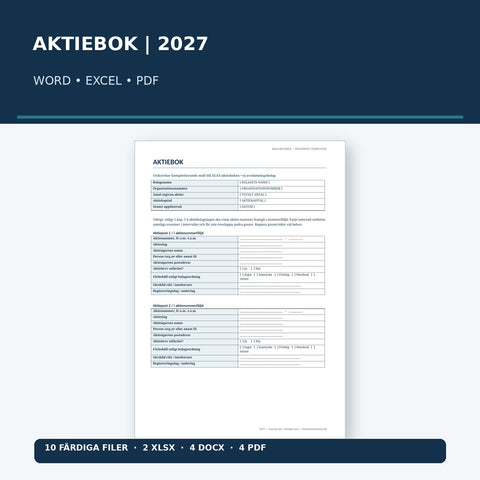
Swedish Share Register Template – Excel/Word/PDF
Excel (XLSX), Word (DOCX), PDF
29 SEK
View template: Swedish Share Register Template – Excel/Word/PDF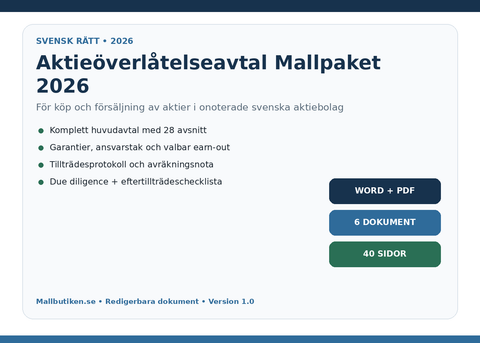
Explore the topic
 Business guides – contracts, HR, AI & compliance
Share Purchase Agreement – what should the agreement include?
When buying or selling shares, the agreement needs to cover the shares, price, reservations, due diligence, warranties, liability, closing, and the...
 Business guides – contracts, HR, AI & compliance
Due diligence in share transfers – checklist for buyers and sellers
Practical due diligence checklist for share transfer: company, finance, agreements, personnel, IP, tax, GDPR, disputes, warranties, and closing.
 Business guides – contracts, HR, AI & compliance
Right of first refusal, pre-emption and consent – what is the difference in a share transfer?
Compare rights of first refusal, pre-emption clauses, and consent clauses in limited liability companies. Determine when they apply, where they are...


