
Separate property for a monetary gift – what applies to spouses and cohabitants?

A donor can decide that a gift to a married recipient shall be the recipient’s separate property. However, it is important not to confuse the rules for spouses with the Cohabitees Act. For cohabitees, not all property is shared upon separation; generally, only the joint home and household goods acquired for joint use are shared.
What does separate property mean?
For spouses, the main rule is that property is marital property unless it is separate. Property can become separate through a condition in a deed of gift from someone other than the other spouse, among other ways. In the event of a future division of property, separate property is generally not included in the equal division.
The gift condition should be clear
It should be evident which gift is referred to and that it is to be the recipient’s separate property. If the donor also wishes to regulate returns or property that replaces the original gift, this should be explicitly formulated. Unclear standard phrases can create interpretation problems long afterwards.
What happens if the money is used for a new asset?
Traceability becomes important. If a cash gift is used to purchase other property, the question may arise whether the new property has replaced the gift. Therefore, it is wise to document the transfer and keep supporting documents that show the connection between the gift and the new asset.
Married recipient and cohabitee – the rules differ
Important clarification: The Cohabitees Act actually has a specific rule regarding gifts from someone other than the cohabitee. According to Section 4, a home or household goods that a cohabitee has received with a condition of separate property – and property replacing it – can be kept outside the cohabitation property. Money in itself is normally not cohabitation property, but the condition and traceability can become important if the money is used for, for example, a joint home. It is therefore too categorical to say that conditions of separate property have no significance at all for cohabitees.
Compare the Cohabitees Act, Sections 3–4 with the Marriage Code, Chapter 7, Section 2.
| Situation | What is important? |
|---|---|
| Married recipient | Conditions of separate property can keep the gift outside a future division of property. |
| Cohabitee | Money itself is normally not cohabitation property. The deciding factor is whether the money is used for a joint home or household goods acquired for joint use. |
| Money mixed in a joint account | Evidence regarding the origin of the gift can be made more difficult. Save the deed of gift and transaction documentation. |
Common misunderstandings
- “Separate property works exactly the same for cohabitees and spouses.” No. For cohabitees, the division of property as a main rule only covers the joint home and household goods acquired for joint use. At the same time, Section 4 of the Cohabitees Act contains an explicit exception for certain gifts with conditions of separateness from outside donors.
- “The money is protected regardless of how it is used.” Not necessarily. The usage and traceability can become significant.
- “It is enough for the recipient themselves to write that the gift is separate.” When a donor wants to create separate property, the condition should come from the donor in connection with the gift.
Four scenarios: gift from parent, gift between spouses, and new home
| Scenario | Legal control |
|---|---|
| A parent gives their married child 200,000 SEK with a clear condition of separate property. | The condition can create separate property according to the Marriage Code, Chapter 7, Section 2. Keep the deed of gift and payment documentation. |
| The money is used for a new asset. | Property that replaces separate property can also be separate, but document the financing chain. Interest and other returns are as a main rule marital property unless otherwise prescribed. |
| A cohabitee receives money and buys a home for joint use. | Determine which property has been acquired, who owns it, how the gift can be traced, and whether the exception in the Cohabitees Act, Section 4, or a cohabitation agreement may be applicable. A bank statement alone does not resolve all division of property issues. |
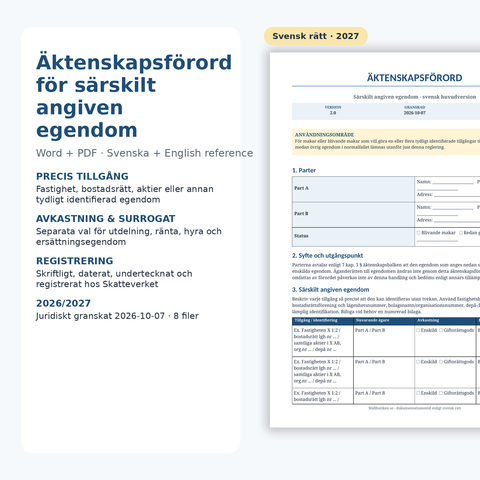
| One spouse gives money to the other and wants it to be separate property. | The condition from the other spouse is not covered by the gift rule in the Marriage Code, Chapter 7, Section 2. Spouses can instead use a registered prenuptial agreement for specifically designated property (79 SEK). |
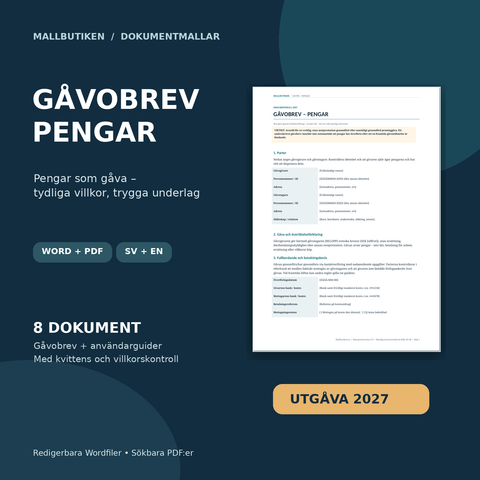
For gift conditions, there is a deed of gift for money (29 SEK). For questions regarding advance on inheritance, see advance on inheritance – deed of gift, set-off, and statutory share. A condition of separateness and a condition of advance on inheritance are two different things.
Practical checklist
- Clearly identify the donor, recipient, and amount.
- Specify whether the gift shall be an advance on inheritance or not.
- Explicitly state whether the gift shall be separate property.
- Consider whether returns and replacement property should also be included.
- Save bank documentation and the deed of gift together.
Also read our guide on deeds of gift for money and the guide on advance on inheritance.
Do you need a written deed of gift?
Mallbutiken's template for a cash gift helps you document the amount, parties, and central conditions.
See Deed of Gift Money – 29 SEKSources
Templates in this article
Explore the topic
 Deeds of gift – guides, formalities & document templates
Advancement of inheritance – deed of gift, set-off, and statutory share 2026
How inheritance advances work in 2026: the presumption for gifts to children, deduction, valuation, statutory share, and why the deed of gift shoul...
 Deeds of gift – guides, formalities & document templates
Gift deed for money – monetary gift, advancement of inheritance, and separate property
Guide to gift deeds for money: when the monetary gift is completed, gift or loan, advancement of inheritance, separate property, spouses, tax, and ...
 Deeds of gift – guides, formalities & document templates
Advance on inheritance – how gifts to children affect the inheritance
How inheritance advances work according to the Inheritance Code: gifts to children, exceptions, valuation, correct calculation example, repayment, ...


