

About this template
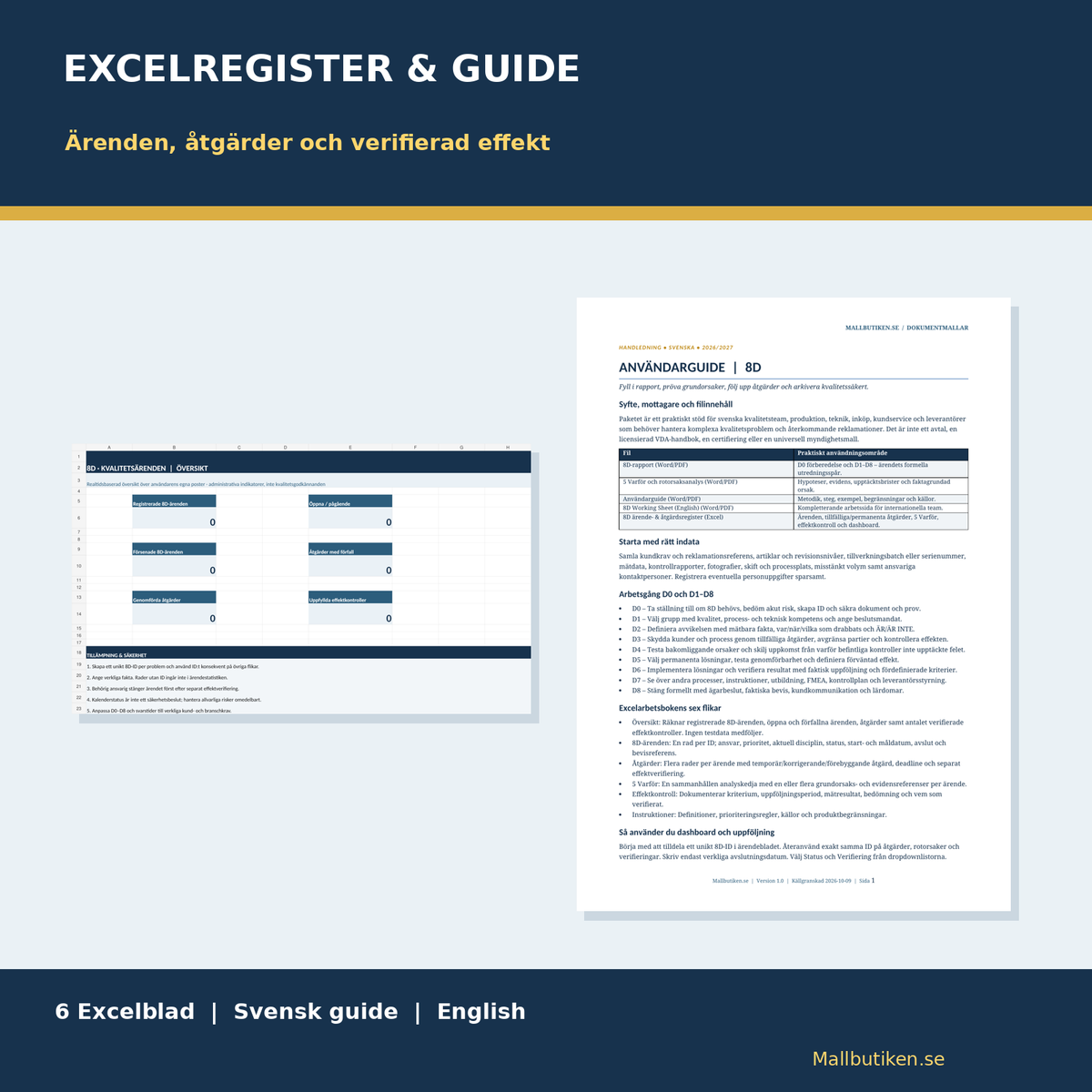
8D Report & Root Cause Analysis 2026/2027 is a professional, editable template package for companies that need to investigate quality issues, supplier deviations, and customer complaints using a systematic method. The package includes a complete report template in Swedish for D0–D8, a separate 5 Whys and root cause analysis, a detailed user guide, an English working document, and an Excel register for cases, actions, and verified effectiveness.
From the first deviation to formal closure: identify the scope, protect the customer, test root causes, implement permanent actions, and document whether they actually worked. Standard price: 79 SEK, one-time purchase.
Document version 1.0, relevant for 2026/2027. The main steps of the method have been compared with publicly available information from Siemens and WEDEAQ (licensed VDA QMC partner). The package is independently developed, does not contain protected VDA/OEM original forms, and is not a certification or a promise of compliance with customer-specific standards.
What is included in the 8D package
| Document | What is it used for? | Format |
|---|---|---|
| 8D Report (Swedish) | D0 initial protection, D1 team, D2 problem definition, D3 temporary containment actions, D4 root cause, D5 permanent action selection, D6 effectiveness verification, D7 prevention, and D8 formal closure. | Word + PDF |
| Root Cause Analysis and 5 Whys | Analysis form for five whys, alternative hypotheses, cause of non-detection, verification evidence, and decision on the next action. | Word + PDF |
| Detailed Swedish user guide | Method description, step-by-step, document control, examples, Excel instructions, common mistakes, and sources. | Word + PDF |
| 8D Problem-Solving Sheet (English) | English working document for D0–D8 and action decisions in Swedish operations. A supplement, not a full translation of all Swedish files. | Word + PDF |
| 8D – Case and Action Register | Excel workbook with overview, cases, actions, 5 Whys, effectiveness control, and instructions. | Excel (XLSX) |
Total of nine files in a ZIP package: 4 DOCX + 4 searchable A4 PDFs + 1 XLSX. Swedish is the primary language; English working document included.
Who is the 8D report useful for?
The templates are suitable for quality managers, production engineers, process owners, supplier quality, purchasing departments, workshops, industrial companies, and technical service organizations. Typical cases include recurring product failures, delivery complaints, process disturbances, lacking control points, or quality problems where a simple one-off correction is insufficient.
The method can also be used in other industries but should be adapted to the scope of the problem. For small isolated flaws, a simpler action log may be more proportionate; safety-critical incidents often require additional special investigation.
The Excel tool – six tabs for traceable follow-up
| Worksheet | Function |
|---|---|
| Overview | Automatic indicators for registered 8D cases, open/ongoing cases, delayed cases, overdue actions, completed actions, and effectiveness checks marked as fulfilled. |
| 8D Cases | 100 prepared rows for customer/process, item, problem description, priority, current discipline D0–D8, person responsible, date, customer communication, and case status. |
| Actions | 150 rows for temporary containment, permanent correction, or preventive system changes with responsibility, deadline, execution, effectiveness status, and evidence reference. |
| 5 Whys | 100 rows for analytical causal chains, confirmed root cause, non-detection, method, and evidence. |
| Effectiveness Control | 100 rows for comparison before/after action, sampling, control period, acceptance criteria, reviewer, and actual outcome. |
| Instructions | Workflow, safety limitations, status definitions, and sources. |
The workbook contains data validation, filterable and structured register fields, calendar-based delay indicators, and automatic summaries. Neither Excel nor the Word template automatically approves a risk. The status "completed" is not the same as verified effectiveness, and "delayed" only means that a registered target date has passed.
How to use 8D – step by step
- D0 – Prepare if necessary: assess urgent safety and customer risk, save evidence, and allocate resources. Document any immediate blocking.
- D1 – Team: assemble people with relevant process, quality, and technical expertise as well as authority.
- D2 – Define the problem: specify requirements vs. actual outcome, product/batch, scope, and the important "is/is not" limitation.
- D3 – Temporary containment actions: stop or sort suspicious material, protect the customer, and show with data that the containment actions are working.
- D4 – Root cause: analyze with 5 Whys, fishbone categories, and testing. Investigate separately why the error could occur and why it was not detected.
- D5 – Select permanent action: choose a solution to the cause and plan in advance how the action will be verified.
- D6 – Implement and verify: document the implementation, test the effectiveness over a relevant period, and compare with established acceptance criteria.
- D7 – Prevent recurrence: check other lines, products, FMEA, control plans, work instructions, and suppliers.
- D8 – Formal closure: document lessons learned, customer communication, approval by the person responsible, and outstanding issues. Archive the documents.
The difference between 8D, CAPA, and FMEA
8D is a structured workflow to solve an identified problem and document the actual root cause. CAPA is often used more broadly for corrective and preventive actions. FMEA is a forward-looking method for analyzing potential failure modes and their effects. The methods can complement each other but should not be confused.
8D, ISO 9001, and industry requirements – what applies?
The 8D method is not a general legal requirement for all Swedish companies. ISO 9001:2026 is a standard for quality management and improvement, but it does not mean that a specific downloadable 8D form must be used by all organizations. In the automotive industry, for example, customer requirements, IATF 16949, and VDA methodology may set specific requirements for report format, response times, problem definition, verification, and customer communication.
This template is a general self-produced support for the 8D workflow, not a licensed VDA 8D report. Always check current customer manuals and actually applicable industry or product safety legislation. In the case of dangerous products or safety-critical faults, specific obligations to stop deliveries, investigate, and notify competent authorities may be required.
Common pitfalls
- Writing an 8D report afterwards without a documented investigation.
- Mixing hypotheses, symptoms, and verified root causes.
- Forgetting why existing controls did not detect the error.
- Closing a case without an independent assessment of the action's effectiveness.
- Confusing customer approval with internal quality assessment.
- Failing to update FMEA, control plans, instructions, or other affected processes.
- Using a general report where the customer requires a specific format.
Frequently asked questions about 8D reports
What is an 8D report?
A documented investigation that step-by-step describes the problem, immediate customer protection, fact-based root cause analysis, permanent actions, verification, and feedback of experience.
Must you always go through all eight steps?
It depends on customer requirements, operations, and the scope of the problem. For serious quality deviations, a complete 8D flow is often used. For simpler flaws, another proportionate method may be better.
Are 5 Whys and Ishikawa included?
Yes, a separate 5 Whys template and a table with generic cause families to support fishbone analysis. The templates do not test hypotheses automatically.
Can Excel be used for multiple cases?
Yes. 100 case rows and several separate registers for actions, analyses, and effectiveness checks are included.
Is this the same thing as a VDA 8D template?
No. No protected or licensed original forms are included. Check your customer's or industry's specific method and document requirements.
Is there an English version?
A supplementary English 8D working document is included. The main report, root cause analysis, and detailed guide are in Swedish.
Is the report proof of ISO certification?
No. It is a work aid and does not replace a functioning quality system or audit by an authorized certification body.
Format and digital delivery
Price 79 SEK. ZIP with four Word documents (DOCX), four searchable A4 PDF files, and one Excel workbook (XLSX). No physical shipping. Word and Excel can be edited in compatible software. Automatic digital delivery after purchase assumes that the ZIP file is attached to Shopify Digital Products.
Professional sources and further reading
- Siemens – 8D report and structured problem solving
- WEDEAQ – The 8D method, Swedish descriptions, and VDA QMC methodology
- ISO – Quality Management ISO 9001:2026
Related templates
For forward-looking risk analysis: FMEA – Failure Mode and Effects Analysis 2026/2027. For audit planning and verification of the quality system: Internal Audit ISO 9001 2026/2027.
Disclaimer: The template package does not replace product safety investigation, legal advice, applicable customer- and industry-specific rules, licensed VDA methodology, or a specialist's safety assessment.